Get Full Government Meeting Transcripts, Videos, & Alerts Forever!
Get email alerts on the County Capital Projects topic
No spam. Unsubscribe anytime.
County and delegation outline capital priorities: coroner facility, 9-1-1, dog pound, radio tower and grant strategy
Summary
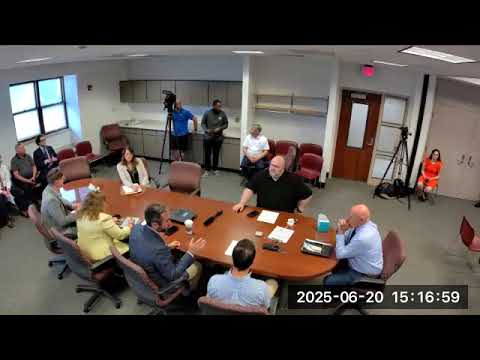
At the June 20 meeting, Trumbull County commissioners and state representatives reviewed prioritized capital needs, possible reuses of county property, grant strategy using hired consultants and short-term options to rehouse the coroner and EMA.
Trumbull County commissioners used a June 20 meeting with state lawmakers to outline immediate capital needs — a replacement or renovation for the county coroner’s workspace, a new radio tower to improve communications, upgrades to the county’s emergency-management facilities and improvements to the dog pound and 9-1-1 dispatch center.
County commissioners told the delegation that the coroner is currently operating out of temporary space (a garage and an EMA facility) and that retooling a vacated health-department building would cost about $2,000,000 because of ventilation and elevator work. Commissioners described a lower-cost alternative: renovating a county-owned fire-department building at the fairgrounds to house EMA and related services, which they estimated would need roughly $300,000 to $1,020,000 depending on scope.
Why it matters: County leaders said their forensic pathologist shortens case-processing times compared with sending cases to larger metro centers. Officials said losing that on‑site capability would lengthen forensic turnarounds and could slow criminal-prosecution timelines.
Key project notes and near-term asks - Coroner facility: County officials described a need for better autopsy and evidence-processing space and flagged a legal barrier to providing services to neighboring counties; representatives suggested the possibility of shared-service models and said they could examine statutory constraints. The coroner’s current workspace was described as inadequate. - EMA and fairgrounds strategy: Commissioners proposed moving the EMA director and related operations to a county-owned fire building at the fairgrounds as a lower-cost, near-term fix. Estimated renovation needs were cited in the range of a few hundred thousand dollars. - Radio tower at fairgrounds: Commissioners said a government-owned radio/cell tower could improve year‑round cellular coverage and support 9-1-1 dispatch and EMA. They estimated a tower cost in the neighborhood of $1,000,000 and said the county could negotiate either a government-owned structure with carrier leases or ask a private provider to build and operate the tower. - Dog pound and 9-1-1 center: Commissioners listed the dog-pound and dispatch-center upgrades among priority capital projects. A grants consultant on site and the state delegation recommended packaging projects and regional partners to improve competitiveness for limited state capital funds. - ODOT property negotiations: Commissioners said they were negotiating for a parcel with the Ohio Department of Transportation; an ODOT figure discussed at the meeting was roughly $150,000 as a possible acquisition price, which officials said they hoped to lower through negotiation and potential phased payment terms. - 9-1-1 dispatcher classification and corrections reclassification: The county asked about reclassifying 9‑1‑1 dispatchers and correction officers as first responders; legislators said reclassification could affect wage scales and retirement status and could make employees eligible for certain grant or benefit programs, but that reclassification may also raise compensation costs for the county depending on contract and pension impacts.
Grants and planning: State representatives and the county’s newly hired consulting team urged the county to prepare prioritized capital lists and bundled grant applications, and they offered multi-representative letters of support from a regional caucus. Consultants and legislators emphasized that smaller, shovel-ready projects or regionalized proposals are likelier to be funded than single, large-dollar asks without outside matching resources.
Ending County officials said they would continue to work with consultants and the state delegation to refine cost estimates, identify grant matches, and seek legislative or administrative support where appropriate.