Get AI Briefings, Transcripts & Alerts on Local & National Government Meetings — Forever.
Experts tell presidential commission recent Supreme Court rulings restore broader free‑exercise protections; witnesses urge executive and legislative steps
Summary
A panel of constitutional law scholars and advocacy leaders told a presidential commission on religious liberty at the Museum of the Bible on Thursday that recent Supreme Court decisions have shifted doctrine toward stronger protection for free exercise and church autonomy, but that litigation, congressional action and administrative steps are needed to address unresolved harms.
A panel of constitutional law scholars and advocacy leaders told a presidential commission on religious liberty at the Museum of the Bible on Thursday that recent Supreme Court decisions have shifted doctrine toward stronger protection for free exercise of religion and greater deference to historical practice, but that further litigation, legislative action and administrative steps are needed to secure consistent relief for people and organizations they say still face burdens.
Professor Stephanie Barclay, a law professor at Georgetown Law School and faculty co‑director of the Georgetown Center for the Constitution, framed her account in historical terms and repeatedly cited the First Amendment’s opening line: "Congress shall make no law respecting an establishment of religion or prohibiting the free exercise thereof," which she said should be read as a single, coherent guarantee. "The Free Exercise Clause and the Establishment Clause were understood by the framers to work largely in tandem," Barclay said. She argued the clauses protect both the right not to be discriminated against on religious grounds and the right "to live according to one's religious convictions, even when those convictions conflict with generally applicable laws."
Barclay told the commission that the Court has been moving away from doctrines that treated religious exercise less favorably. She urged a case overruling Employment Division v. Smith — the 1990 decision that allows neutral, generally applicable laws to stand without accommodation for religious exercise — and called for doctrinal development to protect church autonomy and other institutional religious interests.
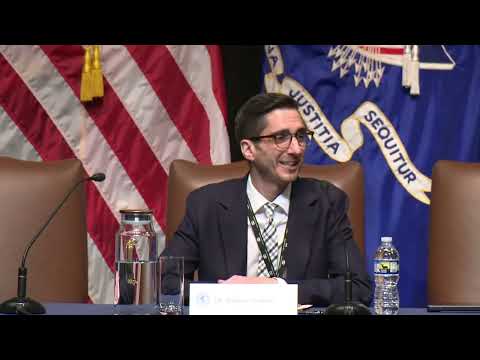
Professor Joshua Blackman of South Texas College of Law gave a chronological account of the Court's religion‑clause jurisprudence and argued decisions such as Everson v. Board of Education and Engel v. Vitale had long been read to require a strict separation of church and state. But he said a string of recent cases — including Trinity Lutheran v. Comer, Espinosa v. Montana Department of Revenue and Kennedy v. Bremerton School District — have dismantled older tests such as Lemon v. Kurtzman and reinstated history and tradition as central inquiries. "The test now is based on history and tradition. And particularly, is there coercion?" Blackman said.
Kristen Waggoner, chief executive and general counsel of Alliance Defending Freedom, pressed administrative and legislative remedies alongside litigation. She urged the administration to restore and strengthen conscience‑protections at federal agencies, enforce existing federal conscience laws, protect houses of worship from IRS targeting, and resist financial or regulatory pressure on religious organizations. "If we fail, we will fail the next generation," Waggoner said, adding that the cost borne by litigants — financial, emotional and otherwise — is often severe even where the Supreme Court ultimately grants relief.
Panelists discussed several open cases and fact patterns they said merit urgent attention, including litigation over Oak Flat (the site identified in briefing as part of the Apache Stronghold dispute) and the so‑called St. Isidore religious charter school litigation. Joshua Blackman described options available to the executive branch under existing statutory authority with respect to the Oak Flat land exchange and urged the administration to consider environmental‑review and valuation tools as means to delay or limit transfers. Barclay and others urged Congress to consider clarifying statutory protections, and several witnesses urged the Department of Justice to file amicus briefs in key cases and to seek certiorari in cases that could resolve circuit splits.
Commission members asked witnesses about the real‑world harms of uncertain doctrinal rules. Barclay recounted litigants who, she said, suffered or died while waiting for courts to resolve religious‑exemption claims. Waggoner and others outlined recommendations for administrative actions the president could take immediately — including restoring a Conscience and Religious Freedom Division at the Department of Health and Human Services, enforcing federal conscience statutes, protecting charities from de‑banking, and adopting training to prevent law‑enforcement targeting of religious activity.
Speakers also discussed the policy front: school choice and inclusion of religious schools and charters in state programs; the so‑called Johnson Amendment and the resulting chill on clergy speech; parental rights in schools, especially around gender‑identity policies; and private‑sector deplatforming and financial‑market pressures that advocacy groups say disproportionately affect religious and conservative organizations. Several witnesses urged the commission to propose public‑education and civic‑literacy initiatives to strengthen cultural support for religious liberty.
The hearing produced no votes or formal actions; it was convened to collect testimony and recommendations for the administration. Commission members said the panel’s testimony will inform the commission's report and possible executive recommendations to the president.