Get Full Government Meeting Transcripts, Videos, & Alerts Forever!
Get email alerts on the Land Use Development topic
No spam. Unsubscribe anytime.
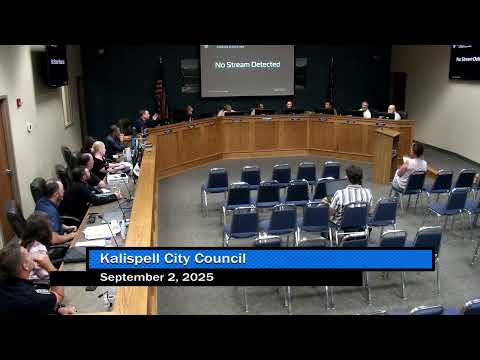
Kalispell council annexes North Meadows tract but rejects 99‑unit apartment permit after neighborhood outcry
Summary
Council approved annexation of the North Meadows property but amended zoning to R‑4 and denied a conditional use permit for a 99‑unit apartment project after weeks of public comment raising traffic, drainage, wildfire and school‑capacity concerns.
The Kalispell City Council voted to annex a 12.13‑acre parcel south of Bluestone Drive but stopped short of allowing the developer’s proposed 99‑unit apartment complex, approving R‑4 residential zoning and denying the requested conditional use permit on procedural and neighborhood‑compatibility grounds.
Supporters of the annexation said bringing the property into city limits will align the site with city planning and utility service; opponents urged the council to reject high‑density multifamily at a location they described as underserviced by sidewalks, subject to drainage problems and at risk in a wildfire scenario. After extensive public comment the council amended the zoning from the applicant’s requested RA‑1 (residential apartment) to R‑4 (single‑family/two‑unit) and then voted to deny the CUP tied to the multifamily plan.
Councilor Ryan Hunter and other members said public safety and environmental buffers were central to their decision, while planning staff and the project engineer said the technical reports submitted met current city standards.
“This project does not address the urgent need for low income housing in this region,” said Patrick Hawkins, a Rankin Elementary staff member who spoke during public comment, arguing the development would strain schools and emergency services. Several neighbors described narrow streets, lack of sidewalks and chronic drainage problems on Bluestone Drive, saying the neighborhood already sees heavy pedestrian and bike traffic to nearby schools and parks.
Donny McBath, planner II, summarized staff recommendations and the planning commission record, noting the commission had recommended approval of the annexation and the conditional use permit subject to 20 conditions after receiving supplemental traffic and geotechnical reports. McBath said the traffic analysis projected the development would generate 667 daily trips and that the site’s soils and groundwater had been analyzed by Alpine Geotechnical, which recommended slab‑on‑grade foundations and construction oversight.
Toby McIntosh of Jacola Engineering, speaking for the applicant, said standard permit conditions are written to ensure the project built as presented: “The conditions are there… to make sure that what’s being discussed here and what’s being provided in the application is what the applicant’s held through to the design.” McIntosh also said draft impact‑fee estimates for the 99 units total about $414,000 to offset public‑service impacts.
Opponents repeatedly told the council the site’s proximity to Ashley Creek and local drainage history posed unacceptable risks. “Bluestone cannot handle another 100 cars let alone 300,” said Fred De Lehi, adding that residents fear accidents and construction impacts. Neil Maven, a nearby resident and former wildland firefighter, warned the council the area is in the wildland‑urban interface and urged steps to improve ingress and egress before adding more residents.
Council debate focused on three practical questions: (1) whether annexation and the base zoning should proceed; (2) whether the site must preserve the city’s 200‑foot riparian buffer established in subdivision standards; and (3) how to address missing sidewalks and pedestrian safety on Bluestone Drive. Council members noted the subdivision regulations’ 200‑foot buffer is a “starting point” that can be reduced with site‑specific geotechnical and riparian studies, but some members said those other benefits of a riparian buffer—wildlife habitat, filtration, bank stability—remain even when a subdivision variance is technically possible.
The council voted as follows: on annexation (Resolution 62‑91) the motion passed (Nunnally, Carlson, Graham, Hunter and Mayor Johnson voted yes; Dahlmann and Fisher voted no). The zoning ordinance (Ordinance 19‑45) was approved as amended to R‑4. The conditional use permit for a 99‑unit multifamily development was denied by roll call.
Councilors who supported the denial said they were not opposed to infill housing generally, but felt this particular site, with its single point of access, local street width, and riparian concerns, required a different approach. Several councilors suggested the owner could pursue a subdivision or lower‑density residential plan compatible with R‑4 standards.
The developer and staff have options to revise the proposal. Because state law changes limiting local conditional‑use authority are pending, council members emphasized the importance of acting now; however, the council’s final zoning decision reduces the likelihood the specific multifamily plan will proceed as presented.
The council’s action closes the immediate application for a 99‑unit project but leaves the annexation and the property’s future use open to subsequent proposals consistent with the new R‑4 zoning.
The council took the action after about four hours of public comment and technical presentation; the denial came after discussion emphasizing neighborhood safety, creek buffers and pedestrian connectivity.