Get Full Government Meeting Transcripts, Videos, & Alerts Forever!
Get email alerts on the Virtual Education topic
No spam. Unsubscribe anytime.
Wyoming’s virtual programs operate through districts; consultants report enrollment accounting and accountability arrangements
Summary
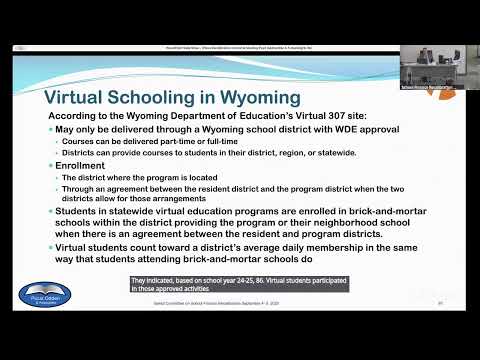
Consultants told the committee Wyoming’s virtual education programs must be delivered through school districts and that virtual students are counted in district ADM; district administering the virtual program bears accountability for student outcomes.
Consultants briefed the Select Committee on School Finance about how virtual education is structured and counted in Wyoming. They said full‑time and part‑time virtual programs must be provided through a Wyoming school district and that districts enrolling virtual students count those pupils in average daily membership (ADM) just as they count brick‑and‑mortar students.
Key points: consultants told the committee that students enrolled full time in virtual programs are generally assigned to a brick‑and‑mortar school in the district providing the virtual program or to their resident district through an agreement; the district administering the virtual program is accountable for outcomes and typically counts those students in its ADM. Amanda Brown also noted national variation: about half of U.S. virtual schools are charter‑run, and states differ in whether they fund virtual students at the same rate as on‑campus students.
Wyoming practice: consultants reviewed state rules and interviews and reported that most virtual enrollments in Wyoming are structured through districts and that statewide virtual charter entities exist but remain district‑based for ADM purposes. The consultants cautioned that virtual students still participate in local activities in small numbers (WHSAA reported 86 virtual students participated in approved activities in 2024–25) and that districts work out agreements if students want to take part in local athletics or other on‑campus activities.
Why it matters: how virtual students are counted affects funding allocations and accountability for academic outcomes. Committee members asked whether virtual schooling costs less; consultants said costs vary and that many states fund virtual students at similar rates to in‑person students because teacher and curriculum costs remain substantial.
Next steps: the consultants will continue to monitor virtual enrollment trends and provide additional information on cost differentials, district agreements and accountability arrangements if the committee requests more granular analysis.