Get Full Government Meeting Transcripts, Videos, & Alerts Forever!
Get email alerts on the Public Comment topic
No spam. Unsubscribe anytime.
Community speakers urge full funding, stronger CTE and new online funding approach during committee’s public comment
Summary
During public comment at the Select Committee on School Finance meeting, parents, educators, advocacy groups and CTE representatives pressed the committee to protect or increase school funding, invest in career and technical education, review online school funding models and address mental‑health and tutoring needs.
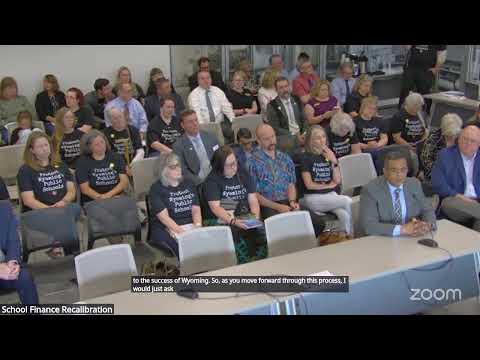
Public comment at the Select Committee on School Finance meeting on June 17 featured a series of speakers who urged the committee to prioritize public‑school funding, bolster career and technical education (CTE), reconsider funding for virtual schools and address mental‑health, tutoring and library resources.
Speakers and main points
- Nate Martin, executive director of Better Wyoming, said many Wyoming residents worry recalibration could be used to cut tens of millions from schools to pay for tax reductions, and urged the committee to follow the process in service of students and communities.
- Community members gave personal testimony describing public schools as central to small towns and credited schools with supporting students who later became productive community members, emphasizing mental‑health, counseling and stability provided by public schools.
- Brandy Maddox, a certified tutor and Ph.D. candidate at the University of Wyoming, described tutoring’s local impact, saying the tutoring program at her school has supported roughly one in four graduates and urged that funding sustain these supports.
- Rob Hill, speaking for the Wyoming Association for Career and Technical Education and Wyoming SkillsUSA, urged increased emphasis on CTE. He cited widespread demand from local employers — examples included needs for welders, plumbers and electricians — and said equipment, shop space and program capacity are limiting how many students districts can serve.
- Affie Ellis, an attorney representing Wyoming Virtual Academy (WIVA) and the curriculum provider Stride K12, asked the committee to examine online‑school funding. Ellis noted Wyoming’s practice of fitting virtual students into the brick‑and‑mortar formula and urged the committee to consider alternative funding structures used in other states to reflect differences in costs such as transportation, device provisioning and material shipping.
- CTE instructors and local superintendents highlighted gaps in hands‑on CTE capacity (welding booths, workspaces) and said donated equipment from industry has helped but is not a long‑term substitute for reliable, funded facilities and equipment.
- Several speakers asked the committee to honor the state constitution’s requirement for a complete and uniform system of public instruction and pressed the committee against redirecting school funds for other purposes.
Committee response and next steps
Committee members thanked speakers and reiterated that public comment would continue through the meeting schedule. Consultants and LSO staff said they would incorporate public testimony into their panels and white papers. The committee will continue to receive public comment at subsequent meetings and will review consultant white papers in September and a draft report in October.
Why it matters: public comment signals priorities and concerns that the committee must weigh against technical model inputs. Requests for stronger CTE funding, a new online‑student funding approach, and continued resources for counseling and tutoring could require formula changes or additional appropriations.