Get Full Government Meeting Transcripts, Videos, & Alerts Forever!
Get email alerts on the School Facilities Mold topic
No spam. Unsubscribe anytime.
Granville County Board votes to relocate Mary Potter students after mold tests
Summary
After independent air-quality testing found elevated mold levels in the 200 and 300 wings of the Mary Potter Center for Education, the Granville County Board of Education voted to move affected students and staff to the vacant Holly Creedmoor campus and to clear the Mary Potter building of operations.
The Granville County Board of Education on Tuesday voted to relocate students and staff from the Mary Potter Center for Education after independent air-quality testing found elevated levels of mold spores in multiple areas of the campus.
Board member Dr. Winborn presented the laboratory results and recommended a relocation plan, saying the lab found an “altered indoor fungal ecology,” scientific language he said is used to describe the presence of mold. He recommended what the presentation called “Solution B”: move affected programs and employees to the vacant Holly Creedmoor campus rather than perform immediate, large-scale remediation at Mary Potter.
The recommendation followed testing done this year and additional rounds after a staff report of poor air quality. The district contracted a third-party laboratory; according to the report summarized for the board, technicians took 30 airborne samples and 16 surface samples across the Mary Potter campus. The presenter said 24 of the 30 air samples and 10 of the 16 surface samples showed an altered indoor fungal ecology, with the highest readings concentrated in the 300 wing and elevated results in parts of the 200 wing. Tests of the boardroom, administrative suite and Phoenix Academy (the 400 wing) returned normal results. The presenter also noted that humidity readings were above recommended ranges in many tested areas, a condition that promotes mold growth.
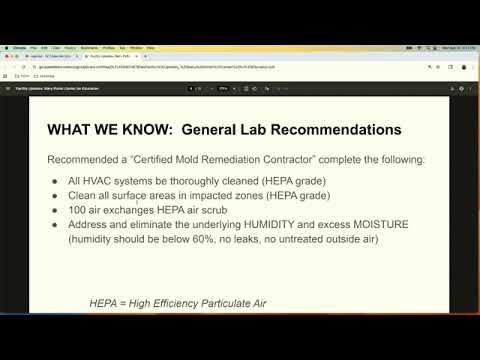
The lab recommended contracting certified mold-remediation specialists, HEPA-level cleaning and at least 100 air exchanges before retesting, and—critically—fixing underlying moisture and humidity problems to prevent recurrence. The presentation said the campus has multiple long-standing infrastructure problems: aging, two-pipe HVAC equipment that does not dehumidify properly; chilled-water fan-coil units showing rust and leakage; failed roofs and gaps in the building envelope; single-pane windows; and other deferred-maintenance items. The team noted potential asbestos in floor tile and elsewhere that could be disturbed by construction.
The board considered two options. “Solution A” would temporarily relocate students while the district remediated mold, replaced HVAC and roofing, and repaired the building envelope; the district estimated that work would take 12 to 18 months and that remediation plus repairs could cost roughly $6 million (including an estimated $100,000 in moving costs, about $250,000 for remediation and roughly $5.5 million for repairs, all described as conservative estimates). District staff cautioned those figures could grow if the work uncovers additional issues such as asbestos.
“Solution B,” the option the board adopted, directs the district to move affected students and central-office staff into the Holly Creedmoor campus and remove operations from the Mary Potter building. Staff estimated the immediate costs for Solution B at a bit more than $200,000 — including cleaning and preparing Holly Creedmoor, moving costs and replacement or professional cleaning of materials that are mold-affected — and said the move could be done in phases to minimize classroom disruption. Dr. Winborn told the board his recommendation was Solution B.
Chief maintenance official Mike Carroll told the board the situation is the result of deferred maintenance and that preventive maintenance earlier could have reduced the risk. Carroll described the age and condition of chillers and other mechanical systems and said some equipment is at or past typical life expectancy. He also said the facility contains large amounts of asbestos-containing floor tile; an abatement-only estimate for tile cited during the meeting was about $780,000.
Finance staff said the district does not have $6 million available for the full remediation scenario. A staff member reported roughly $4.3 million available in fund balance and said the county provides about $3.2 million a year for capital projects, funds that are largely already allocated to other needed repairs. The board discussed those budget constraints while weighing the health and operational risks.
Board members and staff also discussed operational details and community impacts: Strong-arm Bakery, which rents the Mary Potter kitchen, asked to be considered for relocation to Holly Creedmoor; the director of elections flagged the gym at Mary Potter as a scheduled polling site for November and asked whether that use would be affected. Staff said they did not sample the gym in the most recent round but that earlier testing and the gym’s direct-venting design made restricting access unlikely; staff said they would follow up with additional sampling or advice if needed.
After discussion, a motion to adopt Solution B — relocate affected students and staff to Holly Creedmoor and remove operations from the Mary Potter building while leaving decisions about the building’s ultimate disposition for a future meeting — was made and seconded and approved by voice vote. The board recorded the outcome as passed by voice vote; no roll-call tally of named votes was recorded in the public transcript.
District staff said the move would be phased and that the board would receive updates at each step. They also said the district will solicit quotes or contracts for moving and any required cleaning; because moving and cleaning are service contracts, staff noted formal sealed bidding might not be required.
The board meeting record and the laboratory reports are available in the district’s BoardDocs repository, and staff said they will post the reports to the district website and make them available to anyone who requests them.