Get Full Government Meeting Transcripts, Videos, & Alerts Forever!
Get email alerts on the Child Welfare Budget Reform topic
No spam. Unsubscribe anytime.
Idaho health department outlines child-welfare budget request, aims to shift children from congregate care to prevention and foster homes
Summary
Department of Health and Welfare Director Adams told a Senate committee the agency is asking for supplemental funds and a budget prioritizing child-welfare prevention, foster-family recruitment and retention to reduce costly congregate placements and out-of-state placements.
Director Adams, head of the Idaho Department of Health and Welfare, told the Senate Health and Welfare Committee that the department will seek a $14 million supplemental this year and is prioritizing child welfare in its upcoming budget to reduce the number of children placed in congregate care and out-of-state facilities.
Adams said Idaho has about 463,000 children and receives roughly 24,000 hotline reports of potential abuse or neglect a year; the department responds to about 15,800 of those and finds children safe in about 89 percent of investigations. "In 11 percent of the cases, or 1,700 times a year, the child is deemed unsafe," Adams said. He described two broad responses: prevention cases that keep children at home with services, and placement cases when children are removed and placed in settings such as foster homes, kinship care or congregate care.
The department asked legislators to allow it to focus resources on prevention and foster-family recruitment and retention to reduce costs and improve outcomes. Adams said prevention cases cost about $1.80 a day (roughly $657 a year) while some congregate care placements can now cost as much as $1,400 a day. "We want 85 percent of kids in prevention cases," Adams said, adding that prevention aligns better with both cost savings and child outcomes.
Why it matters: Adams told the committee child-welfare is an open-ended entitlement for the state — the department must care for any child committed to its custody — and placement decisions and length of stay drive the budget. The department has repeatedly requested supplementals for child welfare in recent years; Adams presented a history showing supplementals that rose from roughly $1.5 million in 2022 to the current $14 million request.
Key details from the presentation and committee discussion:
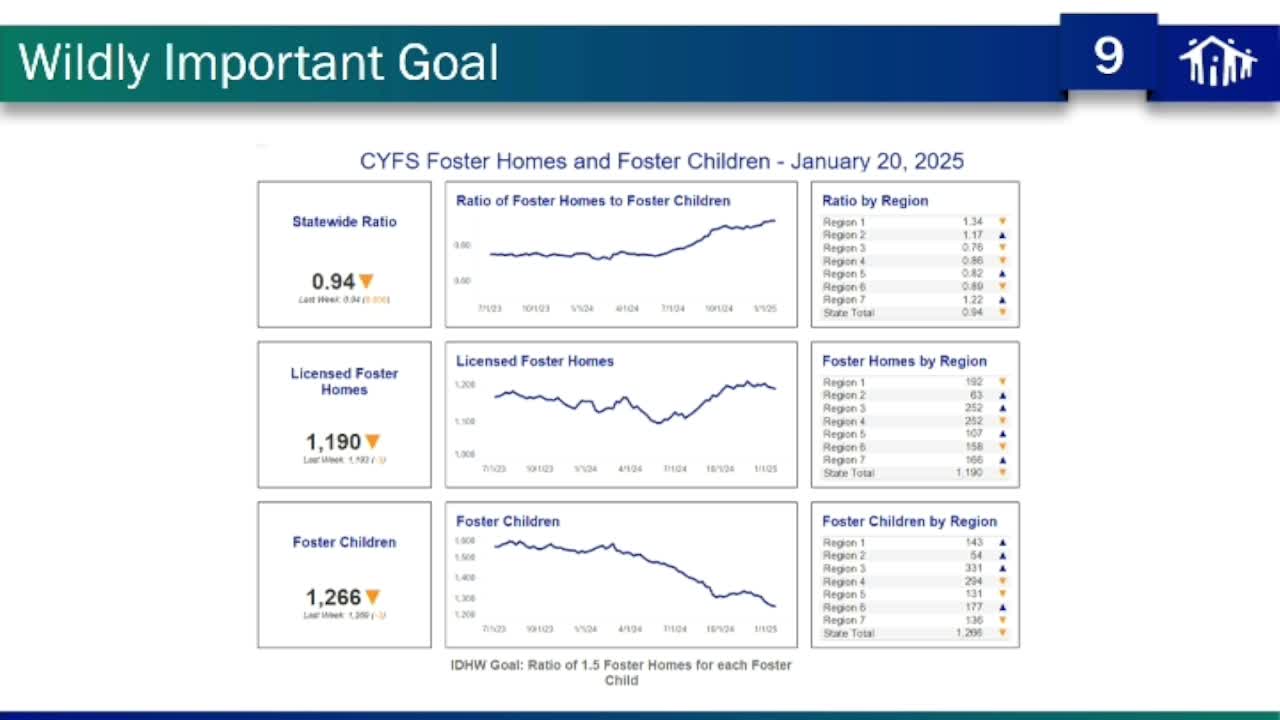
- Caseloads and capacity: The department reported roughly 1,400 placement cases per year and about 300 prevention cases per year. About 1,200 children a year achieve permanency; 65 percent are reunified with biological parents and 25 percent are adopted. Adams said the department’s ratio of foster families to foster children improved from 0.74 to 0.94 after recent efforts, and congregate-care counts fell from about 268 to about 90, with out-of-state placements falling to 49.
- Cost differentials: Adams contrasted per-child costs across placement types: foster and kinship placements at about $16 a day (roughly $5,800–$5,000 per year as presented), congregate care historically averaged $385 a day based on 2024 data and has reached roughly $1,400 a day in some contracts, and prevention cases about $1.80 a day.
- Recruitment and retention measures: The department described multiple initiatives it says have increased recruitment: streamlined licensure rules, reciprocity for families licensed in other states, marketing and partnerships (free parks passes, fishing licenses), a faith-engagement office, a foster-family newsletter and forum, and a proposed pay increase for foster families targeted toward harder-to-place groups (Adams said the department proposed a 5 percent pay increase overall, with larger increases for older children and sibling groups and 2 percent for infants).
- Operations and supports requested: Adams described requests for staff to lower social-worker caseloads, a 24-hour warm line for foster families with clinician support, technology to speed licensure and identification of kin, and funding for recruitment activities. Deputy Director Monte Pro said the department is aiming to reach the national recommended caseload range of about 12 to 15 cases per worker and acknowledged regional variation in current caseloads.
- Policy and legislative context: Adams credited oversight and recommendations from the Office of Performance Evaluations (OPE) and cited Senate Bill 1379 as making it harder to move children into congregate care without additional justification; he said the bill has been associated with fewer congregate placements. The department also waived adoption fees and removed certain regulatory barriers to licensure, which Adams said led to immediate improvements in recruitment.
- Congregate care and short-term settings: Adams told senators the department had used short-term solutions such as Airbnb placements during COVID-era bed shortages but said those have been closed: "I've got 0 Airbnbs and 0 kids," he told the committee, noting the last such placement closed in November. He said the reduction came from placing children in newly recruited foster homes and other in-state settings.
- Federal funding exposure: Adams said Title IV-E (federal foster-care funding) is a mandatory stream and therefore not at risk from proposed federal cuts, and that discretionary federal grants are being pursued with caution. He identified some IRA-funded energy- and weatherization-related dollars as potentially more exposed to federal policy changes and described new internal clearance and exit plans for federal grants so the state would not shift grant-supported programs to the general fund.
Committee response and follow-ups: Senators asked for regional details on foster-family ratios, how to reduce out-of-state placements for children with complex needs, whether deregulation could safely speed licensing, and how prevention services are concretely delivered. Deputy Director Pro described prevention work as strengthening protective factors (for example, therapy, substance-use treatment or concrete supports) and said the department aims for many prevention cases to resolve in about six months. Members also raised coordination with Guardian ad Litem programs; the department said it has begun quarterly meetings with Guardian ad Litem regional executive directors and will include them in resource mailings.
Nut graf: The Department of Health and Welfare presented a child-welfare budget and policy package that centers on prevention and foster-family recruitment/retention to reduce reliance on costly congregate and out-of-state placements; the department said targeted, time-limited investments should produce both better outcomes for children and long-term savings.
Ending: Adams told the committee he expects to show results within about a year and a two-year horizon to flatten the cost curve if recruitment, retention and prevention investments succeed. The department will present the formal budget request to Joint Finance-Appropriations Committee (JFAC) in coming weeks.