Get Full Government Meeting Transcripts, Videos, & Alerts Forever!
Get email alerts on the Workers Compensation Rule Rewrite topic
No spam. Unsubscribe anytime.
Senate Commerce approves Industrial Commission workers' compensation rule rewrite after rejecting in‑state office language
Summary
Lawmakers approved a broad rewrite of the Industrial Commission’s workers’ compensation rules but rejected language that the commission proposed requiring insurance carriers to "maintain an office within the state of Idaho," following debate from insurers, trial lawyers and third‑party administrators.
The Idaho Senate Commerce Committee voted to approve a comprehensive rewrite of the Industrial Commission's workers' compensation administrative chapter (IDAPA 17.01.01) while rejecting a specific subsection that the commission had proposed requiring carriers and adjusters to "maintain an office within the state of Idaho." The motion to adopt the rule docket while removing that subsection carried after extended discussion and public comment.
Paul Jeffreys, rules presenter for the Industrial Commission, described the filing as a Zero-Based Regulation chapter rewrite that "was promulgated in accordance with executive order 2020‑01 regarding 0 based regulation." Jeffreys told the committee the rewrite followed five negotiated-rulemaking meetings from November 2023 through July 2024 and two public hearings on Oct. 7 and Oct. 20, 2024. The docket runs from page 50 to page 83 of the pending rule book.
The panel focused on subsection 305.01.A, which the commission had written to say that "all insurance carriers, self insured employers and licensed adjusters servicing Idaho workers' compensation claims shall maintain an office within the state of Idaho." The commission and its staff told senators they interpret the statute (Idaho Code section 72‑305) and their rule to require an in‑state physical presence for claims adjusting but not a literal brick‑and‑mortar front office. Industrial Commission staff explained they have for decades issued guidance saying a private residence or a designated in‑state location can satisfy the requirement so long as adjusting is performed in Idaho.
Elizabeth Kreiner of the American Property Casualty Insurance Association told the committee the industry sought a clearer rule text and asked the committee to strike subsection 305.01.A. Kreiner said the commission issued a guidance memo in February 2023 but did not make an explicit textual clarification in the proposed rewrite. The association urged removing the subsection to avoid an implied brick‑and‑mortar requirement.
Barbara Jordan, director of the Idaho Trial Lawyers Association, said her organization supported leaving the in‑state requirement in the rules to preserve local access to adjusters and to ensure prompt claims service. Jordan said in‑state adjusters help plaintiffs' attorneys and claimants reach adjusters quickly when hearings or claim developments arise.
Chris Wagner of Intermountain Claims, a local third‑party administrator, warned that eliminating an express in‑state office requirement could be interpreted as loosening the in‑state adjusting standard. Wagner described how reciprocal licensing among states can permit out‑of‑state handling unless Idaho's statutory and rule language remains clear about in‑state adjusting.
Patty Vaughn, benefits administration manager at the Industrial Commission, described the commission's use of the International Association of Industrial Accident Boards and Commissions' EDI (electronic data interchange) standards to transmit claims events. Vaughn said the data are protected by statute and accessible only to parties to a claim, and that jurisdictions do not have cross‑access to other states' claim databases.
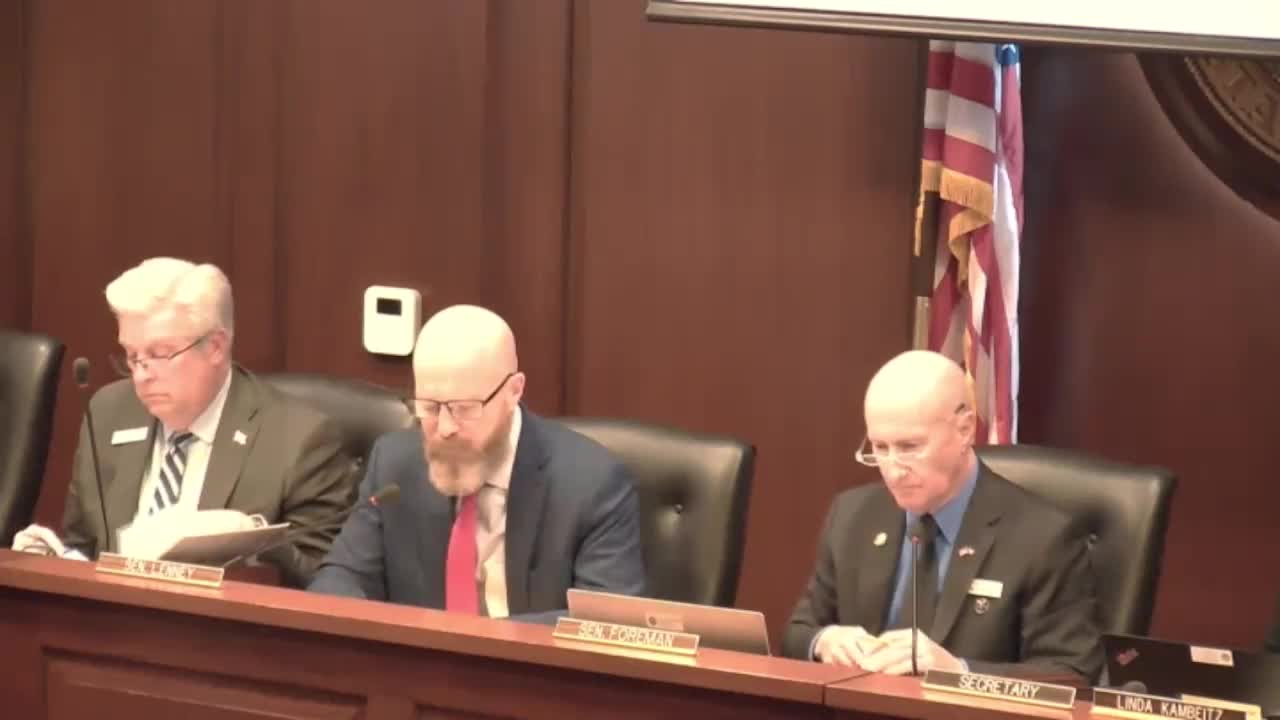
After discussion among senators that included concerns about clarity, statutory precedence, and whether subsection A duplicated protections already found in Idaho Code 72‑305, Senator Foreman moved and Senator Burts seconded a motion to approve docket 17.01.01.2301 while rejecting subsection 305.01.A. The panel voted to approve the docket with that exception.
The commission said the rewrite aims to reduce outdated regulation, streamline electronic payments and reporting, and modernize administrative processes while maintaining the commission's mission "to fairly administer the Idaho workers' compensation law." The commission will continue to monitor stakeholder concerns and may propose statutory changes if the committee or stakeholders request further clarification.
—
Votes at a glance
• Docket 17.01.01.2301 (workers' compensation chapter rewrite): Motion to adopt while rejecting subsection 305.01.A by Senator Foreman; second Senator Burts; outcome: approved by the committee while rejecting subsection 305.01.A (vote tally not specified in transcript).