Get Full Government Meeting Transcripts, Videos, & Alerts Forever!
Get email alerts on the Voter Id Constitutional Amendment topic
No spam. Unsubscribe anytime.
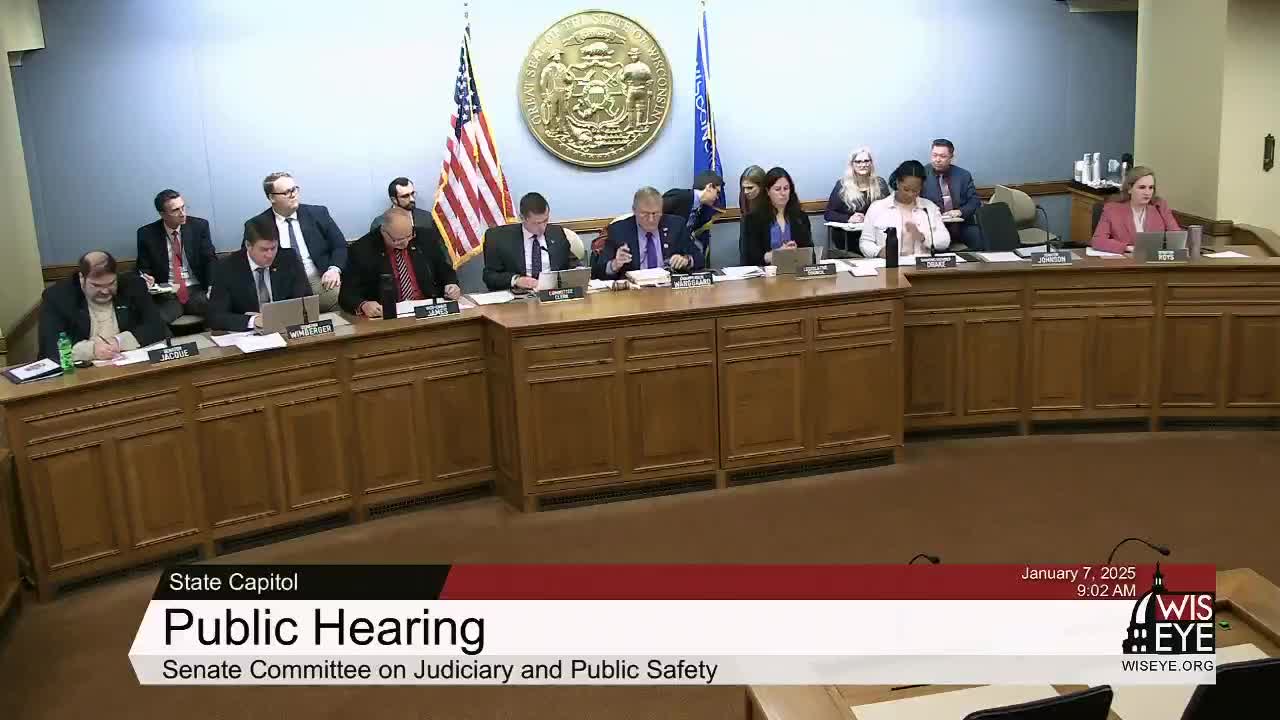
Senate committee advances amendment to enshrine photo voter ID in Wisconsin constitution after heated hearing
Summary
The Wisconsin Senate Committee on Judiciary and Public Safety advanced Senate Joint Resolution 2, a proposed constitutional amendment to require photographic identification to vote, after a public hearing and an executive‑session vote in which proponents said the change would protect election integrity and opponents said it would entrench barriers for eligible voters.
The Wisconsin Senate Committee on Judiciary and Public Safety advanced Senate Joint Resolution 2, a proposed constitutional amendment that would require presentation of a photographic identification to vote, following a public hearing and an executive-session vote in which the measure’s supporters and opponents sharply disagreed over whether the change would protect election integrity or disenfranchise eligible voters.
The resolution’s author told the committee the measure is intended to ‘‘ensure that people of Wisconsin have full confidence in the security and the integrity of Wisconsin elections’’ and to prevent future courts from overturning voter‑ID statutes. ‘‘The only way to ensure that this or future supreme courts will not overturn voter ID is to enshrine this basic election integrity law in Wisconsin’s constitution,’’ the author said in testimony.
Supporters — including the bill’s author and backers who spoke to the committee — argued the proposal would lock an existing statutory requirement into the constitution so it could not be set aside by a future court majority. Legislative counsel told the committee the proposed amendment would require provisional ballots be available at polling places, but those provisional ballots would only be counted if the voter later presents a valid ID. ‘‘An individual who appears at the polls and doesn’t have a voter ID can vote a provisional ballot,’’ counsel said, ‘‘and they have until 4 p.m. on the Friday after the election to present that valid voter ID at the clerk’s office for the provisional ballot to be counted.’’
Opponents — including the League of Women Voters of Wisconsin, Disability Rights Wisconsin, All Voting Is Local and the Wisconsin Democracy Campaign — testified the amendment would enshrine into the constitution a restriction that already disproportionately burdens seniors, people with disabilities, low‑income residents, students and voters of color. Deborah Kronmiller, executive director of the League of Women Voters of Wisconsin, told the committee the league opposes the amendment and said the law ‘‘would place an unfair burden on people who do not need a driver’s license or who move frequently,’’ singling out elderly and disabled voters as at particular risk of disenfranchisement.
Disability Rights Wisconsin’s public policy manager, Lisa Hassenstab, told the committee that roughly one in four adults has a disability and cited a Rutgers University figure showing an 11.7 percentage‑point turnout gap in Wisconsin between voters with and without disabilities in 2022. Hassenstab also described practical barriers: limited public transit in large areas of the state, DMV locations that report only ‘‘limited’’ accessibility and online DMV resources that remain difficult for some assistive technologies to use.
Speakers from voter‑access groups said existing paths to obtain a free state ID do not always remove practical obstacles. Sam LeBold, state director for All Voting Is Local Action and a former municipal clerk, said the DMV has an ‘‘ID petition process’’ for people lacking documentation, but that the process and the cost or time to obtain underlying documents (such as a birth certificate) can be a meaningful barrier. League testimony cited a legislative fiscal bureau estimate that implementing the 2005 voter‑ID law cost the DMV about $2,300,000 annually.
Committee members debated timing and priorities during the hearing. Several members said the measure is on a legislatively required schedule (this is second consideration for a constitutional amendment) and that getting the question onto an upcoming spring ballot required acting now. Dissenting members argued other priorities — from public safety and mental‑health policy to addressing transportation and administrative barriers — deserved more urgent attention.
After the public testimony the committee moved into executive session. The committee summary prepared by legislative counsel described the amendment as written: it would accept state, federal, tribal or Wisconsin college/university photo IDs as valid and would require provisional balloting procedures that count provisional ballots only if a valid ID is later presented. The motion to pass SJR 2 was moved and seconded in executive session. The roll call recorded several ayes and nos and the committee approved the measure to send to the full Senate for further consideration.
What happens next: as with all constitutional amendments in Wisconsin, the measure must be adopted by two successive legislatures and then ratified by voters in a statewide referendum to take effect. If enacted as written, the amendment would lock a photographic‑ID requirement into the Wisconsin Constitution and leave modification of the types of acceptable IDs and related statutory exceptions to the Legislature and implementing agencies.
Votes at a glance (as recorded on the committee floor): the motion to pass SJR 2 was moved by Senator Wittenberg and seconded by Senator Jacque. The executive‑session roll call, as read aloud in the transcript, recorded ayes from several members and nos from others and the motion carried in committee; the committee record in the transcript shows recorded yes votes and no votes and the committee advanced the resolution. (The measure next moves to the Senate floor and, if approved there, would proceed through the constitutional amendment process.)
Sources: public testimony before the Wisconsin Senate Committee on Judiciary and Public Safety; statements on the record from the League of Women Voters of Wisconsin, Disability Rights Wisconsin, All Voting Is Local, the Wisconsin Democracy Campaign, legislative counsel and the authors of SJR 2.