Get Full Government Meeting Transcripts, Videos, & Alerts Forever!
Get email alerts on the Asian American History topic
No spam. Unsubscribe anytime.
Historian James Ikeda urges global-history view of Asian American past at Lacey Museum talk
Summary
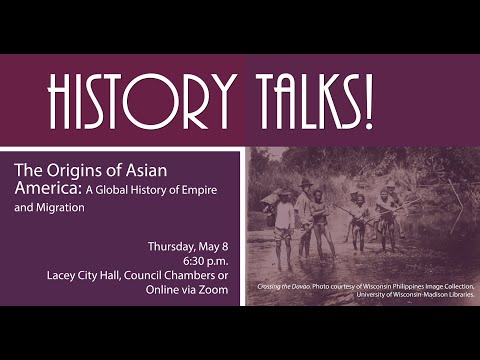
At the Lacey Museum's May History Talks, educator and historian James Chiyoki Ikeda argued for reframing Asian American history through empire and global migration, linking immigration laws, colonization, and transnational movements and answering audience questions on resettlement and local museums.
James Chiyoki Ikeda, a Japanese American educator and PhD candidate at Northeastern University, urged audiences at the Lacey Museum’s May History Talks to reframe Asian American history as a product of empire and global migration rather than primarily an assimilation story.
Ikeda began by proposing a revision of his lecture title, saying, “The Origins of Asian America — towards a global history of empire and migration,” and asking attendees to place immigration to the United States in the broader context of colonization, imperial rivalry and transnational labor flows.
The lecture challenged a common assimilationist narrative that treats Asian American history as a sequence in which immigrants arrive, face discrimination, then gradually assimilate. “The assimilationist story…tends to collapse all people of color and immigrants into a single undifferentiated mass of victims of discrimination turned loyal American citizens,” Ikeda said. He recommended supplementing that view with questions about foreign policy, colonial administrations, and population movements in Asia that helped shape migration to the U.S.
Ikeda illustrated the approach with historical examples. He traced Chinese migration in the 19th century to upheavals such as the Opium Wars and the Taiping Rebellion and described the British use of Asian contract labor — the so-called “coolie” trade — to replace enslaved labor in colonies. He contrasted indentured and credit-ticket labor systems and cited historian May Nye’s comparative work on Chinese migrants’ agency across global gold rushes.
Turning to Japan, Ikeda explained how Meiji-era land reform, industrialization and imperial expansion produced both internal dislocation and overseas migration, and how Japan’s growing power shaped U.S. policy differently than it did toward China — for example, the U.S.-Japan “gentlemen’s agreement” compared with the Chinese Exclusion Act. On the Philippines, he connected U.S. colonial rule after the Spanish-American War to Filipino migration patterns, noting that Filipinos were exempt from the national quotas imposed by the Immigration Act of 1924 until the Tydings-McDuffie Act (1934) reclassified the Philippines for immigration purposes.
Ikeda also reviewed U.S. immigration law milestones: the Emergency Quota Act (1921) and Immigration Act of 1924 (Johnson–Reed Act), which imposed national-origin quotas and effectively barred Asian immigration; the McCarran–Walter Act (1952), which removed race-based naturalization barriers for some Asian immigrants; and the Immigration and Nationality Act of 1965, which ended explicit racial bars and restructured the admission system.
The talk closed with audience questions and a short Q&A. An attendee asked about the dispersal of Southeast Asian refugees after the Vietnam War; Ikeda noted that resettlement patterns were shaped by military and colonial-era infrastructures and by policies that intentionally redistributed populations outside existing ethnic enclaves, drawing a parallel to post‑World War II resettlement of Japanese Americans. Another audience member recommended a local resource, the Wayne Luke Museum in Seattle, and attendees referenced the Plantation Museum near Pearl Harbor as places that illustrate how immigrant labor waves tied to plantation economies intersect with U.S. immigration policy.
Before the lecture, Felicia Rovacameron, associate curator for the Lacey Museum, opened with a land acknowledgement and program notices, emphasizing the museum’s move and the end of the museum’s History Talks season; she said the Russell House location will remain in use as a research center while a refreshed public space opens at the Belltown Center on Sixth Avenue.
Ikeda said his goal was modest and pedagogical: to give listeners “tools for your toolbox” so they can ask more probing historical questions about empire, migration and transnational ties rather than rely solely on assimilationist frames.
The museum will resume History Talks in September; the program concluded after roughly an hour of presentation and audience discussion.