Get Full Government Meeting Transcripts, Videos, & Alerts Forever!
Get email alerts on the Personnel Benefits Health Insurance topic
No spam. Unsubscribe anytime.
JFAC approves $14,130 per-FTE health‑insurance funding for FY2026
Summary
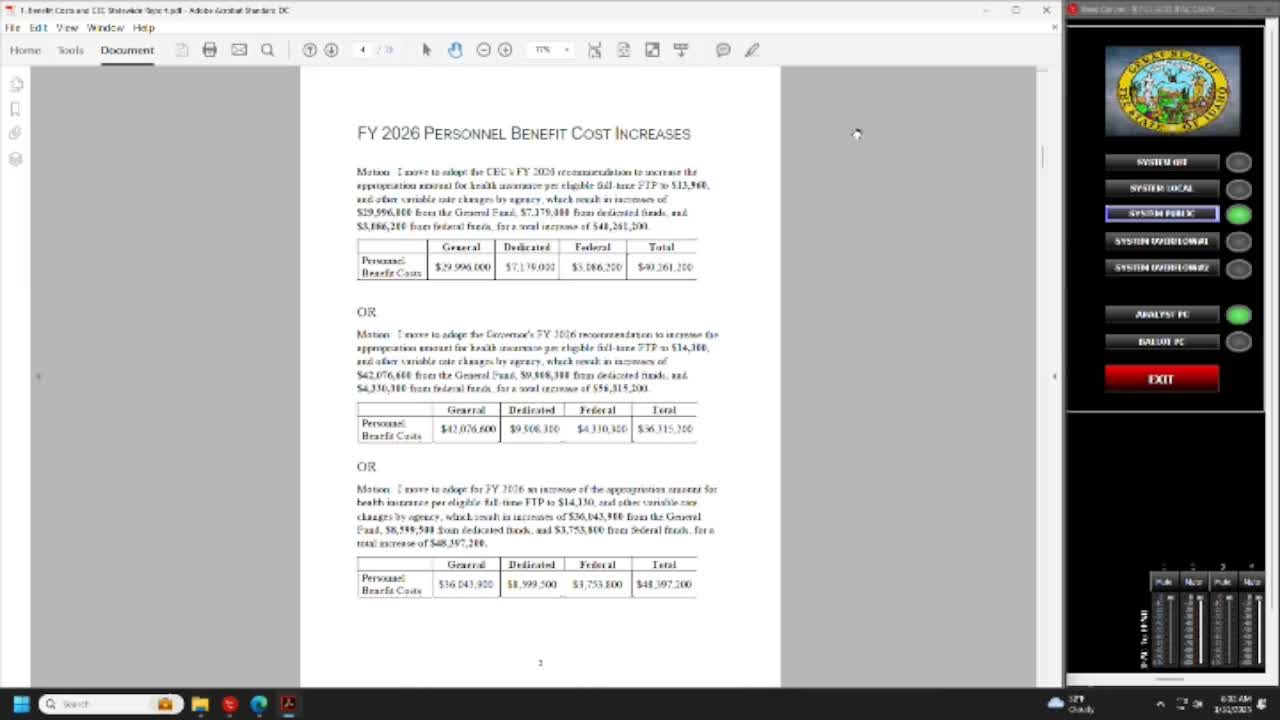
The Joint Finance‑Appropriations Committee approved a compromise health‑insurance funding level of $14,130 per eligible full‑time equivalent employee for fiscal year 2026, a change that will raise state personnel benefit appropriations by roughly $48.4 million across fund sources.
The Joint Finance‑Appropriations Committee on Friday approved a statewide increase in health‑insurance funding for state employees to $14,130 per eligible full‑time equivalent position for fiscal year 2026.
The committee adopted the $14,130 figure as a compromise between a CEC committee recommendation of $13,960 per FTE and the governor’s recommendation of $14,300. The motion passed with a combined vote of 17 ayes, 0 nays, and 3 absent/excused (Senate: 8–0–2; House: 9–0–1). The enacted adjustment increases appropriations by $36,043,900 from the general fund, $8,599,500 from dedicated funds and $3,753,800 from federal funds, for a total increase of $48,397,200.
Why it matters: Health‑insurance funding drives the personnel‑benefits line in agency budgets and affects the projected balance of the state’s health‑insurance reserve. Committee analysts presented three funding options tied to differing projected reserve balances; lawmakers debated how much the state should use reserves to “buy down” premiums versus reflecting the program’s actual costs.
Analyst Michael Bybee described the three options to the committee and gave the projected reserve balances tied to the proposals. Bybee said the CEC motion (the lowest dollar amount) projects an ending reserve balance of about $51.6 million for FY2026, the governor’s $14,300 recommendation projects a $61.4 million ending balance, and the $14,130 compromise falls between those figures.
Lawmakers argued about whether the state should use reserves to smooth premiums. Senator Ward Engelking urged the committee to “reflect the actual cost of insurance,” saying prior buy‑downs had masked year‑to‑year cost trends and would make future increases look larger than they are. Representative Furness raised concerns about actuarial projections and reserve levels, saying Milliman’s projections had been repeatedly conservative in past reports and arguing for a cautious approach: “They have consistently been wrong over the years. They’ve consistently been, too conservative.”
Several members also noted smaller employer‑paid adjustments that accompany the health‑insurance change, including agency budget increases for workers’ compensation and Social Security. Committee staff said language tied to the successful motion will be carried forward so the dollar amounts and statutory direction align.
The committee will incorporate the approved funding level into the committee’s recommended budget language and move on to related personnel‑benefit decisions in subsequent work sessions.