Get Full Government Meeting Transcripts, Videos, & Alerts Forever!
Get email alerts on the Public Defender topic
No spam. Unsubscribe anytime.
JFAC approves multi-part supplemental and enhancement package for new State Public Defender office; debate centers on contract rates and transition
Summary
Committee approved one-time supplementals and ongoing enhancements for the Office of the State Public Defender including Child Protective Act alignment, transcript costs ordered by the Idaho Supreme Court, and increases to contract attorney rates to $125 per hour; legislators voiced concerns about transition planning and county coordination.
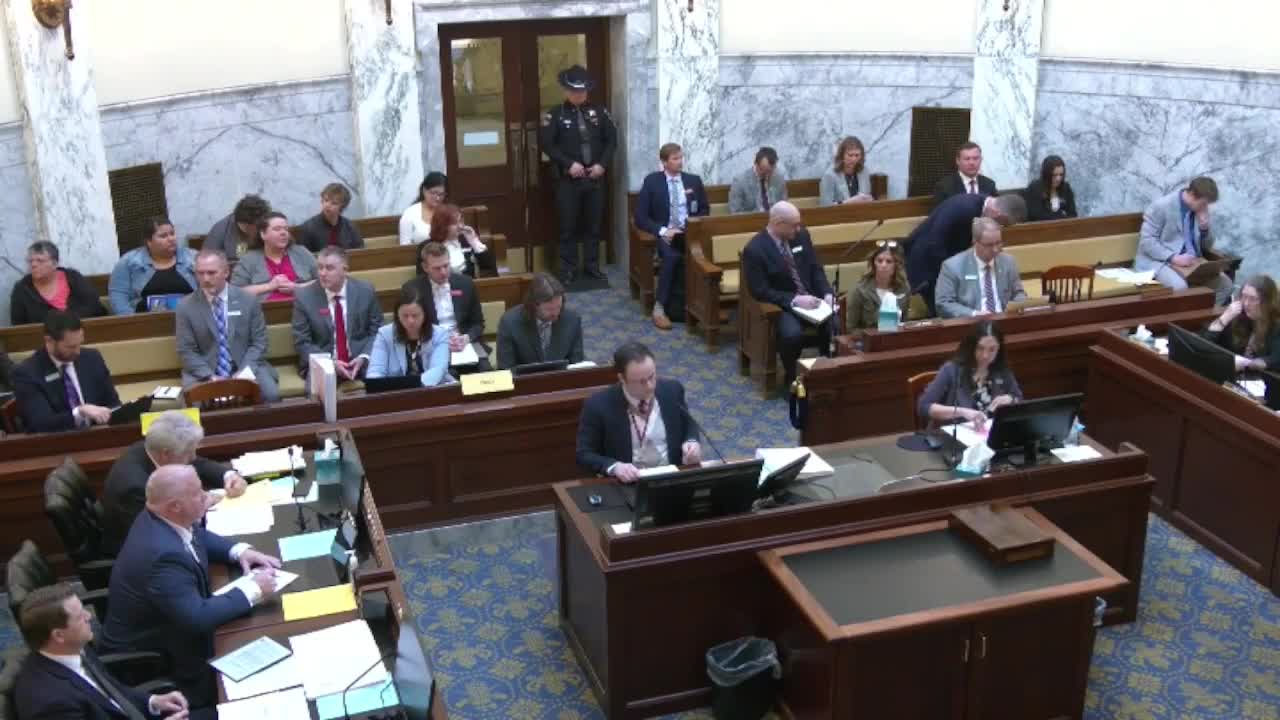
The Joint Finance‑Appropriations Committee on March 24 approved a package of supplemental and enhancement actions for the Office of the State Public Defender (OSPD), including one‑time funding to align Child Protective Act (CPA) representation, funding to cover court-ordered transcript costs following an Idaho Supreme Court decision, and a supplemental to increase contracted attorney rates for the remainder of the fiscal year.
LSO analyst Christopher Lahoset said the first FY2025 supplemental requested $2.5 million in one‑time funding from the Public Defense Fund to align the agency’s authorized appropriation with the cash transfer authorized in Idaho Code section 57‑8‑11; those funds are earmarked for representation under the Child Protective Act. Representative Manwaring moved the motion; the committee approved it on a combined roll call of 15 ayes and 5 nays.
The committee also approved a one‑time $390,200 general‑fund supplemental to cover transcript costs that the Idaho Supreme Court, in State v. Blasek, has assigned to the State. That motion passed unanimously (20–0 combined).
A third FY2025 supplemental approved by the committee added $3,799,900 one‑time from the general fund to increase state employee salaries and to raise the contracted attorney rate from $100 to $125 per hour for the remainder of the fiscal year. Representative Manwaring explained the supplemental aimed to improve contractor availability: the agency had requested $150 an hour; committee action set $125 as a compromise, with accompanying intent language and a policy bill on the Senate floor (referenced as Senate Bill 11 81 in committee discussion) to require analysis of efficiency and potential transition of contracted services to state employees. That supplemental passed on combined committee roll calls (13 ayes, 7 nays).
The committee then considered a FY2026 enhancement package that totaled $32,382,100 (including $31,082,100 general fund and $1,300,000 dedicated funds) and added 17.96 full‑time equivalents for institutional offices, operating budget growth, and contract/ personnel increases. That motion also included a net‑zero $1.2 million fund shift (reduce $1.2M from the Public Defense Fund and add $1.2M from the general fund). After debate — including concerns from Representatives Miller and Pesky about the transition, county relationships, and communication during the state takeover of public defense — the FY2026 enhancement motion passed on a combined vote of 12 ayes and 8 nays.
Legislators pressed several operational questions during discussion: whether counties were provided memoranda of understanding for facility use (some counties reported they had not received MOUs), whether case assignments matched attorney expertise, and whether centralized assignments had impeded local management. Representative Manwaring said the pending policy bill would require consultation between the State Public Defender’s Office, district public defenders and county commissioners and would phase facility transitions to state facilities between 2027 and 2029. The committee did not add additional reporting requirements or conditions beyond the budget motions recorded in committee materials.