Get Full Government Meeting Transcripts, Videos, & Alerts Forever!
Get email alerts on the Medicaid Reform topic
No spam. Unsubscribe anytime.
Idaho panel advances Medicaid overhaul with managed care, work requirements and new rule authority
Summary
The Idaho Senate Health and Welfare Committee voted to send House Bill 345, a package of Medicaid reforms, to the Senate floor with a due-pass recommendation after hearing several hours of testimony from the bill sponsor, state officials, providers and disability advocates.
The Idaho Senate Health and Welfare Committee voted to send House Bill 345, the Medicaid Affordability and Healthcare Access Act, to the Senate floor with a due-pass recommendation after a committee voice vote. Representative Jordan Redmond, sponsor of the bill, told the committee the measure combines reforms to managed care, cost sharing, provider practice authority, and site-neutral payments with new work and verification requirements for the Medicaid expansion population.
The bill, Representative Jordan Redmond said, "truly does offer immediate savings to the taxpayers as well as, substantial long term savings and stability to the Medicaid budget," and he described a package he said removes the 36-month lifetime limit and $50,000 enrollee cap from earlier legislation while adding a broader set of program reforms.
Why it matters: supporters say the changes are designed to rein in fast-growing Medicaid costs and give the state more predictability if federal matching rates change. Opponents — disability advocates, physicians and community organizations — told the committee the bill threatens access and quality for people with disabilities and other vulnerable Idahoans and could impose costly administrative burdens.
What the bill would do: Representative Redmond and department officials described several elements in the draft text. Key provisions discussed in the hearing include: - A move to comprehensive Medicaid managed care for Idaho’s full Medicaid population, with a capitated payment model and oversight by the state Medicaid review panel. Representative Redmond said the change is intended to create stability by setting a fixed, capitated rate rather than continuing fee-for-service exposure. - A work requirement for the expansion population that generally requires 20 hours per week of work, volunteering or schooling, with specified exemptions. Representative Redmond said the department would submit a federal waiver (discussed in testimony as a Section 1115 waiver) to implement the requirement. - Eligibility verification twice a year (biannual redetermination) or at a frequency to be set by the Department of Health and Welfare, intended to reduce improper payments; Representative Redmond cited an 18.6% improper-payment rate for the expansion population and said the state must tighten eligibility. - Limited repeal and consolidation of certain administrative rules with authority for the Department of Health and Welfare to promulgate temporary rules to implement changes; Deputy Director Juliette Sharon told the committee the department "would anticipate having temporary rules ready for July 1." - Protections for federally qualified health centers (FQHCs), site-neutral payment requirements to prevent higher facility charges when a small provider is acquired by a larger system, and practice-authority protections aimed at clarifying what services nonphysician providers may provide under state rules.
Public testimony: more than a dozen groups and individuals testified for and against the bill. Disability advocates repeatedly urged that the disability community be included in managed-care design and warned the bill’s language removing or altering existing rules could jeopardize services for people on waivers. Christine Pisani, director of the Idaho Council on Developmental Disabilities, said, "It is imperative that the disability community be included in the development of managed care as it relates to the many ways this legislation proposes changes for children and adults with disabilities and seniors."
Medical providers and health centers also expressed concerns. Dr. Crystal Pyrak, president of the Idaho Academy of Family Physicians, testified against the bill and said shifting to a managed-care model could "jeopardize the quality of care for our most vulnerable populations." Mountain States Policy Center and the Idaho Freedom Foundation supported the bill as a step toward fiscal sustainability; Fred Birnbaum of the Idaho Freedom Foundation said Medicaid expansion cost growth is a "burning platform" that requires reforms.
Administrative impacts and costs: witnesses cited differing estimates of administrative burden. Representative Redmond said the Department of Health and Welfare expects to add 17 full-time employees to implement eligibility and work-verification requirements and that the fiscal note already factors those costs into net savings estimates he cited (a one-time net savings figure presented at the hearing and an ongoing estimated savings). Opponents pointed to experiences in other states — notably Arkansas and Georgia — where work requirements imposed large administrative costs, resulted in many eligible people losing coverage because of reporting difficulties, and produced little demonstrable employment gains.
Department assurances: Juliette Sharon, Deputy Director at the Department of Health and Welfare, told the committee the department intends to issue temporary rules to reflect statutory changes and "we would anticipate having temporary rules ready for July 1," which she said is intended to avoid a gap in rule coverage for providers and participants.
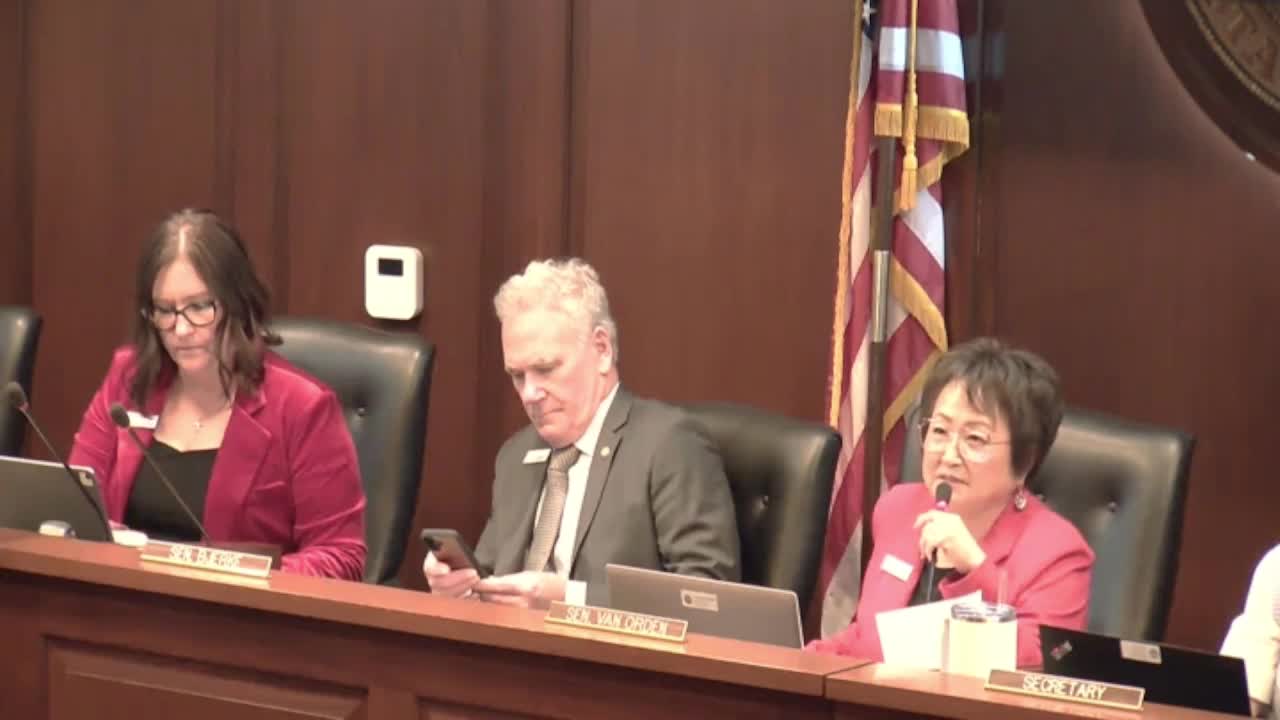
Committee action and next steps: after roughly three hours of testimony and questions from committee members, Senator Lenny moved to send House Bill 345 to the Senate floor with a due-pass recommendation. The motion was seconded and approved by voice vote; committee leadership instructed staff to record the result for the formal record. The bill will be scheduled for floor consideration.
Votes at a glance: - House Bill 345 — Motion to send to the floor with a due-pass recommendation (mover: Senator Lenny). Outcome: approved by committee voice vote; roll-call tally not recorded in the hearing transcript.
What the committee left unresolved: several witnesses and some senators pressed for clearer, written assurances that (1) the disability community will be formally engaged in managed-care design; (2) temporary rule language and transition staffing will be in place before major program changes take effect; and (3) federal waiver strategy (1115 and 1332 waivers were discussed) will be aligned with protections for waiver populations and school-based Medicaid services. Committee members also asked for clearer detail on how contracts would cap insurer profit, how site-neutral payment rules would be enforced and the timing of eligibility redeterminations.
The bill will next proceed to the Senate floor. If the measure advances, committee members and agency officials said they expect continued stakeholder work through the Medicaid review panel and rulemaking to translate statutory changes into program operations.