Get Full Government Meeting Transcripts, Videos, & Alerts Forever!
Get email alerts on the Water Resources Budget topic
No spam. Unsubscribe anytime.
Idaho water officials defend spending plan, request 5 admin positions and $30M ongoing for projects
Summary
Department of Water Resources leaders told the legislative budget committee the agency holds large committed balances and ARPA funds while seeking five water-administration positions and a $30 million ongoing transfer for water projects; committee members pressed for details on specific projects, timing and oversight.
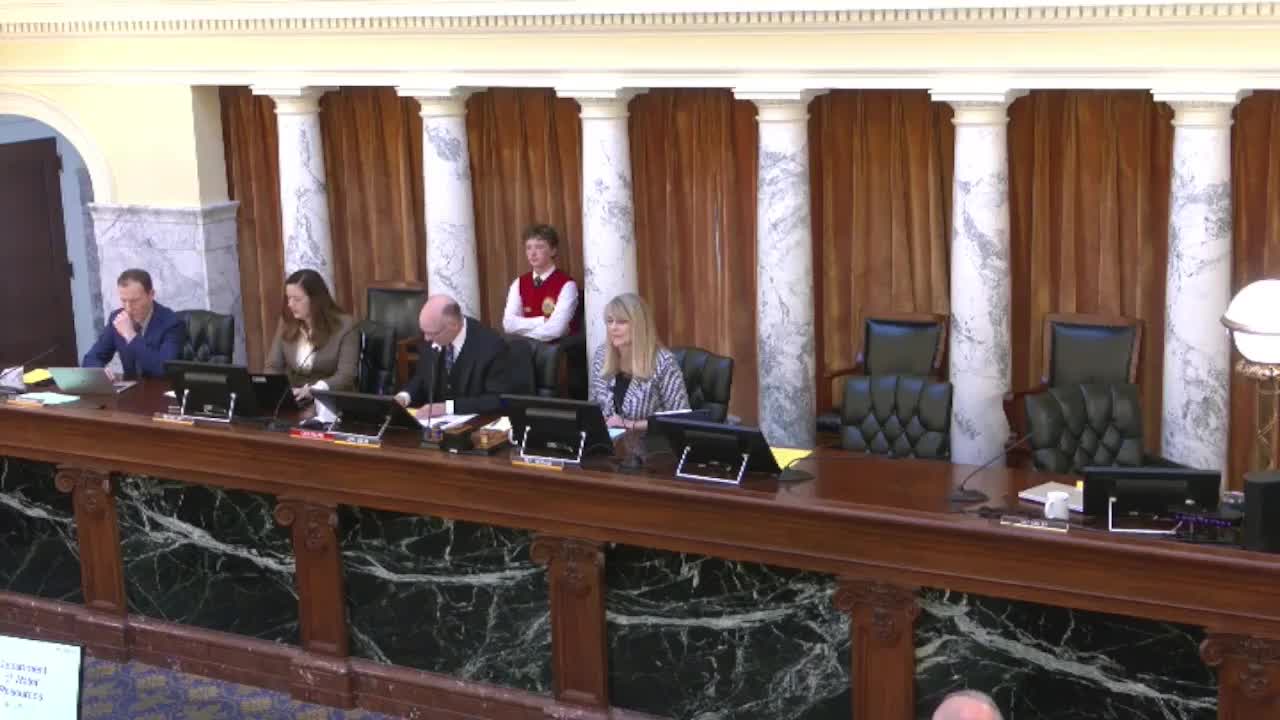
The Idaho Department of Water Resources outlined its 2026 budget request to the joint legislative budget committee, noting large committed balances in its water management account, continued spending of ARPA funds for statewide water projects and a request to add five full‑time positions to create a Water Administration Bureau.
The agency’s budget analyst, Janet Jessup of Legislative Services, told the committee the department had received a one‑time $50 million ARPA allocation and a separate $50 million that was made ongoing; she said the department and its board have committed most of the cash in the water management account. “If you read down through that balance sheet…that cash balance at the end of the last calendar year was $320,000,000,” Jessup said, and the board’s committed fund total is “$290,000,000 so that leaves us with an uncommitted fund balance of about $29,000,000.”
Why it matters: Committee members pressed for assurance that the governor’s $30 million ongoing recommendation would be targeted and that the board would bring clear project lists and timelines before the legislature. Several legislators expressed concern about establishing a recurring appropriation without a defined, vetted set of projects and asked for follow‑up detail.
Director Matt Weaver, who represents the Department of Water Resources, and Jeff Raybould, chairman of the Idaho Water Resource Board, described how those funds are already allocated to a broad set of projects across the state, and explained the agency’s approach to loans and grants. Raybould listed funded and partially funded investments the board is overseeing, including Mountain Home Air Force Base water supply work, Anderson Ranch dam raise planning, pipeline and pumping projects for fish hatcheries and the Lewiston Orchards plan, canal conversions, and regional sustainability loans and grants.
On recharge and the Eastern Snake Plain Aquifer (ESPA), Weaver noted a management goal change the board is pursuing to increase average annual recharge in parts of the ESPA from 250,000 to 350,000 acre‑feet. He summarized recent activity: “From that period 2016, we were at an aquifer level that we hadn't seen in modern times…Over that period of time, the Idaho Water Resource Board…was able to average 268,000 acre‑feet a year of recharge. Private individuals…recharged 116,000 acre‑feet a year…and they reduced their pumping by 212,000 acre‑feet.” He described the combined programmatic activity as on the order of 600,000 acre‑feet per year of aquifer management work.
On staffing: The department is requesting five new positions to form a Water Administration Bureau. Weaver said the request would pair five new positions with about 11 existing employees to create a bureau led by a bureau chief and including resource specialists and a technical records specialist. “Currently right now we are not meeting the demand to create and support water districts across the state,” Weaver told the committee, tying the request to increased workload from water‑district creation, training, and meeting obligations created by the recent settlement affecting the ESPA.
On project timing and cashflow: Raybould explained that board commitments often appear as large balances because the board adopts project commitments and then disburses cash as work progresses: engineering and permitting phases can take years, and funds are released on progress. He said the board had roughly $23 million in loans outstanding in the revolving development account and “right at $20,000,000” more in loans out of the water management account. He said the board uses loans and grants differently depending on project importance, applicant capacity and federal cost‑share opportunities; for example, an aging‑infrastructure grant may cover up to one‑third of a project cost, capped at $2 million.
Committee concerns: Several legislators—including Representative Tanner and Representative Miller—asked whether an ongoing $30 million transfer to the water management fund should be approved without a detailed project list and stronger legislative oversight. Weaver and Raybould asked the committee to consider the value of an ongoing revenue stream for planning and long‑term projects such as managed recharge, monitoring, and operation and maintenance of new infrastructure.
Evidence and next steps: Jessup said she would follow up with the committee by providing the board’s statewide project list of identified but currently unfunded projects. Committee members also asked the agency to provide clearer timelines for project design, engineering and disbursement so legislators can assess pace of expenditure and program outcomes.
Ending: Officials emphasized that many projects are multi‑year and that the board’s approach is to authorize commitments and then fund projects as milestones are met. Weaver closed by saying the department’s enhancement requests were shaped by water users’ priorities —administration, supply enhancements and recharge—and that the department would return follow‑up materials to the committee.