Corrections seeks surveillance upgrades and a transport expansion after ambush that wounded staff
Loading...
Summary
Following an ambush during a medical transport last spring, the Idaho Department of Correction asked the legislature to fund advanced mail scanning, drone detection, phone‑call transcription analysis, expansion of a transport bureau and a body‑worn camera pilot for several facilities.
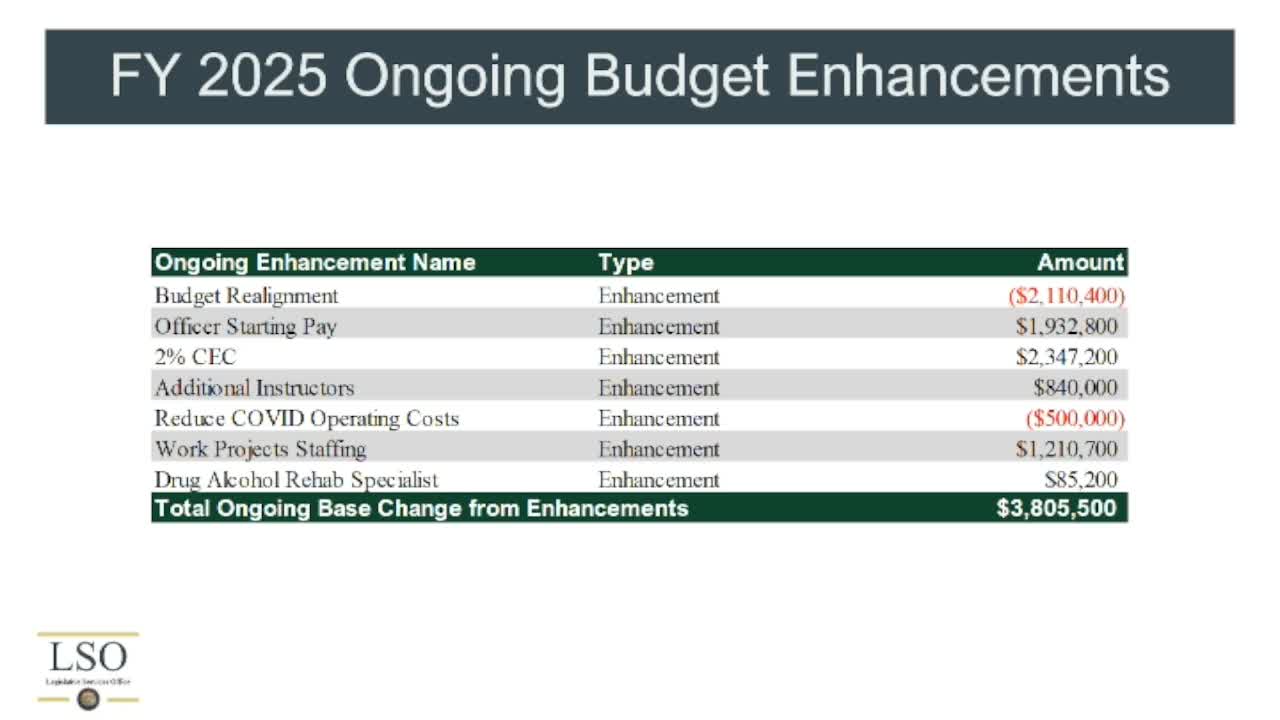
The Idaho Department of Correction told the Joint Finance-Appropriations Committee on Feb. 4 that a security breach during an emergency transport last spring — in which three IDOC employees were shot — prompted a package of supplemental and ongoing requests for state prisons funding.
Analyst Noah Peterson described multiple supplemental requests tied directly to vulnerabilities the agency identified after the incident. Director Josh Tewalt summarized the department’s view that the attack revealed gaps in how emergency transports were managed and the level of staff training and equipment available for high‑risk movements.
Key items in the presentation included:
- Advanced surveillance technology: The department requested a one‑time FY2025 supplemental (presented as $795,000) to implement digital mail scanning, drone detection and a phone‑call transcription and analysis technology (referred to in testimony as LEO). The department told lawmakers that scanning and digitizing incoming mail would close the most porous contraband entry point; the agency estimated it processed millions of phone‑call minutes in 2023 and said transcription could help identify criminal networks and assist law enforcement.
- Costed ongoing request for surveillance tools: For a full fiscal year, the department estimated the three technologies would cost about $2.4 million. The presentation broke that estimate into roughly $1,011,000 for digital mail scanning, $385,500 for drone detection and $1,000,000 for the LEO phone transcription/analysis tool. The agency characterized these as ongoing general‑fund needs.
- Transport bureau expansion: A one‑time supplemental of roughly $1.15 million would expand the Transport Bureau to handle emergency transports statewide. Peterson said the FY2025 supplemental would include personnel and equipment costs for 12 new FTP, with the first‑year personnel cost approximately $455,000 and about $693,000 for vehicles and operating costs (seven equipped vehicles, including SUVs and a wheelchair van). The department presented an ongoing personnel request of about $965,500 if the expansion is continued into FY2026.
- Body‑worn camera pilot: The agency requested federal funds plus a small state match to pilot body‑worn cameras in three locations. Peterson described the FY2025 request as primarily federal funds with a modest general‑fund match (presentation referenced a small state share of roughly $27,000); the agency expects additional state matching costs in FY2026 and FY2027 if the pilot continues.
- Equipment and replacement items: Additional requests included ongoing capital costs for a skid‑steer (presented as $83,200) at the St. Anthony work camp for snow removal and a larger list of vehicle and replacement items totaling several million dollars. The governor recommended contracting snow removal at an ongoing cost of $30,000 rather than purchasing a skid‑steer as the agency proposed.
Tewalt defended the transport‑bureau expansion, saying emergency transports were previously handled as “other duty as assigned,” pulled from shifts not specifically trained or equipped for high‑risk medical transports. He described large overtime burdens at high‑security facilities (the agency cited roughly 20,000 overtime hours at one facility and about 14,000 hours at another) and said creating a trained transport resource was the most efficient option presented to avoid dramatically increasing staffing across multiple secure facilities.
No votes occurred during the hearing; legislators pressed the agency for more information on cost comparisons, contracting options (for snow removal) and whether the expanded transport bureau would enable reallocation of existing positions. Peterson and Tewalt offered to provide follow‑up documentation and operational details to the committee.