Get Full Government Meeting Transcripts, Videos, & Alerts Forever!
Get email alerts on the Agricultural Research Extension topic
No spam. Unsubscribe anytime.
University of Idaho ag research and extension presents needs, highlights Parma lab and digital divide work
Summary
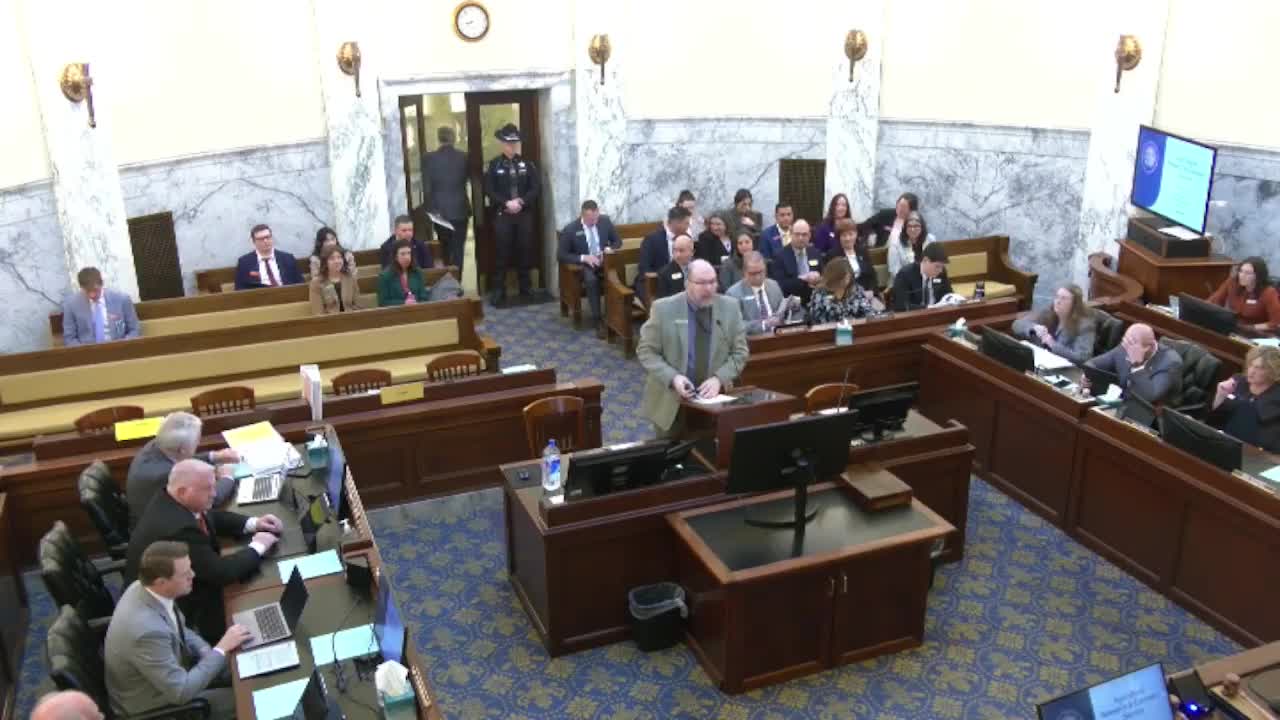
Michael Perella, dean of the University of Idaho College of Agricultural and Life Sciences, told the Joint Finance-Appropriations Committee the college is expanding research capacity, hiring faculty and delivering extension services statewide, highlighting the new Idaho Center for Plant and Soil Health in Parma.
Michael Perella, dean of the University of Idaho College of Agricultural and Life Sciences (CALS), briefed the Joint Finance-Appropriations Committee on the Agricultural Research and Extension Service's FY2026 base budget and requests, saying the college aims to apply science to agricultural production, ranching and natural-resource issues statewide.
Kevin Campbell, the Legislative Services Office analyst who preceded the college presentation, told the committee the service has a physical presence in 42 of Idaho's 44 counties and three recognized tribal communities. He noted the Idaho Agricultural Experiment Station operates 10 research and extension centers with over 14,000 acres for research. Campbell said personnel costs are the largest expenditure—about 81% of the service’s budget—while operating and capital outlay also represent material shares of spending.
Dean Perella, who said he will retire in June after nine years as dean, summarized recent investments and accomplishments. He thanked the legislature and governor for support that has allowed the college to replace aging infrastructure and hire early- and mid-career faculty. Perella highlighted the new Idaho Center for Plant and Soil Health in Parma and said the college is hiring faculty in areas such as viticulture and small-fruit research to respond to grower needs in disease prevention, water management, pest management and post-harvest storage.
Perella emphasized extension’s broad mission beyond production agriculture, listing five extension focus areas: agriculture; natural resources; 4‑H youth development; community programs; and families. He described extension’s recent role addressing the digital divide in rural communities and said the college leveraged ARPA funds to support adult digital literacy work, in part to coordinate with Department of Commerce broadband investments. He also noted competitive federal funding: the college’s Western Center for Rural Development applied for (and one University-related project won) an FCC grant intended to enhance digital literacy and broadband deployment.
Committee members asked for outcomes and measures. Perella said extension collects participant feedback after educational sessions and uses follow-up evaluation to measure impact; he cited an estimate that extension-driven participant actions produced $47 million in savings in the last year and offered to provide more detail on that calculation. Legislators also asked about the rationale for housing adult computer-literacy work within the extension service. Perella explained that extension’s county-based educators and research specialists run community-focused programs (including digital-literacy training) to benefit rural residents, small businesses and families.
Senators and representatives expressed appreciation for the new Parma facility and asked for clarification about ongoing costs and continued federal funding. Campbell described recent FY2024 and FY2025 appropriations, including ARPA support for broadband-related adult literacy work and smaller appropriations for research faculty and maintenance of the Parma facility. For FY2026, the service requested $157,900 ongoing for a viticulture and small-fruit research faculty position and $250,100 for a portion of building maintenance at the Idaho Center for Agriculture, Food and the Environment.
Perella provided closing remarks about the college’s statewide impact: extension reported more than 450,000 face-to-face contacts with Idahoans in the prior year and engaged over 75,000 youth in 4‑H programming. He noted CALS ranked 13th nationally among agricultural science colleges last year and said recent change-in-employee-compensation (CEC) funding helped reduce turnover. Perella thanked the legislature for past investments and said the college would continue to pursue externally funded grants to leverage state appropriations.
The committee did not take immediate action on the Agricultural Research and Extension Service requests and asked for additional details on program outcomes and federal grant status.