Get Full Government Meeting Transcripts, Videos, & Alerts Forever!
Get email alerts on the State Legislation topic
No spam. Unsubscribe anytime.
Tennessee Senate advances package of bills, including pesticide liability limits, pronoun rules and foster‑youth rights
Summary
The Tennessee Senate passed a broad set of bills during its floor session, advancing measures on product liability, education policy, foster‑care rights and state regulatory standards.
The Tennessee Senate passed a broad set of bills during its floor session, advancing measures on product liability, education policy, foster‑care rights and state regulatory standards.
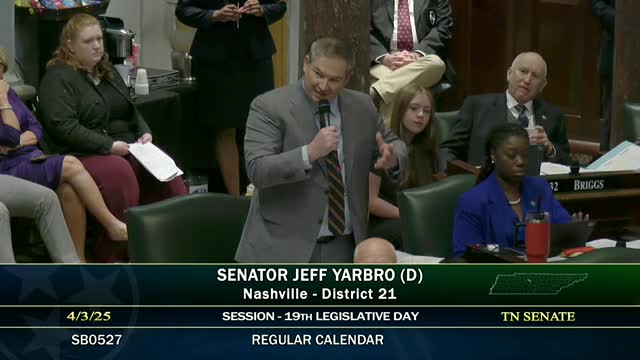
The most contested measure, Senate Bill 527 (as amended), limits failure‑to‑warn claims against pesticide manufacturers in cases where the manufacturer complied with federally required EPA labeling. After extended debate, the Senate approved the bill. Opponents argued the change would hamper injured Tennesseans’ ability to sue manufacturers; supporters said the bill provides certainty for farmers and other product users who rely on EPA approvals.
Why it matters: supporters said the measure protects agricultural production and prevents legal exposure for businesses that comply with federal labeling; opponents said it could restrict civil remedies for people who claim serious harm from chemical exposures.
Senate debate and key quotes - Senator Stevens (sponsor) framed the bill as a limit on “failure to warn” claims tied to federal labels, saying the measure does not prevent all lawsuits but narrows a specific strict‑liability claim tied to product warning labels.
- Senator London Campbell objected sharply. “This is a very, very bad idea. Tennesseans do not want this, and we owe it to Tennesseans to represent their health and their interest and their ability to defend themselves against harmful chemicals,” Campbell said on the floor.
- Senator Lamar opposed the bill on similar grounds: “If you know your product is deadly or cancer causing, you should be held liable.”
Other debated measures - Senate Bill 227 (sponsor: Senator Taylor) — The Senate approved language that makes a nongovernmental organization potentially civilly responsible if it assists a person living in the U.S. unlawfully with long‑term housing and that person later commits a criminal act. Sponsor Taylor said the measure does not prevent charities from assisting people but opens certain civil exposure if the group’s placement is followed by criminal conduct. The bill passed after floor discussion.
- Senate Bill 937 / House Bill (pronoun/name protections; sponsor: Senator Rose) — The Senate extended existing statutory protections and created a civil cause of action tied to compelled use of a preferred name or pronoun in certain public‑school settings and related contractors. Supporters described the bill as protecting free speech and parental rights; critics warned it may permit disrespectful treatment of students and have negative effects on vulnerable youth.
- Senate Bill 134 (learning pods) — The Senate adopted an education committee amendment and passed a bill that exempts “learning pods” from state and local education regulation and from certain building‑code or site‑inspection requirements where the pods consist of informal groupings of families. Sponsor Leader Johnson said the change clarifies freedom for independent homeschool gatherings.
- Senate Bill 1015 (foster‑care rights; sponsor: Senator Hale) — The Senate passed an amendment that requires the Department of Children’s Services to implement a set of rights for children in DCS custody and to provide age‑appropriate materials and staff training. The bill requires materials be provided within 30 days of entering custody.
- Senate Bill 535 (investigative subpoena notices) — The Senate approved a bill limiting electronic service providers’ ability to notify account holders when their data has been provided to law enforcement, giving providers a 90‑day window before they may notify a target and allowing law enforcement one 30‑day extension. Sponsor Stevens said the change is intended to prevent suspects from destroying evidence during investigations of child‑exploitation and other crimes.
Other notable votes (Votes at a glance) - Senate Bill 113 — Concurred in House Amendment No. 1 (limits variances for subsurface sewage disposal to single‑family residences in contract counties). Vote: Ayes 26, Nays 3. Sponsor: Leader Johnson. - Senate Bill 497 — Concurred in House Amendment No. 1 (tattoo apprenticeship timing reduced to 1 year). Vote: Ayes 30, Nays 0. Sponsor: Senator Wally. - Senate Bill 561 — Concurred in House Amendment No. 1 (TWRA fee cap clarified). Vote: Ayes 30, Nays 0. - Senate Bill 946 — Concurred in House Amendment No. 1 (LEA parental notification window extended to 48 hours). Vote: Ayes 31, Nays 0. - Senate Bill 7 — Third‑reading passage with an amendment limiting Tennessee Historical Commission regulation of properties not listed on the register. Vote: Ayes 22, Nays 6. - Senate Bill 134 — Passed as amended (learning pods exempted from many education regulations). Vote: Passed (constitutional majority declared). - Senate Bill 161 — Passed as amended (policy to authorize nonvoting student representatives on local school boards). Vote: Ayes 28, Nays 0. - Senate Bill 227 — Passed (limits civil exposure tied to long‑term housing assistance to undocumented individuals under specified conditions). Vote: Ayes 24, Nays 4. - Senate Bill 238 (conform to HB 78) — Passed. Vote: Ayes 28, Nays 1. - Senate Bill 525 — Passed (municipal charter amendment ballot restrictions tied to three‑judge panel review). Vote: Ayes 25, Nays 5. - Senate Bill 527 (product‑liability limits tied to federal labels) — Passed after extended debate; sponsor said it narrows failure‑to‑warn claims while preserving other causes of action available to plaintiffs. Vote: constitutional majority declared (ayes reported on the floor). - Senate Bill 1015 (foster‑care rights) — Passed as amended. Vote: Ayes 31, Nays 0. - Senate Bill 535 — Passed as amended (delays for electronic‑service provider notice to targets of subpoenas). Vote: Ayes 26, Nays 0. - House Bill 825 (school social‑media/Internet/AI guidance) — Passed (requires Dept. of Education guidance for grades 6–12 and internet protections in schools). Vote: Ayes 25, Nays 0. - Senate Bill 880 ("Sound Science and Regulation" cleanup) — Passed. Vote: Ayes 23, Nays 4. - House Bill 1143 (clean/renewable energy cleanup/definition consolidation) — Passed. Vote: Ayes 25, Nays 5. - House Bill 1133 (nuclear/green energy tax clarification) — Passed. Vote: Ayes 30, Nays 0. - Senate Bill 937 (pronoun and name protections in schools and cause of action) — Passed. Vote: Ayes 25, Nays 5.
What was not decided: a handful of bills were moved to later calendars or taken up for future consideration; several items were handled on the consent calendars with largely unanimous voice votes.
Context and next steps The session included extended, sometimes heated floor debate on liability and education issues. Sponsors frequently framed bills in terms of protecting Tennessee industries, families or parental rights; opponents raised questions about public‑health, civil remedies and effects on minors. Several measures will require state agencies to adopt rules, issue guidance or produce materials (for example, DCS materials for foster youth and Department of Education guidance on Internet/AI safety lessons). Some enactments depend on federal labeling and regulatory decisions (notably the bills tied to EPA labeling). The Senate adjourned to reconvene at the time set in the published schedule.
Ending note: Many bills approved on the floor will next be enrolled for transmittal to the governor or return to the originating chamber for concurrence where required; implementation details and rulemaking timelines will be determined by the responsible state agencies.