Get Full Government Meeting Transcripts, Videos, & Alerts Forever!
Get email alerts on the Indecent Exposure topic
No spam. Unsubscribe anytime.
Senate committee advances bill broadening Idaho indecent-exposure law
Summary
The Senate Judiciary and Rules Committee voted to send House Bill 270 to the floor with a "do pass" recommendation after testimony from sponsors, law enforcement and opponents about whether the measure would modernize Idaho's indecent-exposure statute or criminalize already lawful expression.
BOISE — The Senate Judiciary and Rules Committee voted to advance House Bill 270 on a "do pass" recommendation after sponsors said the measure updates Idaho's indecent-exposure statute to clarify enforcement and opponents said the language is vague and risks unequal enforcement.
House Bill 270, sponsored in the House by Representative Jeff Cornelis of Nampa and supported in the Senate by Representative Tanner and Nampa City Council Member Sebastian Griffin, amends Idaho Code §18-40116 to update the definition of "willful" and "lewd" indecent exposure, including language intended to cover breasts that "have been medically or hormonally altered to appear like that of developed or developing female breasts," the bill text and sponsors' statements say.
The bill's sponsors said the change is intended to give law enforcement and prosecutors clearer authority when people expose themselves in public in a way that offends others. "This simply, this bill just simply says, cover up when you're in public," Representative Jeff Cornelis told the committee.
Proponents described specific incidents in Nampa parks where they said current law left police unsure whether they could intervene. "We believe that we could enforce it where investigated circumstances comport with the described elements of the bill," Council Member Sebastian Griffin said, citing review by a county prosecutor and local police.
Opponents said the bill expands criminal exposure in ways that will be applied unevenly. Nixon Matthews, a former state senator who identified himself as a trans man, told the committee that two people with the same chest could face different treatment under the bill. "A cisgender man and I, a proud trans man, could stand in the same place with a chest that looks the same, and only one of us would be at risk for criminal charges," Matthews said, urging a "no" vote.
Several public commenters, including Rachel Ann Pierce and Jessica Evitt, raised constitutional concerns and said the measure singles out transgender and gender-nonconforming people. Edward Clark of the Idaho Family Policy Center urged passage, saying the state has a "constitutional mandate to 'further all wise and well directed efforts for the promotion of morality,'" and arguing the bill protects children from "overtly sexual conduct." Clark told senators the statute requires that the exposure be "lewd conduct," not mere absence of a shirt.
Committee members asked about unintended consequences, including whether the bill could apply to displays of products or novelty items. Several senators said they were concerned by the breadth of the phrase "in any place where there is present another person or persons who are offended," which they said can extend beyond public parks to private premises if an offended person is present.
Council Member Griffin and other supporters repeatedly told senators that law enforcement discretion and prosecutorial review would limit overreach. "We have police discretion always," Griffin said, adding that the bill requires willful and lewd conduct and that escalations to felony-level penalties would require repeated offenses.
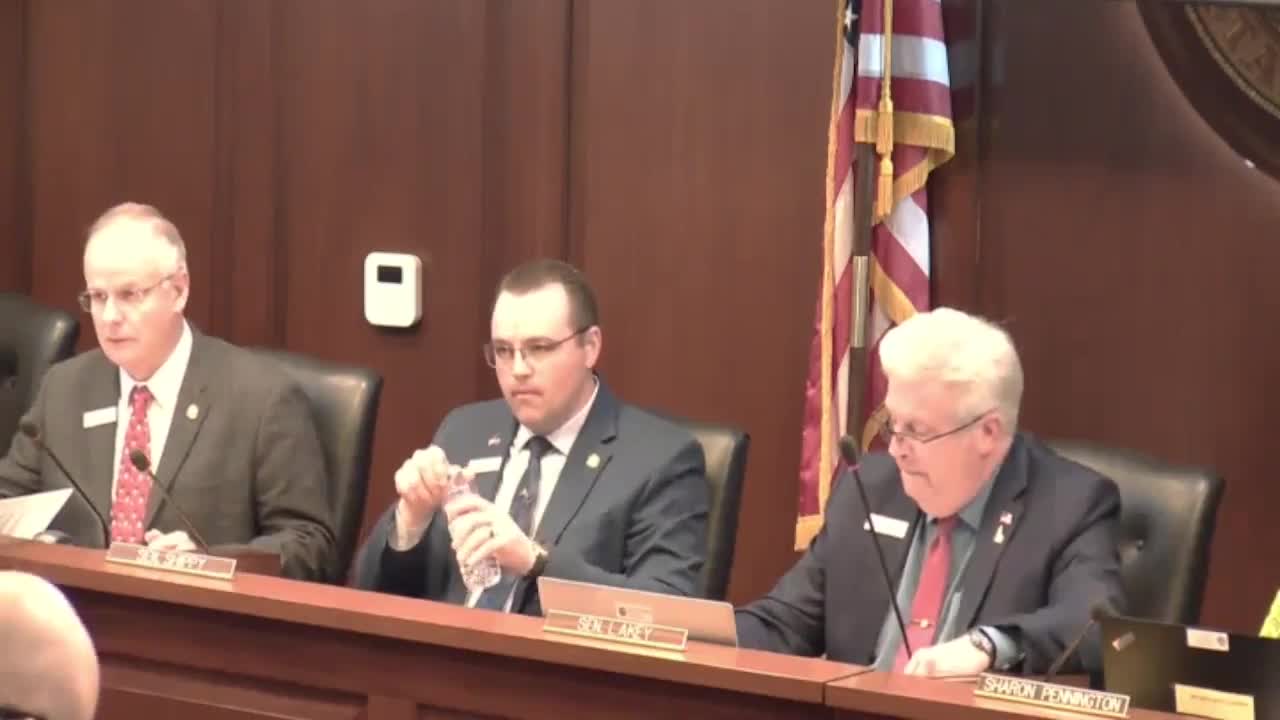
After roughly an hour of testimony and questioning, Senator Lenny moved, and Senator Foreman seconded, to send the bill to the Senate floor with a due-pass recommendation. The committee voice vote resulted in the motion carrying; Senator Wintrow was recorded as voting no. The committee chair recorded the motion as passed.
The measure now heads to the full Senate for further consideration.
Notes: The committee discussion referenced Idaho Code §18-40116 and U.S. Supreme Court precedent cited by a witness (Barnes v. Glen's Theater and City of Erie v. Pap's A.M.) in support of the proposition that states can regulate lewd commercial speech and conduct involving children.