Get Full Government Meeting Transcripts, Videos, & Alerts Forever!
Get email alerts on the Program Placement And Accreditation topic
No spam. Unsubscribe anytime.
Lawmakers question placement of programs and pass‑through grants as accreditation and DEI concerns surface
Summary
Committee members pressed the Department of Health and Welfare on whether certain programs belong inside the division, raised concerns about accreditation and diversity‑equity‑inclusion language, and questioned pass‑through funding for a university‑hosted education platform.
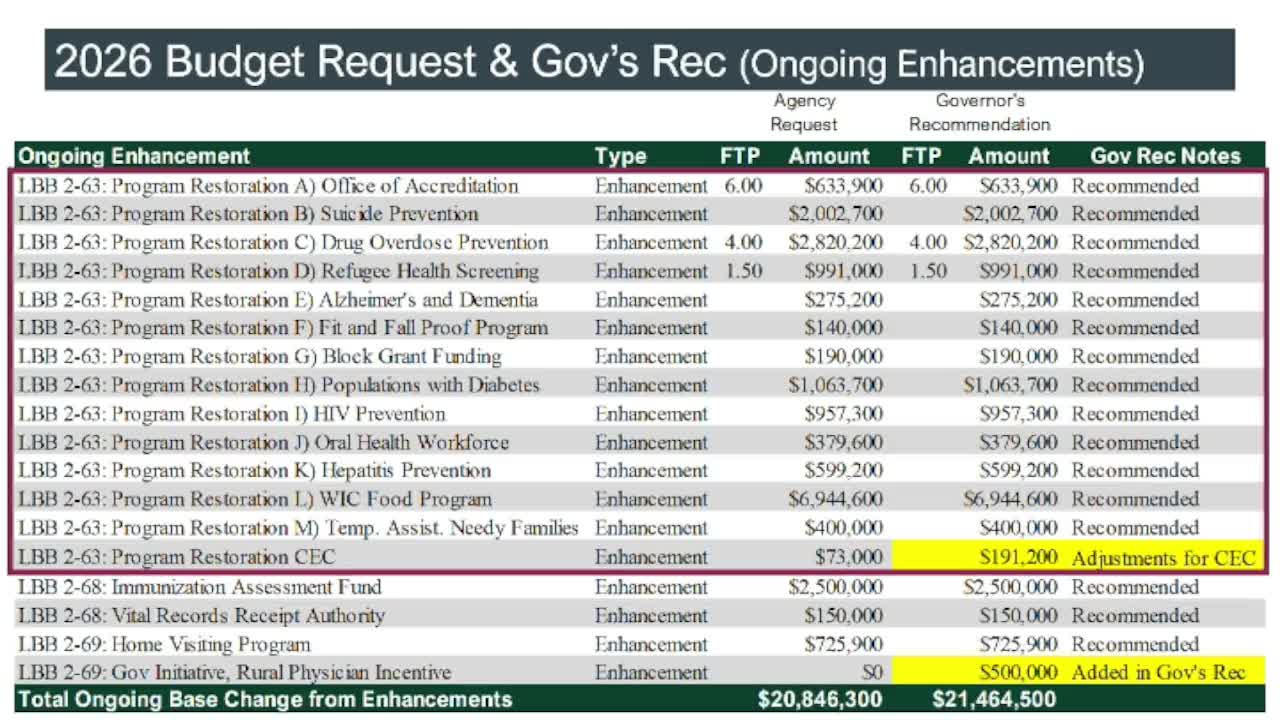
During the budget hearing, several legislators pressed agency leadership on whether particular public‑health programs should remain inside the Division of Public Health Services or be relocated to other state agencies, and they raised objections to accreditation standards that include repeated references to diversity, equity and inclusion.
Representative Price and others asked whether programs such as Alzheimer’s and dementia services and the Fit and Fall Proof exercise program might better belong in an agency that focuses on aging services. Price specifically asked if Alzheimer’s and Fit and Fall Proof should be moved to the Commission on Aging and whether the drug overdose prevention program belonged at the Office of Drug Policy. Director Alex Adams said the department was open to discussions on where programs fit best and noted these restored programs were previously part of the division’s base; he said the department is willing to transfer programs if another agency can deliver them more effectively.
Senator (name provided in the transcript as Tanner Bierke) told the committee he had reviewed accreditation standards tied to the division’s Office of Accreditation and Planning and criticized the standards for repeatedly referencing diversity, equity and inclusion. He said the language indicated, in his view, a policy direction he and some legislators oppose and asked whether removing accreditation status would have funding consequences. Adams replied that accreditation is a voluntary status and that removing accreditation itself would not necessarily affect federal funding, but that the six positions tied to the Office of Accreditation and Planning perform performance measurement and reporting functions that support the division’s programs. “Removing the 6 FTP would be much more problematic,” Adams said, noting staff help link programs to results the legislature wants to buy.
Lawmakers also questioned pass‑through funding arrangements. Representative Horman and others asked about Project ECHO, a continuing medical education platform hosted by the University of Idaho. Adams characterized the $200,000 line as a pass‑through and questioned whether the department should be the budget home for a university program. He noted the legislature had included intent language directing the department to pass that funding to Project ECHO and urged lawmakers to remove that intent language if they agreed the program belongs in the university budget.
Finally, Adams told the committee there is draft legislation expected to be filed that would move the Bureau of Emergency Medical Services from the Division of Public Health to the Office of Emergency Management, saying the move could provide synergies with emergency management, hazmat response and other related duties. He said the department is not opposed to that conversation.
No formal decisions were made during the hearing; members asked agencies to identify performance measures and to provide documentation if programs are to be transferred between agencies.