Get Full Government Meeting Transcripts, Videos, & Alerts Forever!
Get email alerts on the Higher Education Budget And Policy topic
No spam. Unsubscribe anytime.
JFAC hears ISU and Boise State budget overviews; presidents cite student-success gains, restructuring of DEI centers and federal grant uncertainty
Summary
During Jan. 29 Joint Finance-Appropriations Committee hearings, Idaho State and Boise State presidents presented FY2026 budget requests, discussed the restructuring of DEI-related units, LAUNCH enrollment, plans for nursing and cybersecurity expansion, and concerns about a temporary federal funding pause affecting research and student programs.
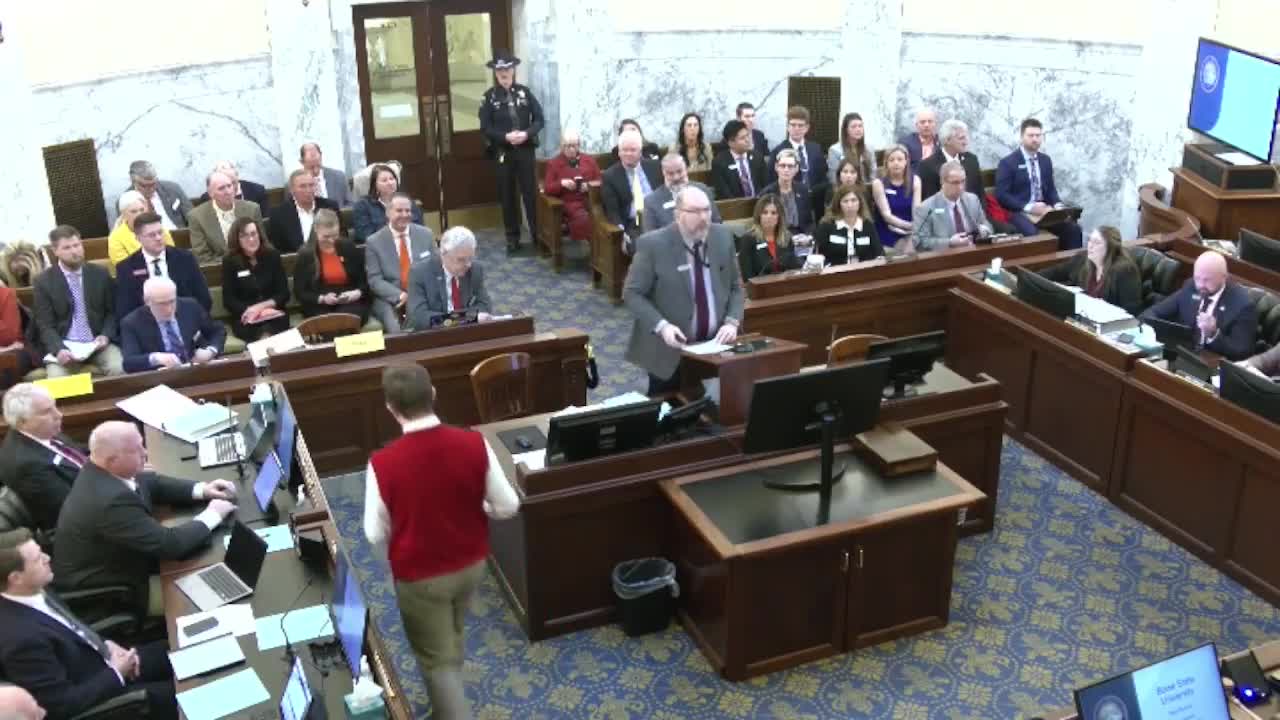
The Joint Finance-Appropriations Committee on Jan. 29 received FY2026 budget overviews from Idaho State University and Boise State University leadership, who highlighted student-success initiatives, workforce-aligned program growth, and near-term risks from a federal funding directive that briefly paused certain federal grants.
Boise State President Marlene Tromp and Idaho State President Rob Wagner each summarized institutional budgets, enrollment, and recent administrative changes. Kevin Campbell, a budget and policy analyst with the Legislative Services Office, presented the slides for both universities and noted common technical and reporting issues the committee has seen across institutions.
Key numbers and budget posture - Boise State reported more than 27,000 students and personnel costs representing 81.8% of overall expenditures; the university said it expects its FY2026 operational capacity enhancement request to be applied entirely to cost-of-living/market adjustments (CEC). Tromp told the committee Boise State has 1,300 students enrolled in the LAUNCH program, with 600 relying on LAUNCH as their only financial support. - Idaho State reported more than 12,000 students. Campbell and Wagner described a multi-year history of adjustments (enrollment-workload adjustments, operational capacity enhancements and consolidations) and noted ISU's FY2026 request includes operational capacity enhancements and enrollment-workload adjustment requests.
DEI-related centers and student-success reorganization Both presidents described reorganizations of diversity-related units into broader student-success efforts. - Wagner said ISU closed a diversity resource center and a gender resource center effective Nov. 15 and moved two FTE into student involvement and equal opportunity/Title IX (reporting to the president); the university then created the Bengal Success Center to support academic completion for all students. - Tromp said Boise State previously staffed several centers and over recent years has transformed them into a unified student-success approach. She said the university reduced staff associated with those centers by five positions but has redirected focus toward serving veterans, rural students and first-generation students. Tromp said Boise State's retention and graduation rate improvements — she cited a 39% increase over five years — are evidence of the refocused approach.
Federal funding uncertainty Wagner and Tromp told the committee they were monitoring a federal Office of Management and Budget (OMB) directive that temporarily paused certain federal grant obligations. Wagner said ISU initially estimated an exposure of about $25 million in federal funding at risk for the university until a federal injunction paused the directive; he said faculty and student support programs were among the areas of concern. Tromp said Boise State worked through the day with staff and associations to assess the potential effects and confirmed restricted federal funds must be used only for their grant-specified purposes.
Other items discussed - Workforce and capacity: Both presidents described plans to expand nursing, health-sciences and engineering programs in partnership with community colleges and other institutions. Tromp told the committee Boise State could grow nursing graduates by about 40 per year with additional funding and cited a free cybersecurity program (Cyberdome) serving rural businesses. - Lawsuit costs: Tromp told the committee Boise State used only non-taxpayer funds to defend a lawsuit and that the university has spent about $1.5 million to date; she did not expect significant additional costs for an appeal. - Academic freedom and campus dialogue: Tromp described Boise State's Institute for Advancing American Values and programming such as Idaho Listens as efforts to broaden campus discourse. She said the university and its student government have adopted free-speech commitments (the Chicago principles) and have expanded required first-year curricula (UF 100/200) into many sections allowing students to select subjects.
What the record does not specify Several figures presented during the hearing were either summarized or not specified in the transcript excerpts: the exact dollar amount of some historical appropriations and the precise updated tuition-and-fees beginning-balance error Campbell noted. Committee members asked Boise State for written assurance that courses comply with Idaho Code sections cited by legislators (discussions referred to Idaho Code 33-138 and 33-139, described in the hearing as statutes regarding dignity/non-discrimination and limits on expenditures). Tromp agreed to provide detailed breakdowns of outside legal costs and spending sources to the committee.
Committee chairpersons asked university leaders to provide follow-up documentation, corrected spreadsheets and additional detail on faculty and program impacts. No formal committee votes or appropriation decisions occurred during the hearing.