Get Full Government Meeting Transcripts, Videos, & Alerts Forever!
Get email alerts on the Vocational Rehabilitation Audit topic
No spam. Unsubscribe anytime.
Legislators hear audit: Idaho Vocational Rehabilitation given federal 'high‑risk' designation; $10M reallocation, $2.4M consultant contract scrutinized
Summary
At a Feb. 24 meeting the Joint Finance-Appropriations Committee was briefed on an audit that found the Idaho Division of Vocational Rehabilitation lacked controls to ensure compliance with appropriation laws; the division has since received a $10 million federal reallocation, a federal "high-risk" designation and engaged a $2.4 million consultant contract to correct reporting and internal-control failures.
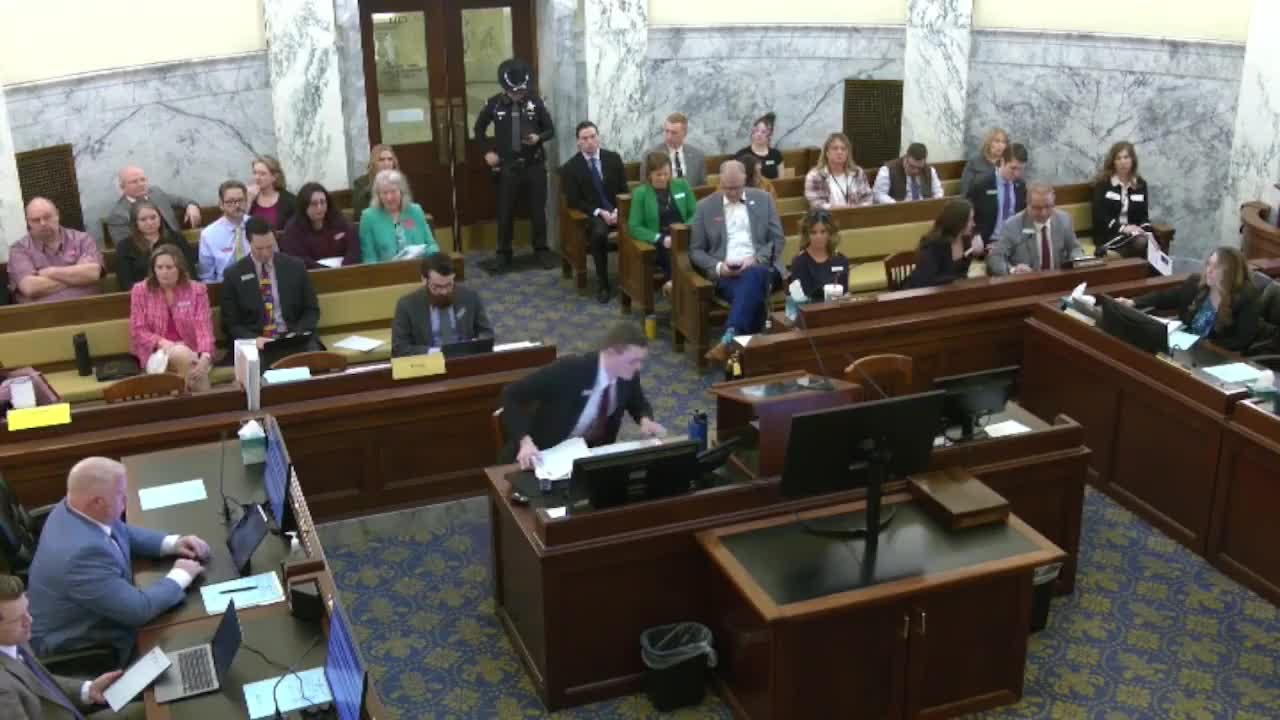
At a Feb. 24 Joint Finance-Appropriations Committee hearing legislative auditors and agency leaders described a fiscal and compliance crisis at the Idaho Division of Vocational Rehabilitation (IDVR) that prompted a federal “high-risk” designation, additional federal oversight and a large consultant contract to correct reporting and control weaknesses.
April Renfro, an auditor with the Legislative Services Office, told the committee the audits division issued an accountability report on Jan. 13, 2025, finding that “the division did not establish procedures and control activities to ensure compliance with appropriation laws applicable to fiscal year 2024.” Renfro said the finding covered inadequate processes to monitor costs committed in individual plans for employment, failures in federal financial reporting, and weaknesses in accounting and obligations tracking.
Renfro described a complex federal grant environment for the Rehabilitation Services Administration (RSA) vocational-rehabilitation grants: the grants operate on federal fiscal years, obligations may span multiple state fiscal years, and IDVR’s case-management system did not communicate with the state fiscal system, complicating period-of-performance accounting. The auditors reported the division failed to timely bill and had a backlog of invoices at the close of FY2024.
Renfro said RSA designated the division as a high‑risk grantee in a May letter, citing concerns under 2 C.F.R. § 200.208 and imposing specific conditions. She said RSA required additional corrective actions, monitored reporting and technical assistance and warned that if corrective steps are not adequate the federal agency may demand remedies including repayment of federal funds proportionate to identified harm.
Judy Taylor, interim director of IDVR, testified that in September the governor recognized a $10,000,000 noncognizable federal reallocation to the division after RSA notified the state of available reallotted federal funds; that recognition was intended to avert immediate operational failure. “We realized running our numbers that we were going to run out of appropriation in early September. By October, we would have been defaulting on our bills and by December we wouldn't have been able to meet payroll,” Taylor said.
Taylor and audit staff said the $10 million federal reallocation requires state matching dollars (RSA’s structure means state match is required to expend the awarded federal funds). IDVR requested a $2.7 million one‑time general fund supplemental to meet the state match for the reallocation; the governor’s recommendation included a $1.7 million one‑time general fund supplemental for client services the agency estimates its federal partners may deem unallowable. Committee staff described the $2.7 million request and the $1.7 million recommendation as decision points for lawmakers.
Audit staff reviewed IDVR’s use of a consultant contracted in August 2024 for $499,999 and amended in November 2024 to add $1.9 million, creating a roughly $2.4 million total contract to provide intensive forensic accounting, business-process redesign, period-of-performance remediation and federal-reporting support. The consulting contract includes a planned fade of consultant support during months 7–12 while state staff absorb responsibilities. Renfro said invoices of roughly $900,000 had been paid to date from federal funds and that the entire contract amount will require state match when federal funds are charged.
Renfro raised concerns that the agency’s corrective action plan was generalized and lacked specific measurable steps and timelines, prompting RSA’s fiscal monitoring and requests for more substantive remediation. She also said the division’s first corrective plan was insufficient and that RSA required a more detailed plan. RSA then required a fiscal monitoring review of the agency and imposed reporting conditions.
Committee members asked how far back the audit and forensic review would reach. Taylor said the forensic audit will examine records back to 2019 to meet maintenance-of-effort requirements and to resolve federal reporting issues. Renfro said the Legislative Services Office included the matter in Idaho’s 2024 single audit work, which could produce question-cost figures that the federal grantor may use in decisions about remedies or repayment.
Taylor told the committee the contractor team brought substantial experience and was recommended in discussions with RSA as a viable model for states; she said the state used reallocated federal funds to pay consultant invoices to stabilize operations and that without that immediate assistance state autonomy or ongoing operation risked stronger federal enforcement. Taylor said the contractor work aims to transfer capability back to the agency by mid‑summer and that IDVR plans to hire and train in-house quality and compliance staff in parallel with consultants’ work.
Audit staff and legislators asked whether more federal disallowances remained likely. Renfro and Taylor said a precise federal determination is not yet available; Renfro noted RSA may seek repayment or other remedies once it quantifies harm, and Taylor said she could not estimate a final cost and that some of the supplemental requests are intended to cover projected ineligible charges.
Ending: The committee received the audit update and identified two central decision points for upcoming budget work: whether to appropriate state matching funds for the $10 million reallocation and whether to provide funds for services the agency estimates federal partners will deem unallowable. The audit and forensic work will continue, and the committee signaled further oversight hearings could be scheduled before finalizing budget actions.