Get Full Government Meeting Transcripts, Videos, & Alerts Forever!
Get email alerts on the Health Insurance topic
No spam. Unsubscribe anytime.
Joint committee sets state employee health‑insurance funding at $14,130 per FTE, approves $48.4 million increase
Summary
On Jan. 31 the Idaho Joint Finance‑Appropriations Committee voted to set FY2026 health‑insurance funding at $14,130 per eligible full‑time equivalent, approving a $48,397,200 increase across state funds. Committee analysts presented three funding options and members debated reserve levels and actuarial projections before the vote.
The Joint Finance‑Appropriations Committee voted Jan. 31 to set the FY2026 appropriation for state employee health insurance at $14,130 per eligible full‑time equivalent (FTE), approving a total increase of $48,397,200 across general, dedicated and federal funds.
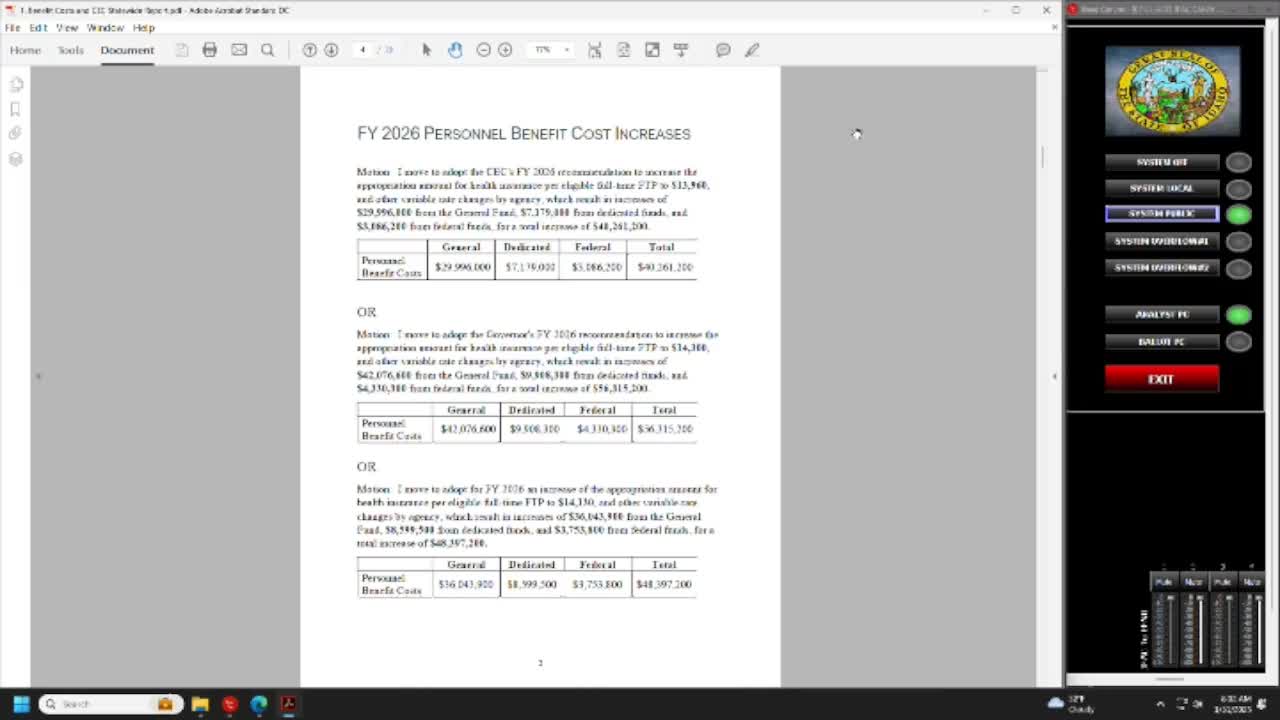
Analyst remarks and three options: Committee staffer Mr. Bybee presented three funding options on the committee packet and screen: the CEC committee recommendation at $13,960 per FTE, the governor’s recommendation at $14,300 per FTE, and a midpoint “Goldilocks” option at $14,130 per FTE. Bybee told members the largest driver of the personnel benefit cost increase was health insurance and that smaller employer‑paid adjustments (workers’ compensation, Social Security) were included in agency budgets.
Why it mattered: The choice affects the state insurance reserve balance and FY2026 spending. Bybee gave projected reserve balances tied to the three options: the $13,960 option projects an ending reserve of about $51.6 million for FY2026; the $14,300 option projects about $61.4 million; the midpoint $14,130 falls between those projections. Committee debate focused on whether to reflect the actuarial projections or reduce premiums using reserves.
Debate highlights: Representative Furness urged the committee to adopt the CEC recommendation ($13,960), arguing past actuarial projections from Milliman had been consistently conservative and that the state’s reserve balances have been larger than needed. Senator Ward Engelking urged members to “reflect the actual cost of insurance,” warning that using reserves to buy down premiums in one year can make future increases look larger. Senator Woodward moved the $14,130 option as a compromise; Representative Tanner seconded.
Vote and funding details: The motion to set the health‑insurance appropriation at $14,130 per eligible FTE passed. The motion text reported the fiscal impact as increases of $36,043,900 from the general fund, $8,599,500 from dedicated funds and $3,753,800 from federal funds, for a total increase of $48,397,200. The committee reported Senate votes 8 aye, 0 nay, 2 absent/excused; House votes 9 aye, 0 nay, 1 absent/excused; combined 17 ayes, 0 nays, 3 absent/excused. The committee stated the motion will carry a “do pass” recommendation.
Process note: Members discussed the joint voting procedure (majorities in each chamber within the joint quorum) while taking the vote. Ms. Figueroa, the roll‑call clerk, administered the roll calls and recorded changes in individual members’ votes during the recorded sequence.
The committee moved on to additional statewide personnel and CEC (change‑in‑employee‑compensation) items after the vote.