Get Full Government Meeting Transcripts, Videos, & Alerts Forever!
Get email alerts on the Education Flags In Schools topic
No spam. Unsubscribe anytime.
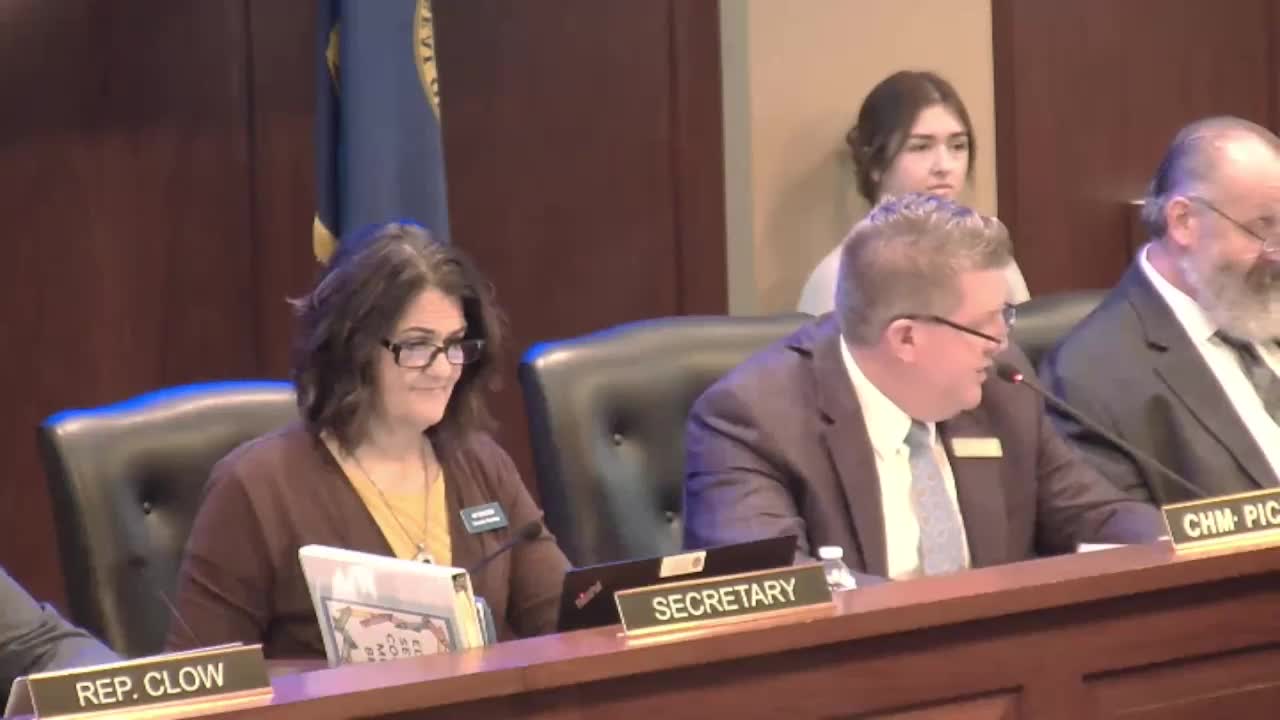
Idaho House Education Committee approves sending flag-display bill to floor after heated debate
Summary
House Bill 10, which would limit flags and banners displayed on public school property to U.S., Idaho and certain official flags, drew divided testimony over free speech, student safety and enforcement before the committee voted 12–2 to send the bill to the House floor with a do-pass recommendation.
BOISE — The Idaho House Education Committee voted 12–2 to send House Bill 10 to the House floor with a do-pass recommendation after more than an hour of debate and public testimony on whether schools should limit which flags and banners can be displayed on school property.
Representative Ted Hill, sponsor of the bill, told the committee: "The intent of this bill is to assure that the American flag and the state flag are the primary flags in the public school." He said the measure is intended to "bring the unity back" in classrooms by preventing what he called political or ideological distractions behind teachers or in school rooms.
Committee members and members of the public gave sharply divided testimony. Greg Wilson, chief of staff at the Idaho Department of Education, told the committee that "flags and banners are currently a local decision, so we do not have a formal process of recognition" and described two narrow examples the department recognizes: Purple Star School recognition for military-family support and the U.S. Department of Education's National Blue Ribbon Schools award. Several classroom teachers and students warned HB 10's wording is vague and could curtail expression and confuse enforcement in classrooms, online instruction and school property.
Opponents argued the bill's language is imprecise on several points: what counts as a "display," whether online classrooms or school parking lots are covered, and how local districts should treat banners used to recognize student achievement. "A person's sexual orientation, their race, or their gender are not political beliefs," testified Mary Tordell Larocque, who said the bill would bar teachers from displaying symbols that signal support to vulnerable students. Teacher Cassie Horner said restricting flags "would significantly harm the values of representation, inclusion and free expression" and urged lawmakers to oppose the bill.
Supporters said the bill merely affirms that the United States and Idaho flags should be preeminent in public schools. Edward Clark of the Idaho Family Policy Center argued the measure would encourage "healthy patriotism in children across the state." Substitute teacher Daniel Murphy testified he supports the bill and said teachers should "check their ideology at the door."
Committee members asked specific implementation questions that HB 10's text does not resolve. Representatives sought clarity on whether the prisoner-of-war (POW) banner would be allowed, whether private university or sports-team flags would be treated differently, and how the measure would apply to online classrooms and student vehicles on school property. Sponsor Hill replied several times that the bill targets banners and flags physically displayed in classrooms and that online content is not practicably controllable by the state, and he said the bill does not set civil or criminal penalties for violations.
Greg Wilson noted state-level recognition of flags and banners is limited: aside from nationally administered recognitions, most flags indicating achievement or service are determined locally. Representative Church and other members pointed to existing state law (the Dignity and Nondiscrimination Act enacted as part of 2021 legislation) and district policies, such as ones used by West Ada School District, as models for content-neutral display policies.
Two procedural motions were recorded. Representative Marmon moved to send HB 10 to the floor with a do-pass recommendation; Representative Brzezinski offered a substitute motion to send the bill to General Orders, which failed on a 5–9 vote. The committee then approved the original do-pass motion 12–2. Representative Marmon moved the first successful motion; the transcript does not record a second for the motion to the floor. The committee did not adopt penalties or a statewide enforcement mechanism in the bill text.
The committee-accepted record includes broad public testimony from students, teachers and policy advocates both for and against the bill. Committee members signaled differing next steps: some said the bill should proceed to the floor as introduced, others urged amendments or consideration as a resolution so the language could be refined. The House Education Committee adjourned at 10:30 a.m. after completing the vote.