Get Full Government Meeting Transcripts, Videos, & Alerts Forever!
Get email alerts on the Idaho State Police Budget Staffing topic
No spam. Unsubscribe anytime.
Idaho State Police request new troopers, fentanyl team and forensic staff as vacancies strain coverage
Summary
Director Colonel Bill Gardner and Legislative Services analyst Noah Peterson presented FY2026 requests including a 10‑member fentanyl unit, forensic staffing conversions, a $4.995 million HDA fund shift request and supplemental housing for remote troopers as committee members raised concerns about high vacancy rates and retention.
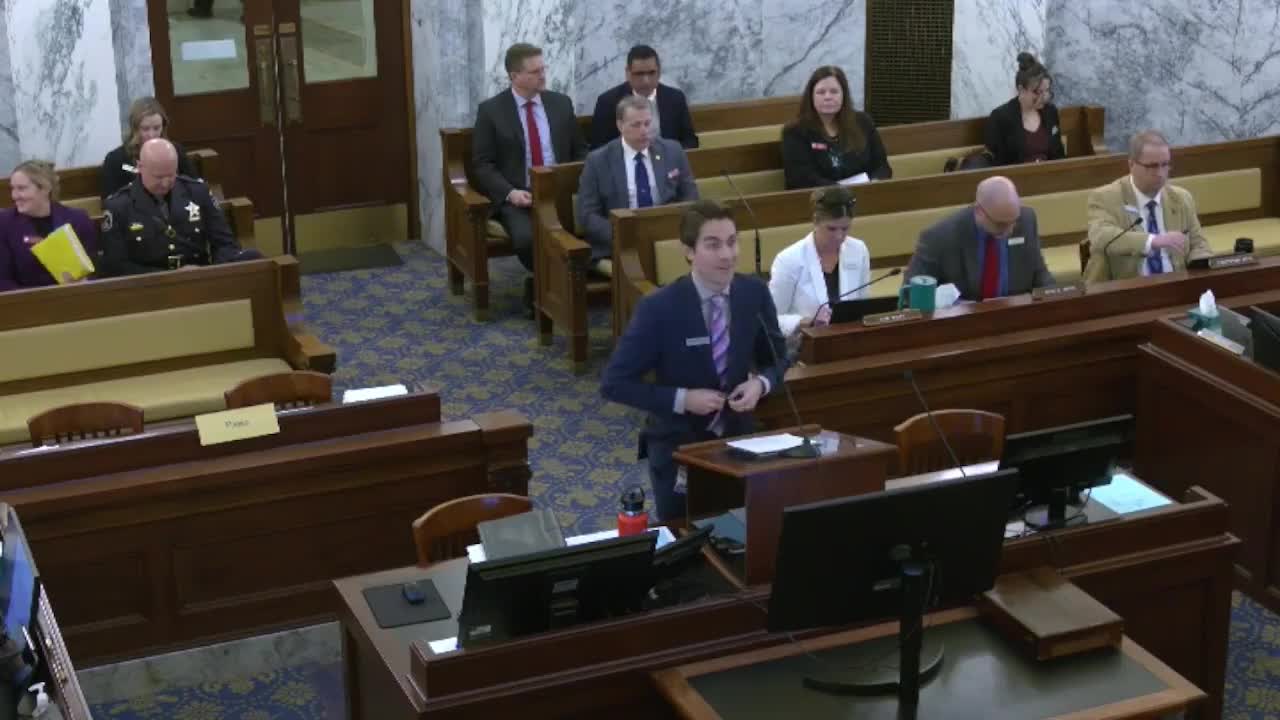
The Idaho State Police requested a range of budget enhancements for fiscal year 2026 and outlined ongoing staffing shortages during a Feb. 12 Joint Finance and Appropriations Committee hearing.
Colonel Bill Gardner, director of the Idaho State Police, and Noah Peterson, a budget policy analyst with the Legislative Services Office, presented the division’s requests and performance context. Peterson described multiple enhancement items and fund shifts; Gardner emphasized operational strain in regions with high vacancy rates and recounted recent large drug seizures tied to targeted interdiction efforts.
Major enhancement requests and items presented by Peterson included a "combat the use of fentanyl" enhancement that adds 10 FTP and $1,043,300 to create a dedicated interdiction unit; conversion of contract forensic scientists to full‑time staff; retention pay increases for forensic staff and dispatchers; and a requested transfer of $4,995,500 and 37.48 FTP tied to changes in the Highway Distribution Account (HDA) fund flows. Peterson said the HDA changes trace to Senate Bill 1201 of 2019 and earlier reductions to the law enforcement fund distribution that culminate in the 2026 shift request.
On investigative staffing, ISP requested a 4‑person Special Investigations Unit focused on Idaho Department of Correction facilities (1 detective sergeant and 3 detectives) at a total cost of $757,300 (approximately $443,300 ongoing for personnel and $314,000 one‑time for vehicles and computers). Peterson also described a request for a forensic deputy lab manager (1 FTP, $118,200) and an estimated $168,100 fiscal impact for proposed DNA collection legislation that would add misdemeanor offenses to the list requiring DNA collection (estimated at 1,681 samples at $100 each).
The agency proposed converting previously contracted retired investigators working on the sexual assault kit initiative (SACI) into permanent positions after finding contractors would not obtain necessary POST certification; Peterson described this as a net $0 transfer to personnel with 2 FTP and $402,100 moved from operating to personnel costs. ISP also requested an ongoing $233,000 appropriation from the Idaho Law Enforcement Telecommunications Fund for an ILETS disaster‑recovery site.
Peterson outlined an appropriation shift of $659,700 of federal funds to miscellaneous revenue because certain contracts are structured as non‑federal; he also said the agency requested $50,000 to comply with the federal Sex Offender Registration and Notification Act (SORNA/Adam Walsh Act).
On operational items, ISP requested 2 fleet service positions (converting contracted workers to employees) and said those positions would help clear a backlog of vehicle upfitting. Peterson also described replacement‑item requests for body armor, vehicles and IT equipment, and a supplemental request of $268,100 for remote housing — originally planned for Mackay and later shifted to Fairfield when ISP said the Transportation Department’s property and utilities made Fairfield more feasible.
Governor’s recommendations and fund notes: Peterson said the governor recommended a one‑time $500,000 Millennium Fund appropriation for a public communication effort described as the "fentanyl takes all" campaign; DFM Administrator Lori Wolf later confirmed the governor’s recommendation is one‑time. The governor’s recommendation also modified the OITS modernization plan, moving 16 (not the original 20) IT positions from ISP to the Office of Information Technology Services (OITS) with a net operating‑expenditure increase.
Committee members pressed ISP officials on staffing and retention. Colonel Gardner cited recruitment and retention problems, particularly in Northern Idaho, and told the committee, "we've seized over 65,000 fentanyl pills, over a full pound of fentanyl powder, [and] 150 pounds of methamphetamine from this specific team," describing recent enforcement results tied to concentration patrols. Gardner said vacancy rates vary by region and that some districts are operating at far less than their authorized trooper counts; he said the agency has resorted to temporarily reassigning troopers from other districts to cover shortages.
Christine Otto, ISP chief financial officer, told the committee the conversion of SACI investigators to full‑time employees is not intended to increase spending materially but is aimed at enabling POST certification and the duties those employees must perform. Otto also said billing timing and multi‑year revenue receipts have affected federal expenditure timing in some grants.
Several legislators said they would pursue further pay and retention proposals after hearing testimony. Senator Woodward warned that population growth has outpaced patrol staffing and indicated she will bring a proposal that goes "more than what the Governor's recommendation is" to address pay competitiveness. Representative Manwaring and others asked about administrative subpoena authority for financial investigations to follow money in complex drug and human‑trafficking cases; Colonel Gardner identified limited subpoena authority as a tactical limitation in complex financial investigations.
No formal committee action on the ISP requests was recorded during the hearing; agency requests were presented and discussed for committee consideration in the budget process.
"We have to get this trend turned around," a committee member said after hearing the staffing data. "I don't expect to solve it in one legislative session, but we have to get this trend turned around."