Get Full Government Meeting Transcripts, Videos, & Alerts Forever!
Get email alerts on the Mask Mandates topic
No spam. Unsubscribe anytime.
House State Affairs advances bill to bar government mask mandates; committee sends House Bill 32 to House floor 13-2
Summary
The Idaho House State Affairs Committee voted 13-2 to send House Bill 32 to the full House with a due-pass recommendation; the bill would bar government officials from requiring masks to prevent viral transmission while exempting some vocational safety uses.
The Idaho House State Affairs Committee voted 13-2 to send House Bill 32 to the full House with a due-pass recommendation after a two-hour hearing that included legislative questions and nearly two dozen members of the public.
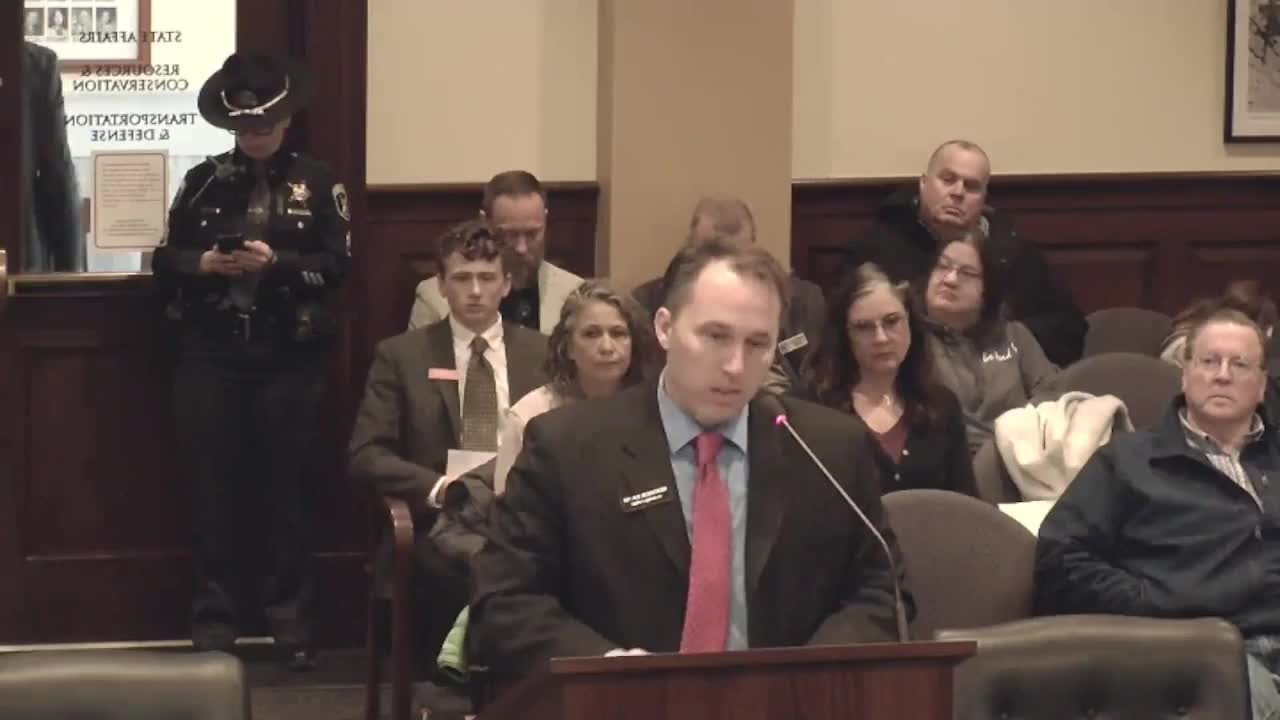
"House Bill 32 prohibits any government official from requiring people to wear a mask for the purpose of preventing virus transmission," said Representative Rob Bieswanger, R.-District 8, who sponsored the bill. "This bill does not cost the taxpayers a single penny. Second, it expands the amount of freedom all the Idahoans get." Bieswanger said the bill includes exemptions for people who must wear masks as an integral, compulsory safety component of their job.
Supporters mainly framed the bill as protecting individual liberty and preventing what they described as excessive fines or criminal penalties imposed under local mask orders during 2020–21. Fred Birnbaum of the Idaho Freedom Foundation said the bill was needed to prevent future political uses of mask policy and cited the bill's exemption language. Several members of the public described personal hardship tied to enforcement of local mask rules; Yvonne Saint Cyr said she faced jail time in a local case related to a mask protest and told the committee she had recently been pardoned.
Opponents, led by Kelly Packer, executive director of the Association of Idaho Cities, said the bill would unduly restrict local elected officials' authority to respond to fast-changing public-health emergencies. "You are blocking elected officials' authority to make decisions, informed decisions down the road on things we may not have any idea about," Packer told the committee, urging that local governments be allowed to act on public-health guidance as situations arise.
Technical and medical witnesses offered contrasting views. Dr. Brandon Couchman, a licensed chiropractor and former paramedic who worked in occupational health roles, described fit testing and occupational requirements under NIOSH/OSHA and said improper mask use can cause harm if not managed correctly. Other witnesses, including Leslie Manoukian of Health Freedom Defense Fund and Matt Edwards, offered legal and scientific arguments against mask mandates; Heather Stout testified she opposed the bill and said her immunocompromised family member suffered severe COVID-19 and relied on masks and layering of protections.
Committee members sought clarification on the bill's scope and exemptions. Representative Mickelson pressed whether the bill would interfere with requirements for food-processing inspectors and whether the statutory exemption language clearly covered occupational food-safety requirements; the sponsor and others pointed to the bill text's exemption clause on page 2 that limits exemptions to roles where masks are an "integral and compulsory safety component" of job duties. Members also asked about penalties and the risk of neighbor-driven whistleblowing; the sponsor said the attorney general would play a role in enforcement and that the bill's whistleblower/penalty provisions would be addressed in a full hearing.
The procedural action: Representative Scott moved that the committee send House Bill 32 to the floor with a due-pass recommendation. The committee held a roll-call vote: Chairman Crane — Yes; Representatives Scott, Palmer, Barbieri, Holtzclaw, Skog, Alfieri, Crane 12, Boyle, Deigert, Hostetler, Mickelson, and Pohanka — Yes; Representatives Achilles and Daugherty — No. The motion passed 13 to 2.
Ending: The bill moves to the full House for further consideration; committee members requested clause-by-clause review of exemptions, enforcement language and interplay with public-health districts and OSHA/NIOSH workplace requirements before a final vote.