Grundy County leaders, residents press legislature for local authority over biosolids; committee keeps bill alive
Loading...
Summary
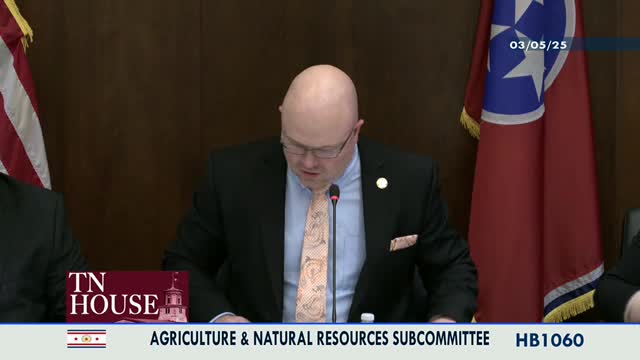
Nashville — Members of the Tennessee House Natural, Agriculture and Natural Resources Subcommittee heard more than an hour of testimony March 5 about treated sewage sludge (biosolids) being land‑applied in Grundy County, with local officials and residents urging authority to regulate or limit spreading locally and state officials describing existing oversight and enforcement options.
Nashville — Members of the Tennessee House Natural, Agriculture and Natural Resources Subcommittee heard more than an hour of testimony March 5 about treated sewage sludge (biosolids) being land‑applied in Grundy County, with local officials and residents urging authority to regulate or limit spreading locally and state officials describing existing oversight and enforcement options.
Mayor Michael Bridal of Grundy County told the committee the county is receiving Class B biosolids from a Chattanooga plant and described odors and alleged environmental effects. “Class b only has a little bit of lime added to it and the raw product … There's 2,900 PFOS, and they they are known to cause cancer and also they are forever chemicals,” Bridal said, adding that residents have reported fish kills and that some loads appeared overapplied or spilled near creeks and wells.
Why it matters: witnesses and committee members said the issue raises public‑health and environmental concerns (PFAS/PFOS were named repeatedly in testimony), potential impacts on tourism and local economies, and questions about whether local governments should be able to regulate the practice when the state permits biosolids land application.
What witnesses told the committee - Mayor Michael Bridal, who identified himself as a three‑term mayor of Grundy County, described multiple local incidents he said involved strong odors, trucks discharging near streams and fish kills in ponds. He said local officials have asked for authority to ensure “it's safe for the citizens of Grundy County.” - Michelle Russell, a resident who spoke with Bridal, said the practice has divided farming communities and caused local disputes. - Kevin Hensley, director of public policy at the Tennessee Farm Bureau, said farmers use biosolids as a cost‑effective fertilizer and warned the legislation as drafted could be unconstitutional because state law already limits local regulation of agricultural practices. He also urged use of “best science” on PFAS and said TDEC and EPA currently regulate biosolids.
TDEC and enforcement John Newberry of the Tennessee Department of Environment and Conservation (TDEC) told the committee TDEC has issued notice‑of‑violation (NOV) letters to the Chattanooga utility in recent years and has required corrective actions after complaint investigations. “There have been notice of violation letters sent over the last few years to the city of Chattanooga,” Newberry said. He acknowledged TDEC needs to improve inspection frequency and said the agency can pursue enforceable orders that include financial penalties, though it had not assessed such penalties against the Chattanooga utility at the time of testimony.
Committee members pressed TDEC on the frequency of inspections, the type of violations found (including at least one spill to a roadway), and whether EPA was involved. TDEC staff said the department is working on reworking its general permit and is considering adding an annual PFAS sampling requirement for land‑applied biosolids.
Points of disagreement and legal context Farm Bureau testimony emphasized that biosolids land application is an agricultural practice subject to state regulation and warned a county‑by‑county approach could conflict with state law. Several committee members and speakers argued poorer, rural counties should not be treated as disposal sites and said local governments should have options to protect residents when they perceive repeated local harms.
Committee action and next steps The subcommittee considered House Bill 1122 (sponsored by Representative Bricken), a measure described by its sponsor as specific to Grundy County and intended to give the county legislative body authority over acceptance or spreading of biomass/biosolids within county boundaries. The committee placed an amendment on the bill, heard public testimony on the amended measure and, after discussion, voted to keep the bill alive and move it to the March 26 calendar for further consideration. “Considering your desire to keep this alive, I would move this to the March 26 calendar,” Representative Bricken said.
The committee asked TDEC to increase responsiveness to citizen complaints and agreed members would follow up with the agency. TDEC officials said they will pursue more inspections and committed to reviewing permit oversight in the region.
What’s next: The committee left HB1122 on the March 26 calendar for further consideration; TDEC staff said they will pursue increased inspections and are working on permit changes that could add PFAS sampling requirements.
Sources: testimony and answers on the record March 5 before the House Natural, Agriculture and Natural Resources Subcommittee. Direct quotes are from Mayor Michael Bridal (Grundy County), Kevin Hensley (Tennessee Farm Bureau), John Newberry (TDEC) and Representative Bricken (bill sponsor).