Get Full Government Meeting Transcripts, Videos, & Alerts Forever!
Get email alerts on the Workers Compensation topic
No spam. Unsubscribe anytime.
Committee backs 5-year pilot letting certain special districts leave State Insurance Fund
Summary
An Idaho House committee voted to send House Bill 160 to the floor with a do-pass recommendation, approving a five-year pilot that would allow some small special districts to seek private workers' compensation coverage instead of participating in the State Insurance Fund.
An Idaho House committee voted to send House Bill 160 to the floor with a do-pass recommendation after hearing from the bill’s sponsor about a five-year pilot allowing certain small special districts to obtain workers' compensation coverage outside the State Insurance Fund.
Representative Josh Tanner, a state representative from District 14, told the committee the State Insurance Fund serves both private and public employers and was created decades ago to protect cities, counties and special districts from insurer failures. "Back in the day, there was a lot of shady businesses that had come around," Tanner said, arguing that stronger federal reserve and regulatory requirements for private insurers have reduced that risk.
Tanner said the bill would let a limited set of smaller specialty districts — excluding school districts — opt out of the State Insurance Fund and purchase coverage on the open market for a five-year term that would allow the Legislature to review outcomes. He said some private market firms specialize in niche pools, such as fire districts, and that those firms can produce lower rates and targeted loss-control services. "We actually were getting a better overall rate," Tanner said of the private-market quotes his office reviewed.
Tanner described examples offered by private underwriters, including focused safety and physical-therapy programs that, he said, sped return-to-work times for firefighters and improved experience modifiers. He also said the bill preserves an option for districts that prefer to remain in the State Insurance Fund and noted the existing alternative route to leave the fund — a bond arrangement processed through the state treasurer — remains available under current law.
A committee member asked how smaller single districts could find better rates outside a larger pooled fund. Tanner answered that some private insurers operate national or multi-state pools specific to fire and emergency services, giving them large risk pools despite representing small individual districts.
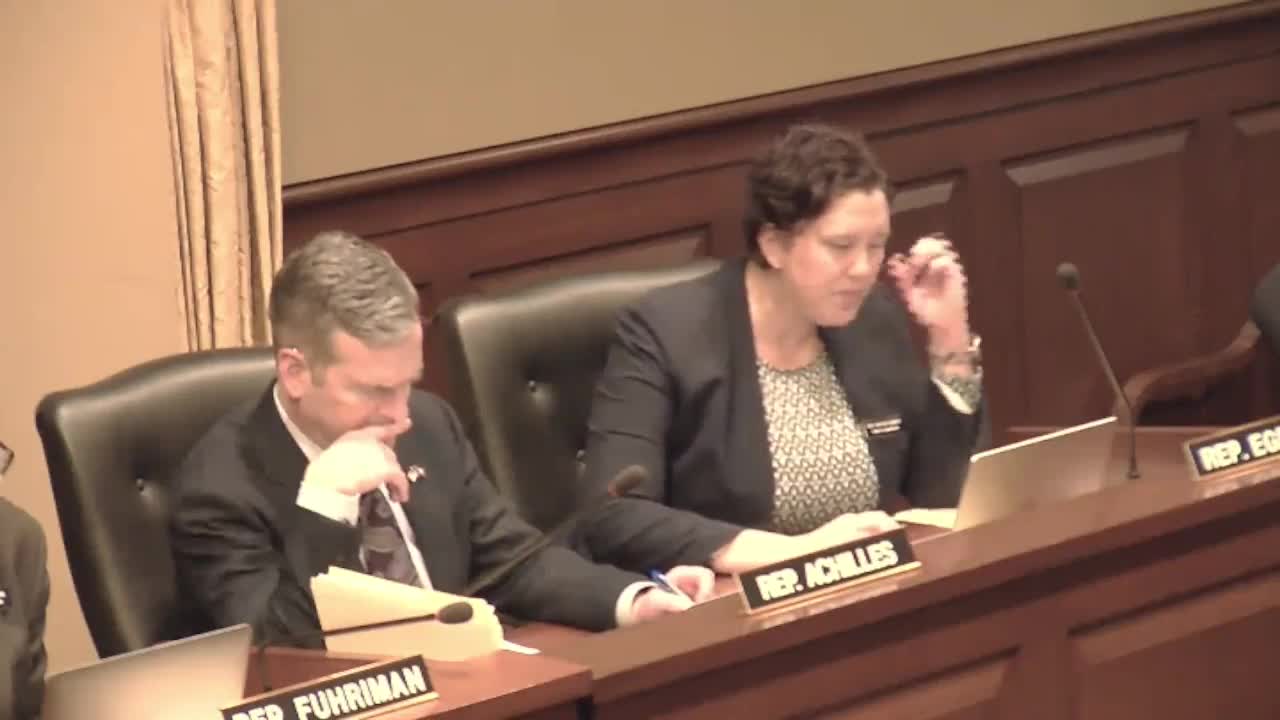
Representative Weber, who declared a conflict of interest role on the State Insurance Fund board, moved to send House Bill 160 to the floor with a do-pass recommendation. The committee approved the motion by voice vote; no roll-call tally was recorded.
The committee also accepted the minutes of its Feb. 5 meeting on a voice vote after Representative Egwig moved their approval.
The meeting concluded with a brief ceremonial recognition of page Lincoln Hendricks and an adjournment.