Get Full Government Meeting Transcripts, Videos, & Alerts Forever!
Get email alerts on the Workers Compensation Testing topic
No spam. Unsubscribe anytime.
Idaho House committee holds bill that would bar observers, recordings of standardized psychological testing in workers' compensation exams
Summary
An Idaho House committee voted to hold House Bill 115 after testimony split lawmakers and witnesses over whether attorneys or other third parties may observe or audio/video-record the standardized testing portion of psychological and neuropsychological independent medical exams in workers' compensation cases.
An Idaho House committee voted to hold House Bill 115 in committee after extended testimony on whether attorneys or other third parties should be allowed to observe or record the standardized testing portion of psychological and neuropsychological independent medical evaluations (IMEs) in workers' compensation cases.
The proposal, introduced by Representative Ben Furman, would amend Idaho Code Section 72-4-33 to restrict third‑party observation and audio/video recording during the standardized testing portion of such IMEs while still allowing other remedies and review mechanisms after testing is complete.
Supporters, including Dr. Joseph Black, a psychologist who conducts IMEs, said third‑party observation and recordings can change how examinees respond and compromise test validity. "The presence of third‑party observation, including recording, actually materially affects the validity of those results in unreliable ways," Dr. Black told the committee, adding that recorded or observed testing can change "processing speed" and other measures central to diagnosing traumatic brain injury and PTSD. He used a blood‑draw analogy to stress test security and data integrity: contaminating a sample at collection undermines the usefulness of the data.
Opponents — including attorneys who represent injured workers — said recordings or the presence of an observer are necessary for transparency in an adversarial process and to give claimants' counsel evidence to test examiners' procedures. "The only way you know whether that's a valid subjective evaluation is if it's recorded," Kurt Holzer, speaking for the Idaho Trial Lawyers Association, told the committee. Attorney Evan Mortimer, who represents claimants, asked, "What are they trying to hide?" and urged lawmakers to preserve recordings or observation so counsel can challenge testing protocols.
Mark Peterson, an attorney who represents employers and carriers and a member of the Industrial Commission advisory board, said the recording/observer tactic has appeared only recently and can be used strategically to prevent employer‑arranged testing from proceeding. "If a claimant's counsel insists on recording or observing the testing portion, the examination just couldn't go forward and the Industrial Commission wouldn't have the benefit of that testing," Peterson testified.
Other witnesses and insurers' representatives — including Chris Wagner of Intermountain Claims — supported the bill, saying test security and valid diagnosis benefit injured workers and that allowing recordings has caused scheduling delays and other problems.
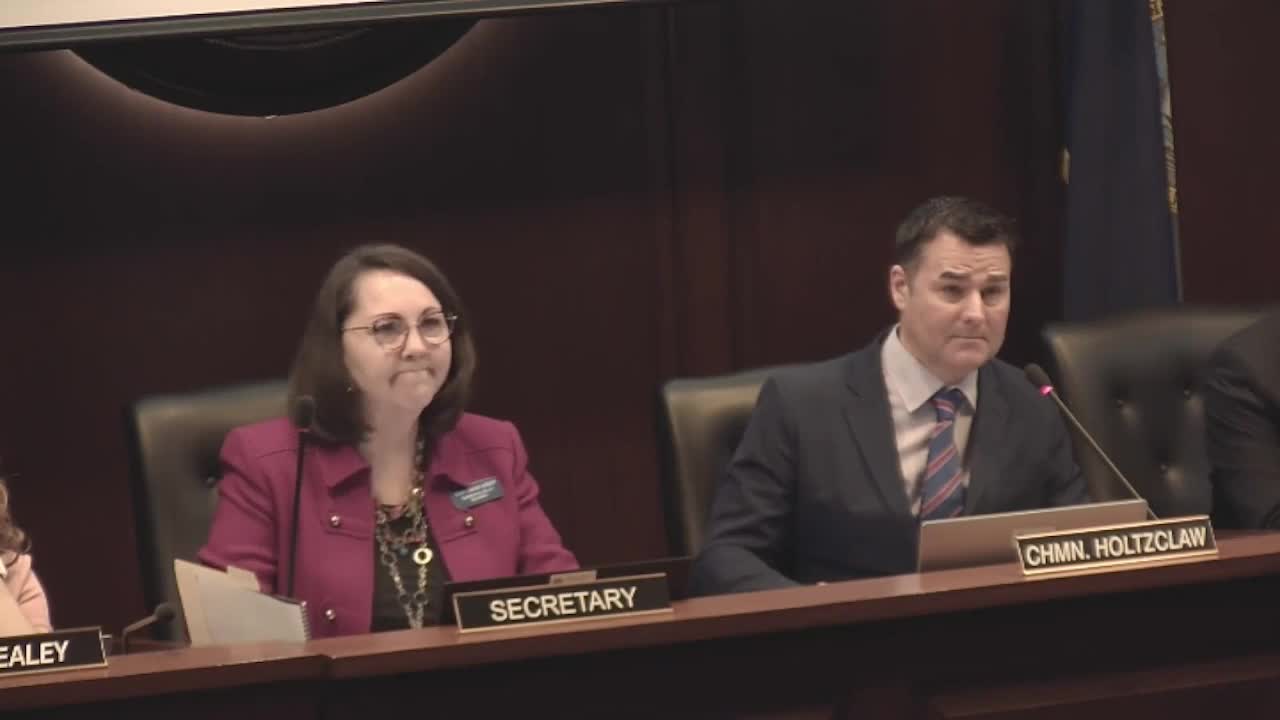
Committee members debated competing priorities: protecting standardized test administration and test security versus ensuring transparency and due process in contested cases. Representative Vishniewski offered a motion to hold the bill in committee; the committee approved that motion on a roll call vote, 11‑4. Lawmakers who voted yes included Chairman Holtzclaw, Representative Vishniewski, Representative Weber, Representative McCann, Representative Beissinger, Representative Bruce, Representative Burgoyne, Representative Leavitt, Representative Tanner, Representative Egbert and Representative Akiles. Lawmakers voting no included Representative Cheatham, Representative Healy, Representative Kaler and Representative Furman.
The committee also approved meeting minutes from Feb. 11, 2025 by voice vote earlier in the session.
Clarifying details recorded during testimony: Dr. Black said independent review is possible after testing by retaining another expert — that expert review is typically paid by the retaining party and, he estimated, costs roughly one‑third to 40 percent of what an original IME would cost. The bill's text as discussed focused narrowly on the standardized testing portion and did not propose banning counsel attendance for the interview/history portions of IMEs.
The bill is held in committee; proponents and opponents signaled they expect more debate if the committee reopens the measure.