Get Full Government Meeting Transcripts, Videos, & Alerts Forever!
Get email alerts on the Health Insurance Reserve topic
No spam. Unsubscribe anytime.
Lawmakers debate health-insurance base and reserve risk; two competing increases fail to win bicameral majorities
Summary
JFAC debated two competing recommendations for the state employee health-insurance base ($13,960 recommended by CEC vs. $14,300 from the governor). Members raised concerns about reserve levels, contractual minimums and potential risk charges; neither motion cleared both delegations.
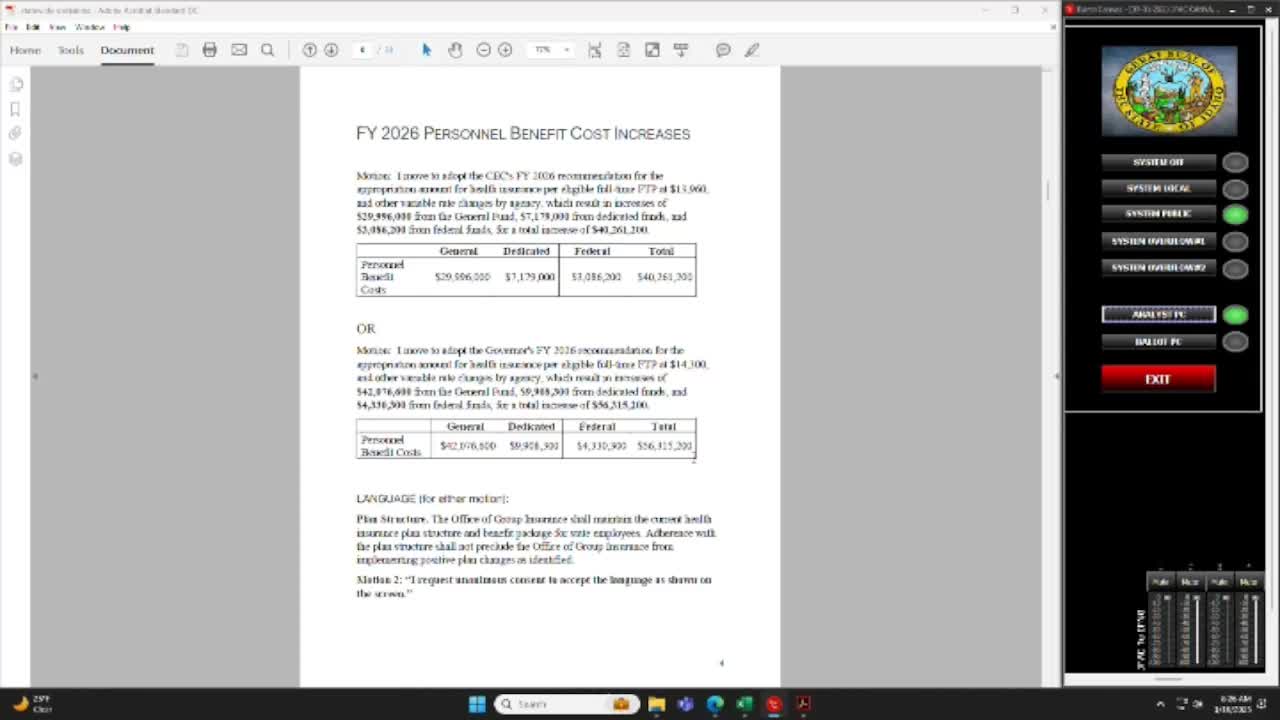
Committee analysts presented two competing recommendations for the health-insurance base used in agency budgets for FY2026. Keith Bybee described the options: the Economic Outlook and Revenue Assessment (CEC) committee recommendation of $13,960 per eligible full-time position (FTP) and the governor's recommendation of $14,300 per eligible FTP. Both were framed as changes to the health-insurance per-employee base and accompanied by variable benefit adjustments by agency.
Analysts and administrators warned of reserve implications. Bybee summarized the actuary's projections: "With the CEC recommendation of changing that to 13,960, it would pull the reserve balance down to, effectively, the statutory minimum of 10% of the total plan amount... That reserve balance would be at $51,600,000." He said the governor's $14,300 option would leave roughly $10,000,000 more cushion in the contingency reserve (projected to be $61,400,000).
Laurie Wolf, administrator for the Division of Financial Management, said the 10% contingency is a contractual floor and noted the actuary's modeling reflects a roughly 50% chance of meeting that floor under some scenarios. "It is actually, a contractual obligation that we stay within that 10% minimum," Wolf said.
Faith Knowlton of the Office of Group Insurance told the committee: "If we fall below the 10% contingency reserve, then a risk charge can be assessed to the state." Both Wolf and Knowlton described that the risk charge would depend on how far below the contingency the plan fell and that modeling provides percentile scenarios the state may consider.
Committee members debated trade-offs: some argued the lower CEC number would reduce premiums and draw down the reserve to a still-adequate level; others preferred the governor's higher base to preserve a larger contingency and reduce the chance of an assessed risk charge or the need for a larger increase next year.
On procedure, Representative Miller moved to adopt the governor's recommendation (base $14,300); Representative Furness offered a substitute to adopt the CEC recommendation ($13,960). The substitute motion failed to reach a majority of both delegations (grand total 9 ayes, 11 nays). The committee then voted on the governor's motion, but that motion likewise did not secure the necessary majority from both the House and Senate delegations in JFAC and therefore failed to advance. No change to the health-insurance base was adopted at this meeting.
Why it matters: The chosen base affects agency personnel costs and the contingency balance for the state health plan. A lower base reduces immediate premium costs but reduces reserve cushion; a base set too low risks contractual consequences and possible future larger adjustments.
Key numbers cited by analysts: - Projected total plan cost for FY2026: about $482,000,000 (actuarial projection presented by analysts). - Projected contingency reserve if CEC ($13,960) adopted: approximately $51,600,000 (about 10% of plan amount). - Projected contingency reserve if governor ($14,300) adopted: approximately $61,400,000 (about $10,000,000 more cushion).
Direct quotes: - Keith Bybee: "With the CEC recommendation of changing that to 13,960, it would pull the reserve balance down to, effectively, the statutory minimum of 10%..." - Laurie Wolf (Division of Financial Management): "It is actually, a contractual obligation that we stay within that 10% minimum." - Faith Knowlton (Office of Group Insurance): "If we fall below the 10% contingency reserve, then a risk charge can be assessed to the state."