Get Full Government Meeting Transcripts, Videos, & Alerts Forever!
Get email alerts on the General Fund Cuts topic
No spam. Unsubscribe anytime.
King County leaders warn steep general-fund cuts would slash prosecutions, patrols and human services
Summary
County leaders told the Council's Budget and Fiscal Management Committee that planned biennial general‑fund reductions — modeled at $150 million and possibly higher — would force program eliminations and staff cuts across prosecuting, sheriff, human services and local services operations.
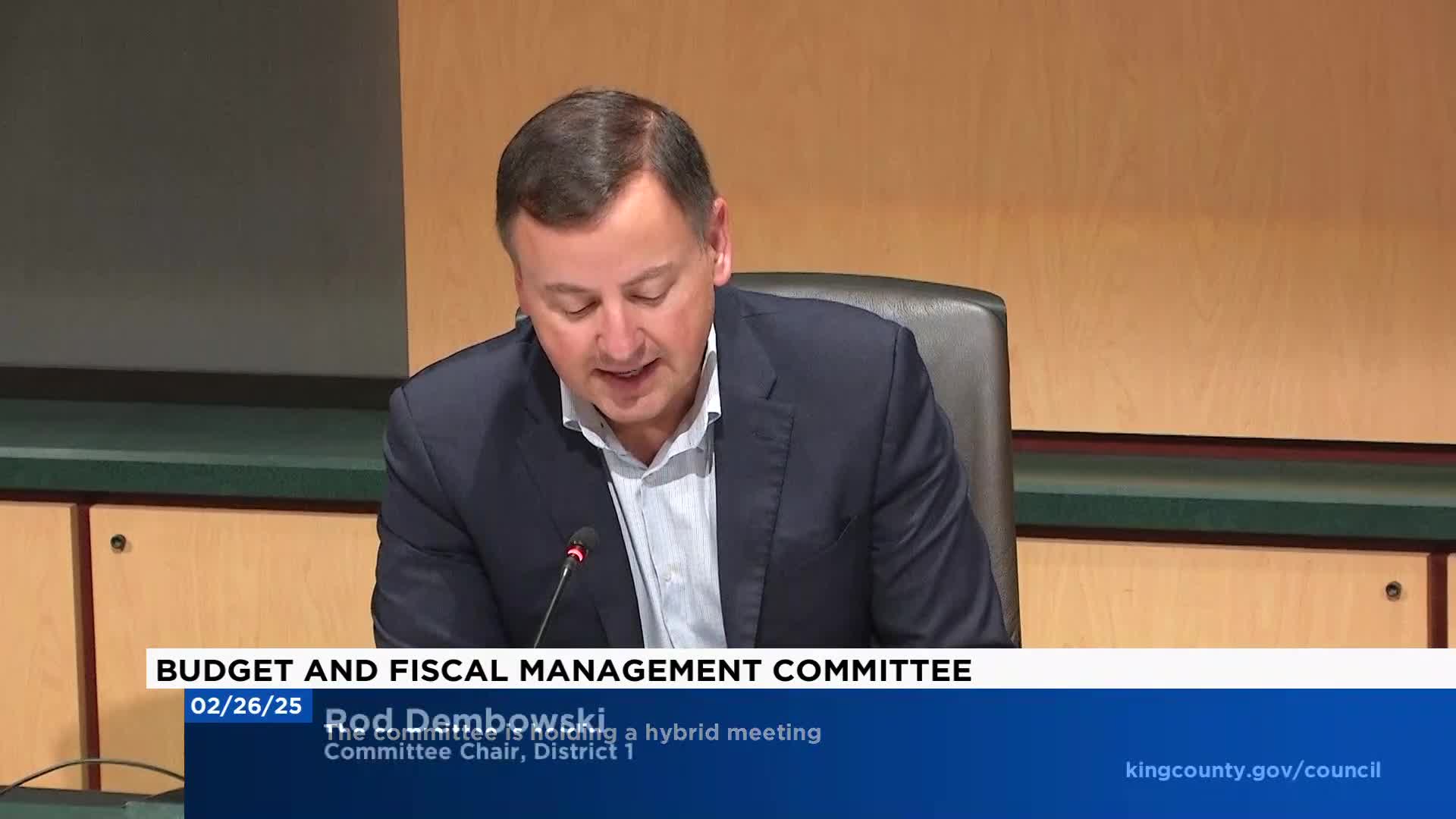
Councilmember Rod Dembowski, chair of the Metropolitan King County Council Budget and Fiscal Management Committee, opened a briefing on Feb. 26 to examine what large general‑fund cuts would mean for county operations and residents.
Prosecuting Attorney Leesa Manion said a $15.5 million reduction to the King County Prosecuting Attorney's Office (PAO) would remove the equivalent of about 90 deputy prosecuting attorneys and sharply reduce the office's ability to file and pursue cases. "This is what a $15,000,000 budget cut to the PAO means to the residents of King County," Manion said, adding that the office currently has 150 criminal deputy prosecuting attorneys who review roughly 10,500 referrals a year and file about 5,500 adult felony cases annually. Manion warned that lower‑priority property and retail theft cases could be deprioritized, victims could go unserved and early‑intervention diversion programs for youth could be lost.
King County Sheriff Patti Cole‑Tindall told the committee that a proposed $30.2 million reduction would be devastating to patrol and investigative capacity. She said the board of options the sheriff's office is considering would shift roughly half of existing deputies into revenue‑backed contracts with Sound Transit, Metro and several contract cities — increasing staffing in those contract jurisdictions while leaving unincorporated areas with far fewer deputies. "There will be about half the number of deputies serving unincorporated communities," Cole‑Tindall said, and emergency response times for life‑threatening calls could lengthen; some non‑life‑threatening calls might not receive any in‑person response. She listed likely cuts to major crimes investigations, domestic‑violence follow‑up, traffic enforcement and voluntary programs such as storefront deputies in Skyway and White Center, search and rescue, and air support.
Kelly Ryder, director of the Department of Community and Human Services (DCHS), said the department currently receives less than 1% of its revenue from the county general fund because local levies and other sources now make up the bulk of funding. Ryder said a proposed elimination of $25.2 million in general‑fund transfers would require cutting 13 programs and about 15 positions, and would put programs such as the Restorative Community Pathways initiative — which the department says has served more than 1,600 individuals — at risk. Ryder described an organizational approach to cuts that favors targeted program sunsetting rather than across‑the‑board reductions to preserve workforce and provider capacity.
Leon Richardson, director of the Department of Local Services, said code enforcement is entirely general‑fund supported and that staff reductions would sharply limit the county's ability to respond to complaints across the 1,700‑square‑mile unincorporated area. He said the department is funded for nine code enforcement officers (including three positions added for 2025), down from six officers in 2024 who managed roughly 317 active cases and 791 complaints filed that year. Richardson also said the county's participatory budgeting program — which has invested about $23 million and funded more than 80 community initiatives — could be narrowed or eliminated.
Committee members pressed the panel on details and communications strategy for state lawmakers. Vice Chair Barone, Councilmembers Balducci, Mosqueda, Quinn and Perry all asked for written materials the council can take to Olympia and for clearer local‑level impact analyses (for example, what specific neighborhoods would see reductions in patrol, or how many cases would no longer be pursued). Dembowski urged coordination with the county's legislative team and mentioned House Bill 2015 — a proposal to allow a one‑tenth cent local sales tax increase — as one option that, if adopted and used by the council, could substantially reduce or eliminate many of the cuts the panel described.
Committee members and department leaders emphasized the scale of the problem. Dembowski summarized the fiscal picture presented by the Office of Performance, Strategy and Budget: a $150 million biennial shortfall is a conservative floor and further pressures — including potential state court decisions on public‑defense standards and public health clinic funding gaps — could increase the total shortfall well beyond that figure. The briefing closed with a commitment from departments to supply deeper, district‑level and program‑level details to help the council and its legislative delegation make the case for additional state or local revenue.
Ending: The panel provided written materials and the committee scheduled follow‑up work with the executive and legislative staff to assemble options and public messaging before the executive's September budget proposal and the council's adoption timeline later in the year.