Get Full Government Meeting Transcripts, Videos, & Alerts Forever!
Get email alerts on the K 12 Education Superintendent Priorities topic
No spam. Unsubscribe anytime.
Idaho superintendent urges return to basics, highlights reading gains and career-technical grants
Summary
Idaho State Superintendent Debbie Critchfield told the House Education Committee on Jan. 23 that the Department of Education’s top priorities are early reading (phonics), essential math standards, career-technical education expansion and teacher preparation; she cited an 8% gain in third-grade reading proficiency and described $65 million in grants for career-technical programs.
Idaho State Superintendent Debbie Critchfield told the House Education Committee on Jan. 23 that the state’s education priorities should focus on foundational skills, preparation for careers and stronger teacher training.
Critchfield said she wants “to get back to basics,” placing particular emphasis on early reading skills taught through phonics and on ensuring students are at grade level in math. She told the committee that Idaho has seen 8% growth in third-grade reading proficiency over the past two years and that the state tests all K–3 students with the Idaho Reading Indicator (IRI).
Why it matters: Critchfield said early reading and math proficiency are the building blocks for future learning and for students to be prepared for work or postsecondary education. She framed the department’s work as supporting locally elected school boards and local educators while modernizing state funding to better reflect student needs.
Critchfield described four central goals: (1) strengthen early reading and reading comprehension by emphasizing phonics and the “science of reading,” (2) define and promote essential math standards so core building-block skills are taught consistently, (3) increase career and technical education opportunities so diplomas connect to locally relevant jobs, and (4) improve teacher preparation and mentoring to reduce turnover.
Reading and math: The superintendent said phonics is the “number one input for successful reading” and that Idaho’s IRI results, which cover roughly 86,000 students who took the test last year, show statewide third-grade proficiency near 70% (she said re-referencing of the norm-referenced test would have put a comparable figure nearer 75%). Critchfield added that the department is moving from a norm-referenced reading measure to a criterion-referenced vendor so that performance can be compared year to year without resetting the bar every five years.
Career-technical education and grants: Critchfield described an Idaho Career Ready Students Grant program that she said has totaled $65,000,000 over the past two years and awarded 224 grants aimed at expanding or creating high-demand CTE programs tied to local employers. She provided examples: five forestry CTE programs in Potlatch, Orofino, Sandpoint, St. Maries and Priest River; an agricultural drone program at Shelley High School; a meat-science class in New Plymouth; and a food-science/culinary lab in Hagerman. She said the department expects local industry and the University of Idaho to partner on curriculum and funding.
Teacher preparation and mentoring: Critchfield told lawmakers the department is preparing recommendations for the State Board of Education to strengthen teacher-preparation standards at colleges and to expand mentoring for new teachers. She said classroom management and behavior supports are the most commonly cited gaps from new teachers and noted research suggesting teacher retention improves after a successful third year with mentoring supports.
Budget and funding changes: The superintendent said the department will propose changes to align part of the public-schools budget to student characteristics rather than outdated line items. She said the total public-schools appropriation is about $2,650,000,000 and that the department proposes to reallocate roughly $433,000,000 of that funding to better reflect the types of students districts serve (for example, special-education or high-need students). She also noted a previous supplemental appropriation of $300,000,000 from the state surplus and that some educators had not been aware that $165,000,000 of appropriated funds were distributed to districts.
Federal issues and legal obligations: Asked about potential changes at the U.S. Department of Education, Critchfield said Idaho remains subject to federal requirements for special education, homeless students and Title IX regardless of whether the federal office’s structure changes. She said the department is preparing guidance for districts about federal law and recent executive actions and that she has joined other state education chiefs in asking for conversations with the incoming federal leadership.
Discipline, behavioral health and local control: Committee members questioned whether schools are being asked to take on social and behavioral roles. Critchfield said local school boards set material and policy decisions and that parents and boards are the first level of accountability. On student discipline, she said Idaho code gives districts latitude on policy and added that the department provides guidance to help teachers control classrooms and protect students without fear of excessive legal risk. She also said statewide data specifically tracking suspensions and expulsions are not reported to her office.
Communications and graduation requirements: Critchfield said the department is discussing whether communication standards should be satisfied across content areas rather than as a single required course, a change intended to broaden student exposure to public speaking and communication in math, science and other classes while preserving speech-and-debate courses where districts choose to keep them.
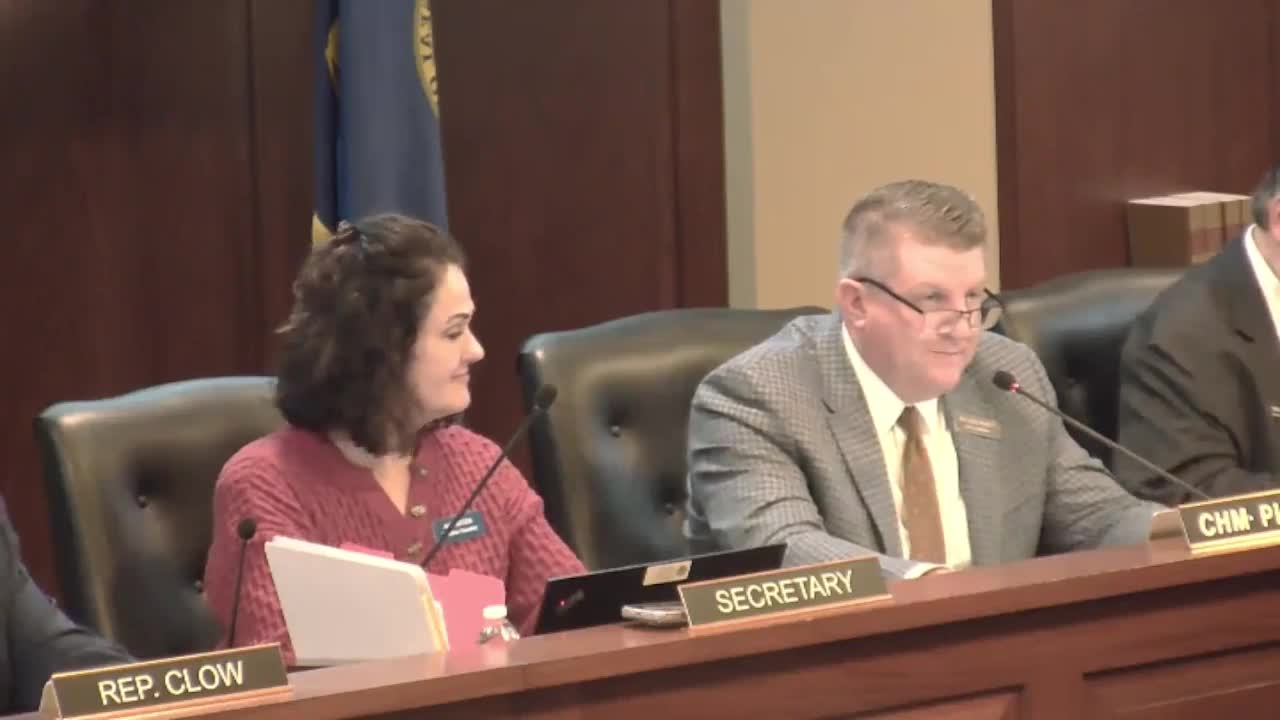
What the committee did: Critchfield answered questions from committee members, including Representatives Clow, Garner, Harris, Hawkins, Tanner, Mathias, Ehart and Nelson; the committee did not take formal action on her presentation but asked for follow-up on several data points.
Looking ahead: Critchfield said the department will present rule-making and statutory proposals in coming months on standards, teacher-preparation recommendations and the budget modernization proposal. She said she will provide additional data on the impact of optional testing exemptions and on how much the removal of non-English learners from some IRI cohorts contributed to observed gains.
Ending note: "We're making great progress in our reading around the state," Critchfield told the committee, and she asked lawmakers to consider aligning resources and policy to support local boards and teachers as the department pursues the priorities she outlined.