Get Full Government Meeting Transcripts, Videos, & Alerts Forever!
Get email alerts on the State Public Defender topic
No spam. Unsubscribe anytime.
New Idaho State Public Defender office seeks millions to cover transcript, contract and personnel costs
Summary
The newly established State Public Defender office outlined multiple supplemental and ongoing funding requests at the JFAC hearing, including use of a $39 million cash transfer into a dedicated state public defense fund, requests for supplemental transcript and contract funding, and staff additions and county onboarding costs.
The Office of the State Public Defender outlined multiple supplemental and ongoing budget requests during a Joint Finance‑Appropriations Committee hearing, asking lawmakers to provide authority to spend a large cash transfer, pay transcript costs after a state high‑court ruling and fund additional staff and contract rates as the new agency absorbs counties.
Christopher Lahoset, budget and policy analyst with the Legislative Services Office, said the office is a newly created agency under "title 19 chapter 60 section 3 of Idaho Code" and that the agency’s base appropriation is just under $49 million after initial startup enhancements. He told the committee that a state controller transfer of $39 million from the tax relief fund into a new state public defense fund is a primary funding source for the agency.
Lahoset outlined several requests the agency has made to the governor and the Legislature: a one‑time supplemental of $2.5 million in FY25 to fully utilize the $39 million transfer; a governor recommended one‑time supplemental of $390,200 to pay transcript costs following the Idaho Supreme Court's decision in State v. Blasick; and a one‑time $5,427,600 request for additional personnel and contracting costs in FY25. For FY26 the agency requests $2.5 million ongoing to use the cash transfer, a request in the $16 million range for ongoing public defense operating costs, authorization for 17.96 additional FTE and $226,700 ongoing to staff four new institutional offices for counties being onboarded (Benewah, Elmore, Jerome and Shoshone), and the governor recommends an additional ongoing $1,290,200 for transcript costs and a one‑time general fund transfer of $16,867,400 to the dedicated fund.
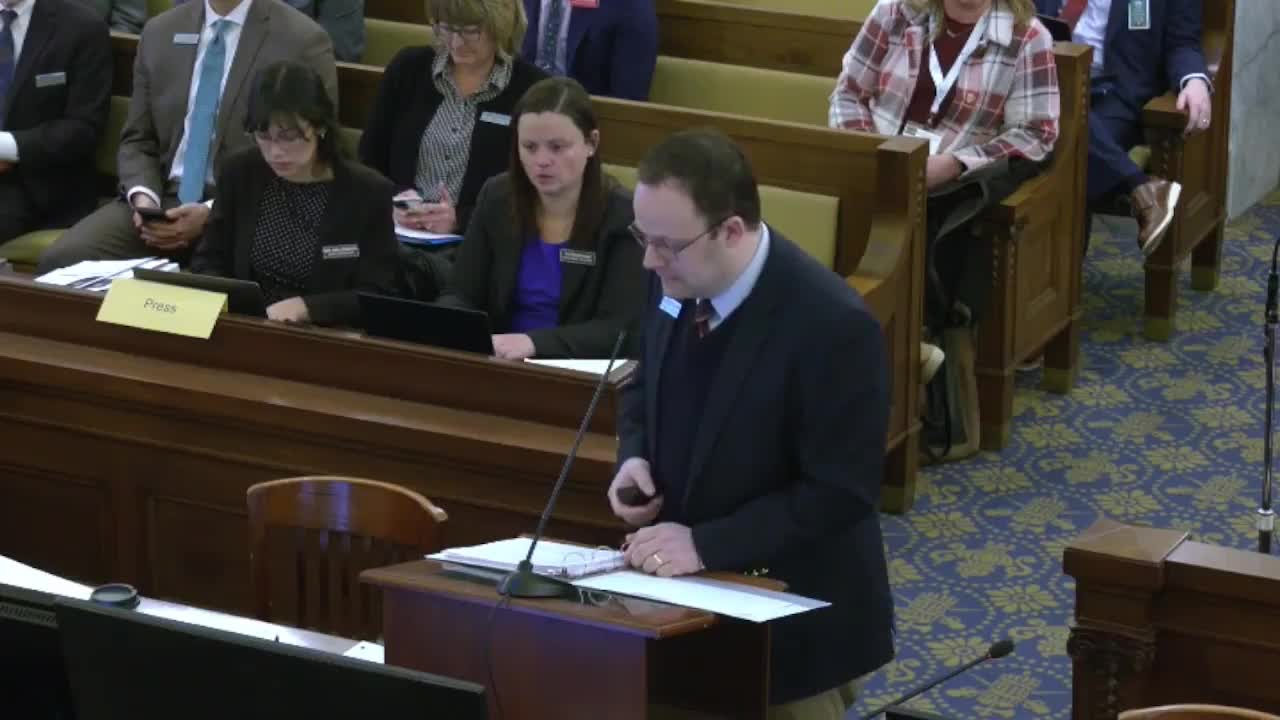
Eric Frederickson, the State Public Defender, told the committee the office has been operating in an intense, early transition period since it began statewide responsibilities in October. "We walked into 1,300 withdrawals and cases," Frederickson said, describing immediate workload and coverage needs. He said the agency has had to triage work with district defenders and litigation staff filling courtroom roles while the new structure absorbed counties and contract attorneys.
Frederickson described several operational challenges raised during questioning: (1) counties currently remain responsible under existing statute for providing facilities until 2029, which the agency said will require statutory clarification to move facilities responsibilities fully to the state; (2) certain evaluations and expert costs previously paid by counties—psychosexual, psychological and similar expert evaluations—now will fall to the state and have unit costs the agency estimates at roughly $2,500 each; and (3) the agency is being appointed to some non‑criminal matters that staff consider outside the statutory mission and has litigated to clarify those appointments.
Committee members pressed for detail on the supplemental timing and whether the agency can obligate one‑time FY25 dollars before year‑end. Frederickson said the agency’s intent is to spend the funds as appropriated, but acknowledged the speed of county onboarding and hiring needs were a driving reason for some requests being placed as supplements. Several legislators said they want more specificity on categories labeled "miscellaneous" and asked for a breakdown the committee can review.
The agency also described a plan to phase in institutional offices by county and to move from caseload counting toward workload‑based staffing once the statewide case management system is implemented. Frederickson said the office has sought uniform pay and merit structures across counties to recruit attorneys for rural districts and to discontinue flat fee contracts that he said raised constitutional and ethical issues.
No formal committee vote was taken at the hearing; staff and members indicated follow‑up questions and requests for more detailed line‑item breakdowns and county‑level information would be provided to the committee.