Get Full Government Meeting Transcripts, Videos, & Alerts Forever!
Get email alerts on the Pretrial Probation Budget topic
No spam. Unsubscribe anytime.
DOC seeks larger pretrial, probation and parole budget as electronic monitoring use rises
Summary
At a Feb. 18 House Finance subcommittee hearing, the Department of Corrections’ Division of Pretrial, Probation and Parole (DP3) said higher use of electronic monitoring and contract costs drove most of a requested budget increase; legislators asked for details on costs, outcomes and definitions of recidivism.
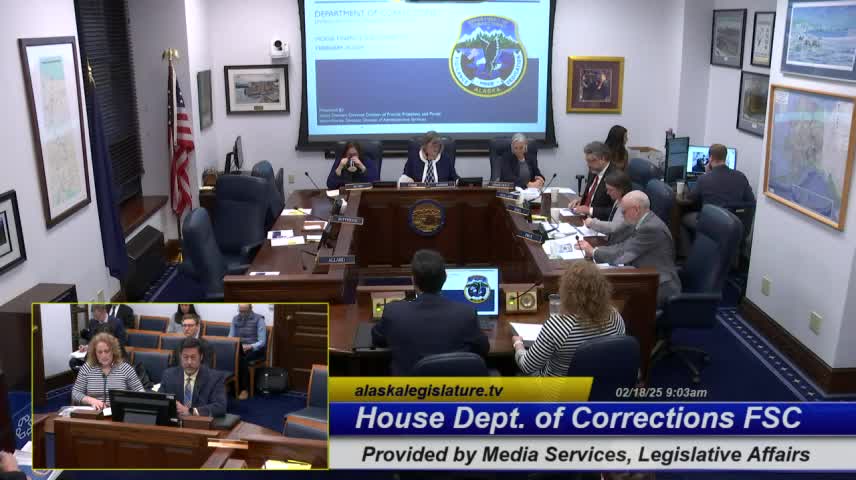
The House Finance Department of Corrections Subcommittee heard a presentation Feb. 18 from Dusty Dumont, director of the Division of Pretrial, Probation and Parole (DP3), and Kevin Worley, director of the division of administrative services, about DP3’s fiscal request and operations. DP3 officials told lawmakers the largest driver of the recent budget increase was greater use and cost of electronic monitoring equipment ordered by courts.
The request prompted questions from Representative Justin Holland, who said he believed the proposed change for the division this year was about $4.8 million. Kevin Worley told the committee that “in fiscal year 25, there was about a almost a $4,000,000 increase within this budget for pretrial” mostly related to electronic monitoring contract costs, and that the remainder of the increase reflected salary adjustments and added lease costs.
Why it matters: DP3 supervises people on pretrial release, probation and parole across Alaska. Lawmakers pressed agency staff for detail because electronic monitoring is both a major recurring expense and a frequently ordered court condition that affects public safety, supervision practices and the department’s operating budget.
Key facts and figures from the presentation: - Electronic monitoring (EM) remains the division’s most commonly ordered supervision tool; DP3 reported that at the start of the fiscal year 72.7% of pretrial supervision cases used EM, up from 68% the prior year. - DP3 reported 1,164 pieces of electronic monitoring equipment in use during a recent week, covering 1,031 individuals; about one-third of those individuals were using more than one device (for example a GPS ankle monitor plus a portable breath-testing SL3 device). - DP3 said increases in EM usage raise equipment loss/damage costs and contractor expenses, which the division incorporated into its FY25 request.
Officials emphasized limits and considerations around EM. Dusty Dumont said officers consider factors such as mental health and homelessness when recommending EM because some devices require daily charging and may be difficult for unhoused people to maintain. Dumont said officers try not to assign devices that would “set [people] up for failure.”
Committee members asked two policy questions: whether EM is a net cost-saving compared with additional staffing, and whether EM improves long-term outcomes such as recidivism. April Wilkerson, deputy commissioner, and Dumont said keeping people in the community generally costs less than incarceration and that EM can protect victims (for example, by triggering alerts when a supervised person enters a restricted area). They also said the evidence is mixed on whether EM reduces recidivism: EM can help some people remain in the community but can lead to violations and returns to custody if conditions are not appropriate or if individuals lack supports.
Lawmakers also asked about program evaluations and definitions. Wilkerson said recidivism in Alaska is defined in statute as return to incarceration within three years after release; it includes those reincarcerated for violating conditions of release rather than only new criminal convictions. Wilkerson said the division is working with external partners to evaluate the pretrial program and identify efficiencies and public-safety impacts.
What’s next: Committee members asked for additional detail on budget line items, contract costs for EM, and outcome measures (including recidivism metrics). The subcommittee’s next meeting was set for Feb. 27, where budget closeout and any amendment deadlines would be addressed.
Speakers quoted or referenced in this report are listed in the speaker section below; quotes are verbatim from the committee hearing transcript.