Get Full Government Meeting Transcripts, Videos, & Alerts Forever!
Get email alerts on the State Board Rules Docket topic
No spam. Unsubscribe anytime.
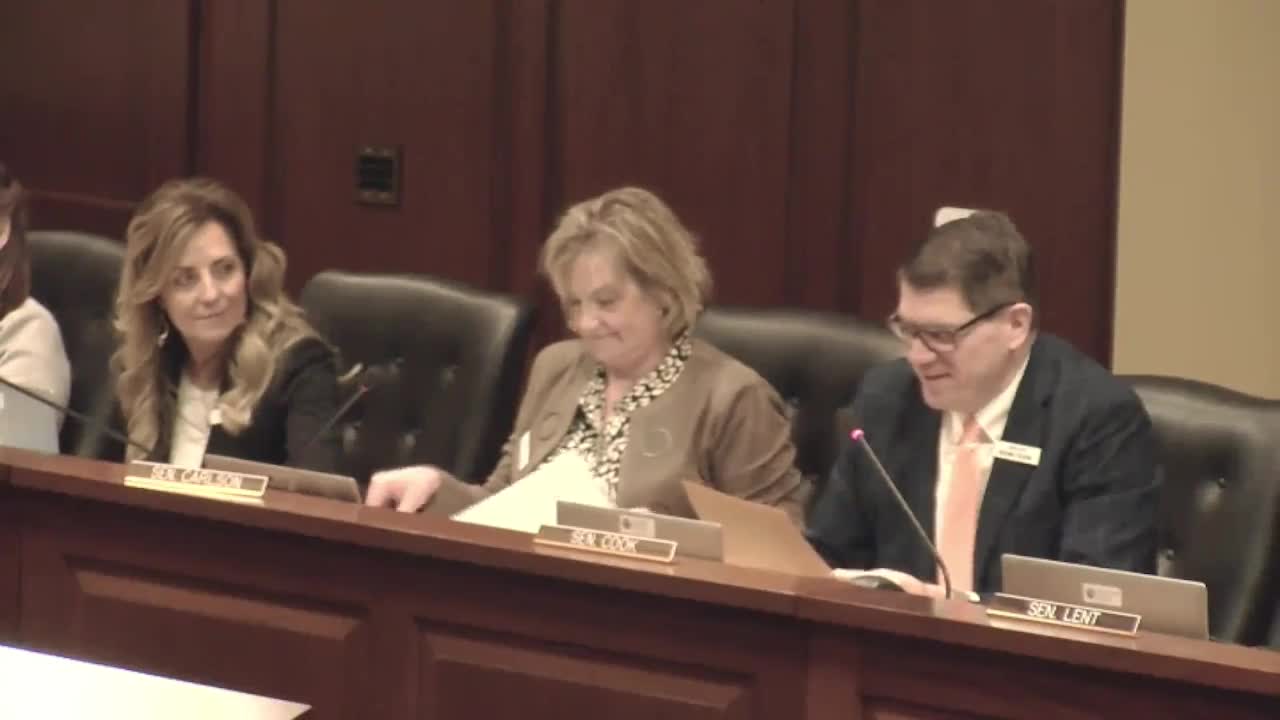
Senate Education Committee reviews State Board rules on accreditation, scholarships, teacher apprenticeship and digital learning; committee delays final votes
Summary
The committee heard State Board of Education staff present multiple rule revisions covering registration of postsecondary institutions, Opportunity Scholarship eligibility, school facility reporting, teacher apprenticeship and certification pathways, Idaho Digital Learning Academy assessment options, and vocational rehabilitation. Members pressed
The Idaho Senate Education Committee heard a lengthy presentation from State Board of Education staff and legislators on a package of proposed rule changes affecting postsecondary registration, scholarships, teacher certification pathways, digital learning and vocational rehabilitation. Committee members asked detailed questions about accreditation standards, Opportunity Scholarship renewal requirements, and a new apprenticeship pathway for teacher certification. The committee postponed final rule votes to a later meeting.
Matthew Ryber, identified to the committee as representing the State Board of Education, ran through multiple rule dockets the board submitted for committee review. He said the rule package includes: changes to registration of postsecondary institutions to accept U.S. Department of Education–recognized accreditors for private proprietary schools; amendments to align Opportunity Scholarship renewal requirements with recent changes in statute; new data reporting tied to school facilities funding; additions to implement last session’s teacher apprenticeship statute; a small change to Idaho Digital Learning Academy (IDLA) guidance to allow a comprehensive final project in place of a proctored final exam in some courses; and federal-aligned updates to vocational rehabilitation rules.
Senator Craig Bernd presented RS 32029, a proposed policy requiring school districts to "assess the impact of mobile device usage on students and develop a policy that promotes distraction free learning." Bernd said the proposal preserves local control by requiring districts to adopt a policy but not prescribing what the policy must contain. "The policy has to be adopted by the end of the year," he said in response to a senator’s question. The committee voted to send RS 32029 to print; members indicated unanimous assent by voice vote and no opposition was recorded.
The largest portion of committee discussion focused on teacher preparation and certification changes tied to recent legislation. Ryber explained rule language to implement Senate Bill 1069 (as described by staff), which created an educator registered apprenticeship pathway as an additional route to the classroom. Several senators pressed staff on quality assurance, oversight and how apprenticeships would be monitored over time.
Senator Semmeroth raised concerns about proposed deletions in the standard instructional certificate rule that, as presented in the draft, remove a baccalaureate-degree reference for some pathways. "The way these proposed revisions read, it removes the baccalaureate degree requirement," Semmeroth said, asking how the change would affect teacher quality and the ability of instructors to teach dual-credit courses. Ryber and other State Board staff responded that traditional educator-preparation programs remain tied to degree-granting, accredited institutions and that the apprenticeship pathway was intended to create an alternate route, particularly for rural and hard-to-staff districts. Ryber emphasized that educator-preparation program approvals and ongoing oversight rest with the State Department of Education and the State Board: "These educator prep programs are jumping through many layers of approval."
Committee members repeatedly pressed for clarity on how the State Board and Department would monitor approved nontraditional or apprenticeship programs over time. Senators asked whether approvals carried the same ongoing continuous-improvement requirements that regional accreditation imposes on public four‑year institutions. Ryber said the State Board intends ongoing oversight and noted the federal registration and notification processes for apprenticeship programs, and pointed to other states such as Tennessee for early data on program outcomes.
Other rule items discussed briefly included: (1) registration language to recognize U.S. Department of Education–approved accreditors for private postsecondary institutions (State Board staff noted public institutions remain governed by code requiring Northwest accreditation); (2) Opportunity Scholarship rule text amended to mirror recent statutory changes on credit/semester renewal requirements; (3) school facility funding reporting changes to track which district is responsible for a student and whether the student is physically on campus for funding eligibility; (4) a small IDLA rule change permitting a comprehensive final project as an alternative to a proctored exam, with site coordinators and local teachers continuing to proctor and assess; and (5) vocational rehabilitation rule alignment with federal standards to allow flexibility about individualized plans for employment and prioritization of service needs.
After extended discussion and multiple requests for clarifying language—particularly about the accreditation and teacher certification sections—the committee did not take final votes on the bulk of the rule dockets. Vice Chair and other members proposed deferring votes to allow members time to review the materials and to prepare follow-up questions. A motion to hold votes "at the call of the chair" was made and approved by voice vote; the committee tentatively planned to reconvene later in the week to complete rule actions.
Formal committee actions recorded in the hearing were limited to procedural motions: the committee voted to send RS 32029 to print, and later voted to hold the remaining rule dockets for review. No rule dockets were finally approved or rejected in the hearing.
The transcript records detailed exchanges; the committee asked the State Board to return with clarifications on oversight, definitions of "approved" versus "accredited," the practical monitoring cadence for nontraditional educator-prep programs, and the precise impact of removing or changing degree language in the standard instructional certificate rule.