Get Full Government Meeting Transcripts, Videos, & Alerts Forever!
Get email alerts on the Health Insurance Funding topic
No spam. Unsubscribe anytime.
Joint Finance panel approves higher state health insurance appropriation per employee
Summary
The Joint Finance-Appropriations Committee on Jan. 31 adopted an increase in the health insurance appropriation to $14,130 per eligible full-time position, raising general-fund and other appropriations and leaving projected reserve balances between approximately $51.6 million and $61.4 million depending on the option considered.
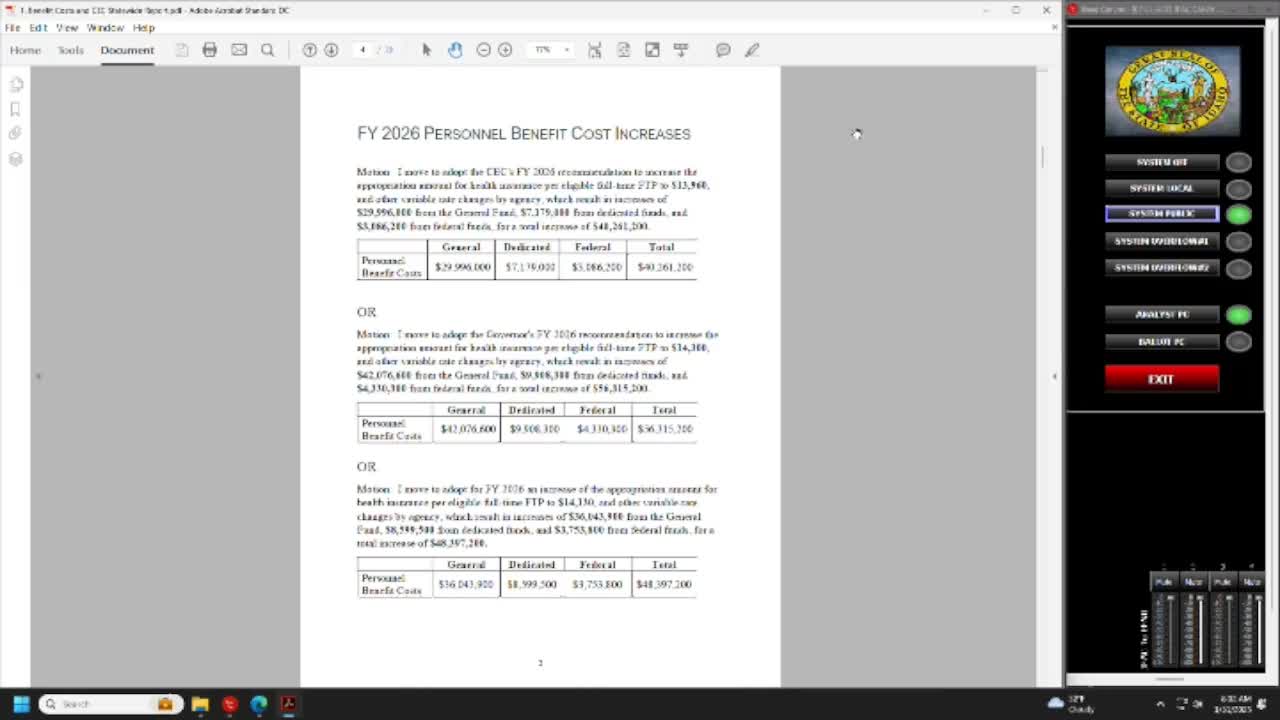
The Joint Finance-Appropriations Committee voted Jan. 31 to increase the state appropriation for health insurance to $14,130 per eligible full-time position, a change the committee’s analysts said will raise state appropriations by $48,397,200 across general, dedicated and federal funds.
Committee analysts presented three funding options before the vote: the CEC committee recommendation at $13,960 per eligible full-time position, the governor’s recommendation at $14,300, and a midpoint compromise at $14,130. Mr. Bybee, the committee analyst, told members the three dollar levels reflect differing approaches to funding health insurance and that the larger change this year is driven by health insurance costs, with smaller agency-level employer-paid adjustments for workers’ compensation and Social Security also included.
The matter mattered to members because of how it affects agency budgets and the insurance reserve. Mr. Bybee told the committee that under the $13,960 option the projected ending reserve balance for fiscal year 2026 was about $51,600,000; under the $14,300 option it was about $61,400,000. He said the $14,130 midpoint would fall between those amounts (a precise midpoint projection was not provided on the record). The committee heard arguments that using reserve balances to “buy down” premiums in prior years masked the underlying cost and would create a larger apparent jump in premium levels if repeated.
During debate, Representative Handy and others argued in favor of the governor’s recommendation as reflecting the “actual cost of insurance” and warned that repeatedly using reserves to reduce the premium would distort future comparisons. Representative Furness and others urged the committee to adopt the lower CEC recommendation, characterizing actuarial projections as conservative and arguing for restraint. Senator Ward-Engelking noted that some recipients of these calculations — such as school districts — do not have reserves to absorb large premium changes and that the 14,300 figure more closely reflects the cost schools will face.
The motion that the committee adopted set the appropriation amount at $14,130 per eligible full-time position, and the motion included the attendant agency-level variable rate changes. The committee recorded that the increases resulting from that motion are $36,043,900 from the general fund, $8,599,500 from dedicated funds, and $3,753,800 from federal funds, for a total increase of $48,397,200.
Roll calls during the session showed the motion passed by the joint committee majority. The committee recorded the total vote as 17 ayes, 0 nays, and 3 absent/excused across the two chambers; clerk read a Senate vote of 8 ayes, 0 nays, 2 absent/excused and a House vote of 9 ayes, 0 nays, 1 absent/excused. The committee ordered that the motion carry a “do pass” recommendation without objection.
The committee followed statutory guidance in preparing language for the Office of Group Insurance to maintain plan structure and benefits; Mr. Bybee cited statutory language during the meeting (the transcript records a reference to “section 5,709 A through D” when describing the legislature’s role in weighing employee benefits). No additional statutory change was enacted; the committee’s action is an appropriation recommendation.
The committee moved on to Change in Employee Compensation (CEC) items after adopting the health insurance appropriation. Staff said they will include the adopted amount in the budget documents and will provide the committee with the finalized language now that a dollar amount motion had passed.
Ending: Committee staff said they will incorporate the adopted dollar into the budget system and distribute final language. Members were reminded that additional personnel benefit items remain under consideration in upcoming hearings.