Get Full Government Meeting Transcripts, Videos, & Alerts Forever!
Get email alerts on the Agriculture Oilseed Rules topic
No spam. Unsubscribe anytime.
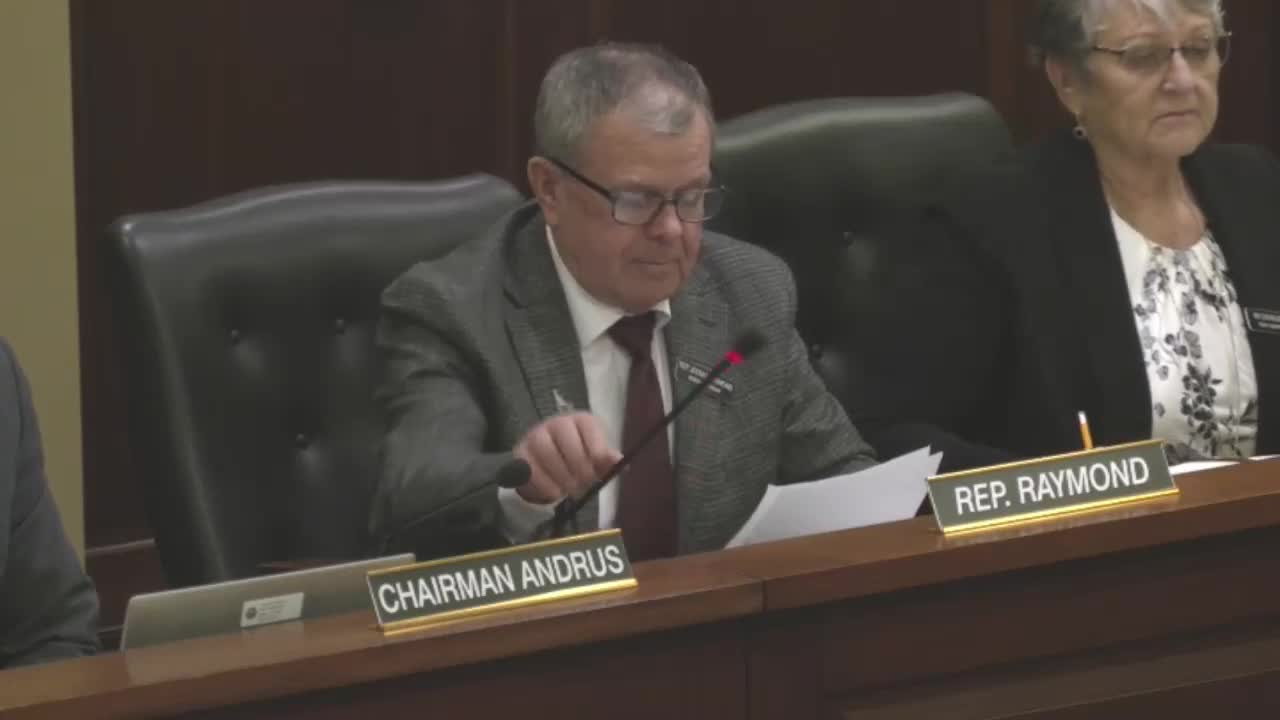
House Agriculture Committee approves Idaho Oilseed Commission rule rewrite and hears commission presentation
Summary
The House Agriculture Affairs Committee voted to recommend approval of an administrative rewrite for rules governing the Idaho Oilseed Commission and heard a presentation outlining the commission’s structure, budget and research priorities.
BOISE — The House Agriculture Affairs Committee voted to recommend approval of an administrative rule rewrite for the Idaho Oilseed Commission and then heard a briefing from the commission’s administrator on the commission’s budget, research programs and markets.
The committee approved a motion to recommend the docket for the Idaho Oilseed Commission’s rule changes after a voice vote. Representative Nannie McCann moved to recommend approval of the docket; no second was recorded on the transcript and no members voiced opposition.
The approved rewrite, as presented, removes duplicative language across the commission’s administrative chapter and specifically eliminates a refund-application provision that the presenter said conflicts with state statute. "My name is Paci LaRacia Phillips, and I stand before you today as the administrator of the Idaho Oilseed Commission," Administrator Paci LaRacia Phillips told the committee. Phillips said the chapter rewrite removes unnecessary text in areas including legal authority, first-purchaser rules and the oil-seed tax invoice.
Phillips told the committee the refund-application language was removed because Idaho Code, Title 22, Chapter 47, includes a refund/escrow-account provision tied to a grower referendum. Phillips said an affidavit from Doug Scoville, a former commission chairman, confirms that a referendum was held after the commission’s creation and that the refund/escrow account should no longer exist. Phillips told the committee she and the commission ran the proposed changes through the Division of Financial Management and solicited stakeholder comment through negotiated rulemaking sessions on Aug. 22 and Oct. 3, 2024.
In a presentation that followed the rule discussion, Phillips described the commission’s statutory authority and operations. She said the Oilseed Research and Development Act established the commission in 1996 and that statute set a tax of 10 cents per hundredweight on oilseeds sold or contracted in Idaho. Phillips said the commission’s operating budget is roughly $175,000 and that research is its largest expense category.
Phillips provided acreage figures as reported to the Farm Service Agency for recent seasons: canola about 93,652 acres, safflower about 17,000 acres, mustard just above 8,200 acres, flax about 520 acres and camelina about 915 acres. She said the commission partners with the University of Idaho on plant-breeding and specialty-crop research and uses a specialty crop block grant administered through the Idaho State Department of Agriculture (ISDA) as a pass-through funding mechanism for some mustard research. Phillips also named private contractors and researchers the commission has worked with, and she identified processors and distributors that buy Idaho oilseeds, including a canola crushing facility in Warden, Washington, operated by Viterra and Mountain State Oilseeds in American Falls.
Phillips emphasized the commission’s three statutory purposes — research, education and promotion — and said the commission must allocate limited resources across growers of different oilseed crops. "We were able to remove a lot of duplicative language, clean up and become more concise," Phillips said of the draft rules.
The committee’s motion language as spoken by Representative McCann identified a docket number that was read aloud as "40Three-oneOne-two401." The committee chair later referenced the docket number differently on the record. The transcript contains both forms; the record does not resolve which docket number is the formal identifier.
After the vote and the presentation, Phillips answered members’ questions about the commission’s activities, and the committee adjourned.
Votes at a glance: the committee approved the recommendation to adopt the presented rule changes by voice vote; no roll-call tally or individual recorded votes were provided in the transcript.