Get Full Government Meeting Transcripts, Videos, & Alerts Forever!
Get email alerts on the Public Health Budget topic
No spam. Unsubscribe anytime.
JFAC reviews public‑health budget as department seeks restorations, one‑time federal enhancements
Summary
The Joint Finance‑Appropriations Committee (JFAC) reviewed the Department of Health and Welfare’s Division of Public Health Services budget, which asks to restore multiple ongoing programs and spend federal one‑time funds on data modernization, workforce support and public‑health grants.
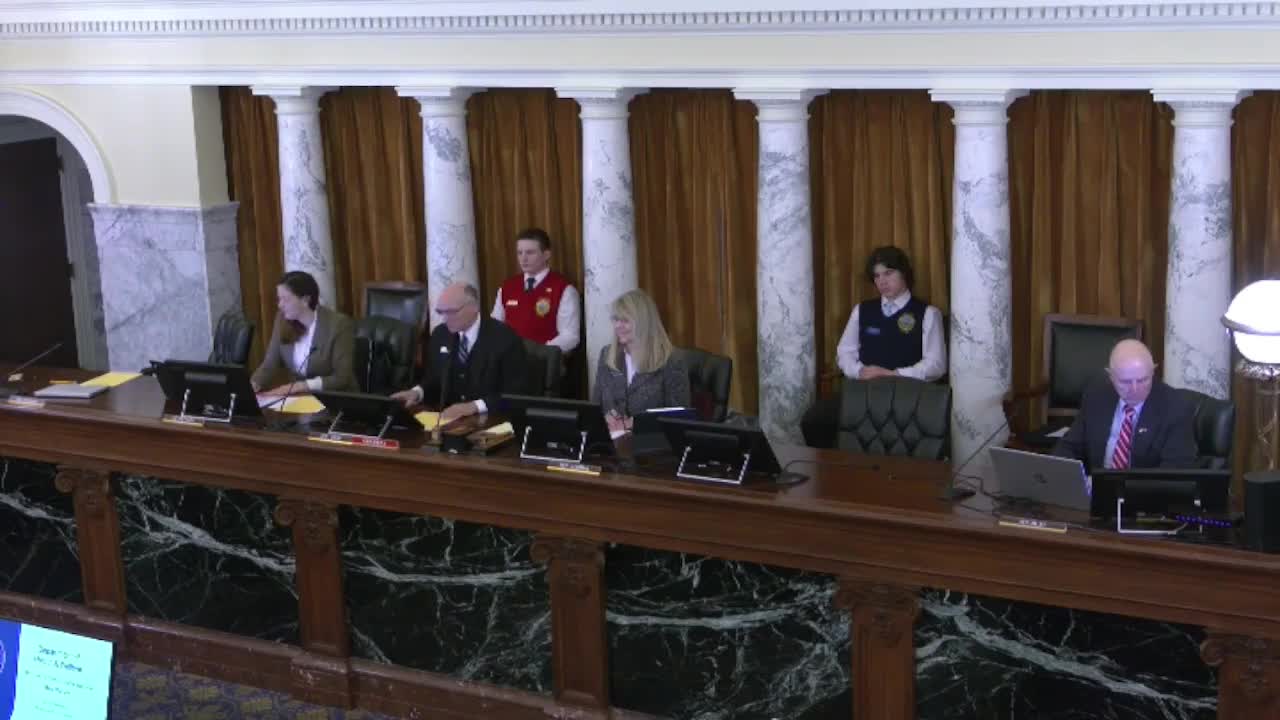
The Joint Finance‑Appropriations Committee on Jan. 22 reviewed the Department of Health and Welfare’s Division of Public Health Services budget, which seeks a mix of ongoing restorations and one‑time federal enhancements to support immunizations, data modernization, suicide prevention and other programs.
The Division of Public Health Services oversees five program areas — physical health services, emergency medical services, laboratory services, suicide prevention and health care policy initiatives — and delivers many services through contracts with local public‑health districts and community providers, Budget Policy Analysis division manager Keith Bybee told the committee. He said the division had 256.52 full‑time equivalent positions established and four vacancies as of Aug. 31, 2024.
Why it matters: The division’s budget funds vaccines, communicable‑disease work, lab testing, maternal and child health programs, WIC and home visiting services. Committee members said restoring some programs would directly affect local public‑health districts and rural care access.
Division director Alex Adams said the budget review amounted to "a healthy exercise" of zero‑based budgeting that produced about a 6% reduction year‑over‑year in the division’s total request. Adams described structural changes tied to the end of CARES Act and ARPA carryover funding that had previously inflated appropriations and expenditures.
What’s in the requests - Base and totals: The fiscal‑year 2025 original appropriation for the division was about $164,020,000, with roughly half of the division’s spending going to trustee and benefit payments for services; personnel represented about 18.6% of the requested 2025 appropriation. The department described a large upward swing in 2025 driven by one‑time restorations after pandemic‑era federal funds declined. - One‑time federal enhancements: The department listed roughly $8,752,500 in one‑time items, including grants and ARPA‑related system upgrades. Specific projects include vital‑records data modernization, WIC system modernization, public‑health data modernization grants and a multi‑year communicable‑disease prevention grant funding 4.4 limited‑service positions. - Ongoing restorations: The department requested restoration of multiple ongoing programs that had been shifted to one‑time funding, including the Office of Accreditation and Planning; suicide‑prevention funding ($1,807,700 general fund and $195,000 federal in the request); a drug overdose prevention program restoration (4 FTE and $2,820,200); refugee health screening (1.5 FTE and $991,000); Alzheimer’s and dementia coordination ($275,200); the Fit & Fall Proof program ($140,000); HIV prevention ($957,300); oral health workforce supports ($379,600); integrated hepatitis surveillance ($599,200); and restoration of WIC and related maternal and child nutrition funding totaling several million dollars. - Other items: The department requested $2,500,000 ongoing from dedicated funds for the Idaho immunization program to maintain vaccine access for children under 19, and $150,000 ongoing for the Bureau of Vital Records and Health Statistics to support processing of birth, death and other vital records. The governor recommended several of the agency requests and proposed a $500,000 ongoing physician‑incentive initiative targeted to providers in federally designated health professional shortage areas.
Committee discussion and questions Committee members asked about whether programs such as Project ECHO and the Bureau of EMS might fit better in other agencies or the private sector. Director Adams said the agency is open to reallocating programs when it makes operational sense but noted many of the programs being restored were long‑standing. On the rural physician incentive program, Division Administrator Elke Shaw Tullock said the loan‑repayment programs have "a very high retention rate. Almost 91% of the providers that receive these loan repayments stay in the state and practice in the state." Adams said metrics and performance reporting are being strengthened as part of the budget review.
Funding, federal dependencies and next steps Adams told the committee that some items depend on federal grant availability and that the department had paused draws during a prior federal funding freeze; he described the ongoing impact as "TBD" until federal positions were clarified. Committee members asked the department for more detail on prior spending of ARPA and data modernization dollars and asked analysts to provide written summaries after the hearing.
The committee did not take final action during the hearing and directed members to follow up individually with analysts for deeper reviews of specific line items.
Sources and attributions: Statements and budget figures above were provided by Keith Bybee (Division manager, Budget Policy Analysis), Alex Adams (director, Idaho Department of Health and Welfare) and Elke Shaw Tullock (division administrator, Division of Public Health Services) during the JFAC hearing.