Get Full Government Meeting Transcripts, Videos, & Alerts Forever!
Get email alerts on the Prison Security Upgrades topic
No spam. Unsubscribe anytime.
After staff shooting, Idaho DOC seeks tech, transport upgrades and body‑worn camera pilot
Summary
Following a spring ambush on staff during a medical transport, Idaho DOC requested digital mail scanning, drone detection, phone-call transcription, expanded transport bureau staffing and a federal body‑worn camera pilot to reduce contraband and improve transport safety.
The Idaho Department of Correction told the Joint Finance Preparations Committee that a spring incident in which a staff transport was ambushed prompted a package of security proposals, including mail digitization, drone detection, phone-call transcription and a permanent expansion of the transport bureau.
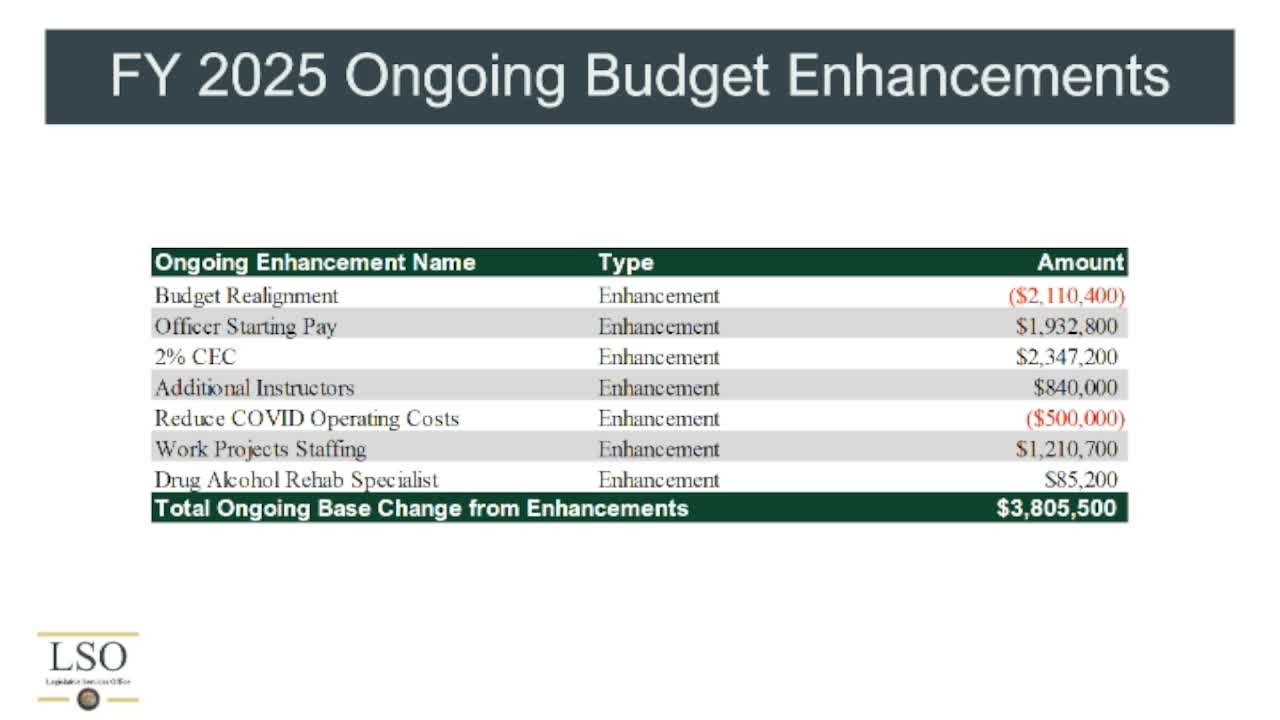
Noah Peterson, budget and policy analyst for the Legislative Services Office, described the incident and the agency’s proposed mitigations. He told the committee that funds requested for fiscal 2025 include an initial $795,000 to implement “digital mail scanning, drone detection and then phone call transcription and analysis” after the ambush. He said the full-year ongoing costs for those technologies would total about $2.397 million.
Why it matters: The agency said sophisticated methods to introduce contraband—autonomous drones and altered print materials—have increased the risk to staff and incarcerated people. Director Josh Tewalt emphasized that digitizing mail would close what he called “our most porous point of entry for contraband” and free staff to focus on other security tasks.
Key elements of the request: Peterson summarized the line items: - Digital mail scanning: agency proposal fiscal-year implementation cost of $1,011,000; ongoing portion included in the $2.397 million total. - Drone detection system: one-time/fiscal-year portion included; ongoing cost cited as $385,500. - LEO phone transcription and analysis: cited ongoing cost of $1,000,000.
Transport bureau expansion: The agency requested a $1,148,000 one-time supplemental to expand its Transport Safety Bureau to take on emergency transports. That request would fund 12 positions (personnel cost approximately $455,000 for the remainder of the fiscal year) and equipment and vehicles (about $693,000 for six SUVs and a wheelchair-accessible van with barriers and lights).
Body-worn cameras: IDOC requested a federal grant-funded pilot for body-worn cameras in three sites; the initial implementation request was presented as primarily federal funds plus a small general‑fund state match in later years. Peterson said the supplemental would cover startup costs such as cameras, docking stations and evidence storage; the state would be responsible for part of the match in later budget years if the pilot continues.
Governor’s recommendation and contractor negotiations: The fiscal slides show the governor recommended most items, with an alternative for snow removal at a work camp (the governor recommended contracting snow removal rather than buying a skid loader). Peterson said the agency is negotiating technology and medical contracts and reported ongoing costs and population-driven budget impacts elsewhere in the DOC budget.
Lawmakers’ questions and agency responses: Legislators asked why expansion meant adding 12 FTP rather than reallocating existing positions. The director explained that emergency transports historically were handled by staff assigned to other duties and that providing the advanced training and relief to staff would require an ongoing cadre specifically trained for high‑risk transports; he also noted thousands of overtime hours had been used for transports at major facilities. Lawmakers also sought cost comparisons for purchasing vs. contracting snow removal; the Division of Financial Management said the governor favored contracting to avoid seasonal capital ownership and replacement costs.
Ending: The committee heard the security rationale and the cost estimates but did not vote. The agency will proceed through the budget process; committee members requested additional details and documentation as they consider supplemental and ongoing appropriations.