Get Full Government Meeting Transcripts, Videos, & Alerts Forever!
Get email alerts on the Judicial Pay Reform topic
No spam. Unsubscribe anytime.
Georgia judges, courts press legislature for recruitment funding and judicial pay reform
Summary
Representatives of Georgia’s Supreme Court, Court of Appeals and Council of Superior Court Judges told a House appropriations subcommittee on May 20 they need funding to address high staff turnover, improve recruitment and implement a pending judicial compensation bill (HB 85) that would set a statewide base salary and cap county supplements.
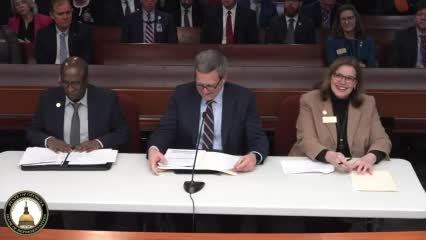
Representatives of Georgia’s statewide courts and judicial-support offices told the House Appropriations Subcommittee on Judiciary on May 20 that recruitment, retention and a pending judicial compensation bill are the most urgent items in their FY2026 budget requests.
The Supreme Court, the Court of Appeals and the Council of Superior Court Judges each asked for targeted salary increases for judicial staff and for judges in the bill now identified as HB 85. Court presenters also requested funding for ADA website compliance and upgrades to court information systems.
Court leaders said high turnover and pay disparities are driving the requests. The Supreme Court presentation said staff-attorney turnover since 2020 has been roughly 72% and that many remaining staff are within five to 10 years of retirement; the Court of Appeals and superior-court representatives described similar recruitment pressures. The Supreme Court and Court of Appeals asked the committee to fund phased or full implementation of an across-the-branch judicial pay plan; superior-court leaders asked the committee to fund the bill’s full implementation to avoid creating new pay disparities between incumbent judges and newly appointed judges in the same circuits.
The Superior Court Council emphasized HB 85, which would set a statewide judicial base salary tied to a federal-district-court benchmark and limit county supplements through a capped locality pay. Council President Judge Anne Harris said the proposal eliminates the current wide range of county supplements and replaces them with a statewide base plus a maximum 10% locality allowance; the locality allowance would shrink automatically if the statewide base continues to increase. Harris said full funding of the enabling legislation would spread costs across about 230 superior-court judges and would narrow — though not entirely eliminate — disparities that now leave Georgia’s state-base judicial pay low in national rankings.
The Court of Appeals and the Supreme Court asked that any phase-in be structured so the benefit is meaningful and not merely a short-term step that creates new intra-circuit differences. Judge Trent Brown of the Court of Appeals and the Supreme Court presenter (who described the court’s budget lines and turnover figures) said that, where possible, earlier implementation of the higher levels would be more beneficial to retention.
Other judicial requests on the FY2026 tracking sheet discussed at the hearing included: funding for ADA (accessibility) compliance for public electronic records and modernization of docketing systems; funding for recruitment and retention pools for professional staff; and continued and adjusted funding for rent and state IT pass-through costs. The Administrative Office of the Courts and the Judicial Council requested funding to continue JCAT/JCATs (juvenile case management) rollout and to support three IT positions briefed in a prior hearing.
Committee members asked about partial funding options and the practical consequences of phasing the pay increases. Superior Court presenters argued that partial funding could create new, problematic disparities between sitting judges (who may be permitted to keep higher county supplement-derived compensation) and new judges who would enter under the new state schedule. Several committee members said a phased approach might be preferable if full funding is not immediately available; judges and court staff urged the committee to make the increases as substantial and timely as possible to close the market gap.
The courts supplied turnover and salary-range information to committee staff, and presenters committed to follow up with precise numbers once legislative provisions are finalized.
Looking ahead, court representatives asked the committee to consider the bill’s budgetary timing and the consequences of any partial phase-in. Several presenters said they would provide more precise recalculations to committee staff once the final statutory language and indexing mechanics are finalized.
Evidence from the hearing: the Supreme Court’s presenter reviewed lines for ADA compliance, recruitment and retention, and a judicial pay reform line; the Court of Appeals and Superior Court leaders reiterated the need to adopt salary reform to address retention risks and equity across circuits.
The subcommittee did not take votes during the session; presenters were asked to supply follow-up data on turnover, exact salary bands and the modeling that underlies the HB 85 numbers.