Get Full Government Meeting Transcripts, Videos, & Alerts Forever!
Get email alerts on the Industrial Commission Budget topic
No spam. Unsubscribe anytime.
Industrial Commission seeks ongoing staff, IRIS maintenance and vehicle replacements amid rising caseloads
Summary
The Industrial Commission presented its FY2026 budget request to the Joint Finance-Appropriations Committee, seeking ongoing personnel funding, one‑time IRIS maintenance support and vehicle replacements while reporting higher caseloads, vacant positions and multi‑fund reversions in FY2024.
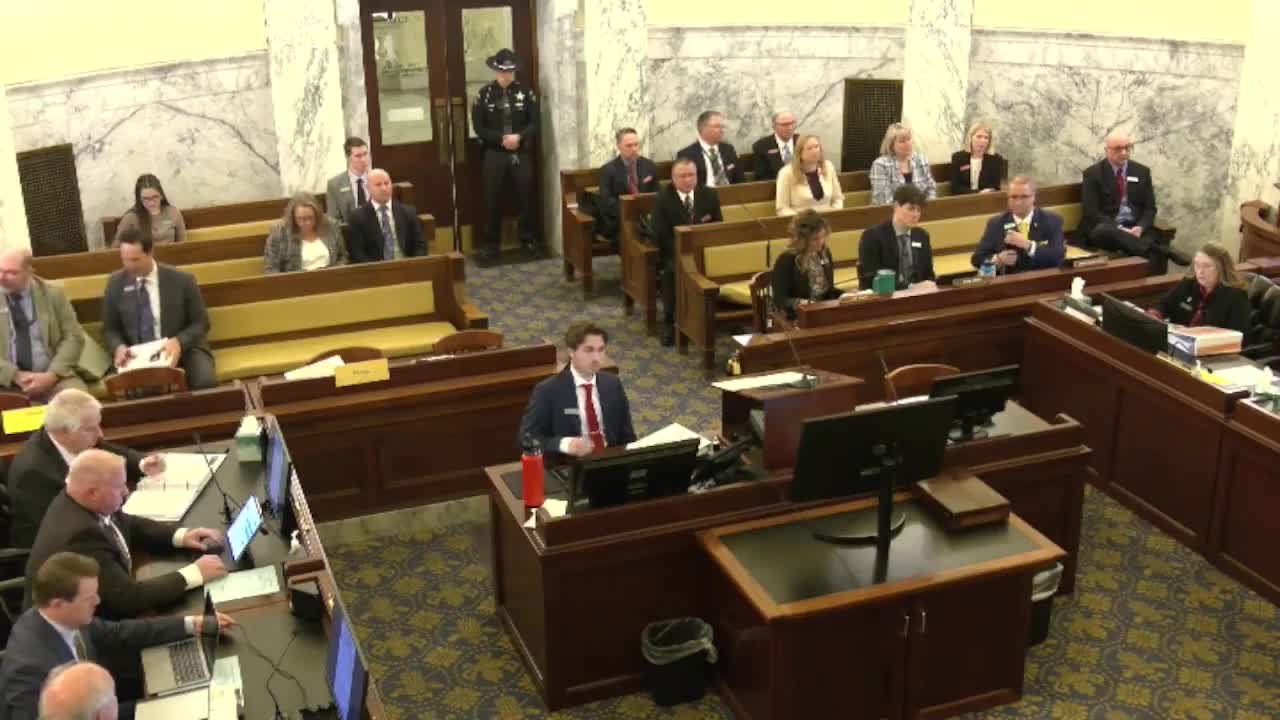
The Industrial Commission told the Joint Finance-Appropriations Committee on Jan. 23 that it needs a mix of ongoing and one‑time funding to sustain a recently completed information modernization project and to reduce backlogs and delays across its programs.
Noah Peterson, budget and policy analyst with the Legislative Services Office, summarized the agency's three programs — compensation, rehabilitation and crime victims compensation — and the commission's FY2026 request, including 10 enhancement requests totaling $852,400 ($298,200 ongoing and $554,200 one time). "The target turnaround time for the fiscal department to process a request for payment from the crime victims compensation program ... is 30 days," Peterson said, noting that at the time of the August budget submission there were 872 outstanding payments and an estimated 12‑week turnaround.
Why it matters: The Industrial Commission oversees workers' compensation adjudication, rehabilitation services and a crime victims compensation program that pays claimants up to statutory maximums. Committee members pressed the agency on whether reverted funds from FY2024 could be applied to fill vacant positions and on the ongoing costs of IRIS, the commission's records modernization project.
Key facts and requests - Agency staffing and vacancies: The commission has 130.25 FTP authorized, with 70.5 FTP in the compensation program, 47.25 in rehabilitation and 12.5 in crime victims compensation; as of August the agency reported 12 vacant positions. The FY2026 enhancement package would not add new FTP but would use vacant FTP to fund requested positions. - IRIS (Industrial Commission Redesign Information System): From FY2021–FY2025 the Legislature appropriated $12,874,000 in one‑time funding for IRIS development and related items. The FY2026 request includes a one‑time $288,000 maintenance contract to provide long‑term technical support because the Office of Information Technology Services (OITS) is not yet able to assume that work. - Personnel items: Ongoing requests include a senior financial technician ($66,500 ongoing) to reduce payment backlogs in the crime victims compensation program; a referee (hearing officer) position ($111,600 ongoing) to shorten time to decision (agency said average decision time rose from 90 to 110 days after the loss of a referee in 2020); a rehabilitation field consultant for the Twin Falls/Burley area (about $32,300 ongoing); a technical records specialist (about $62,300 ongoing); and reclassification funding for five adjudication associates ($25,500 ongoing) to reflect greater duties after IRIS. - Trustee/benefit reversions and fund transfers: Peterson told the committee the commission reverted roughly $4.56 million in FY2024, driven primarily by $3.0 million in trustee and benefit payments (about $2.4 million of that from the crime victims compensation program). The supplemental request for FY2025 included a net $47,000 transfer to properly allocate $47,000 of a prior one‑time appropriation to the Peace Officer Temporary Disability Fund. - Fleet replacements and equipment: The agency requested four small SUVs (three for rehabilitation, one for compensation) to replace field vehicles with 82,000–98,000 miles and model years roughly 2006–2011; and $104,200 for IT replacement items (laptops, docking stations, monitors). Director George Gutierrez emphasized staff safety and reliability for field work as a driver for vehicle replacement.
Substantive discussion and agency context Agency director George Gutierrez and his staff explained that IRIS has improved electronic record access and reduced paper handling, but has also shifted certain tasks back to legal support staff and created higher volumes of data and cases in employer compliance. "We are now identifying nearly 60% more cases. These are 60% more employers who we've determined are not compliant with the workers compensation law," Gutierrez said, arguing the increase in identified cases has strained legal and adjudicative capacity.
Committee concerns centered on three areas: (1) whether reverted funds could be repurposed to hire needed staff (agency said most reversions were trustee/benefit payments and that transfers would require legislative or executive action); (2) the recurring one‑time requests for IRIS maintenance costs and what the contracted work includes (Mr. Peterson and Director Gutierrez said they would provide a detailed written breakdown); and (3) fleet adequacy and mileage — members asked for a fleet inventory and replacement justification.
Decisions and directions No formal vote was taken during the presentation. Committee members asked the agency to provide more detailed documentation: (a) a full breakdown of all IRIS costs and how prior appropriations were spent, (b) a complete fleet inventory and replacement rationale, and (c) clarification about whether reverted trustee/benefit funds could be reallocated. Director Gutierrez said he would provide follow‑up material to the committee.
Background and limits of authority Peterson noted the Industrial Commission is a dedicated‑fund agency; its appropriation does not come from the General Fund but from dedicated sources including the Industrial Administration Fund, the Peace Officer Temporary Disability Fund, the Crime Victims Compensation Fund and miscellaneous revenues. The commission's three commissioners are gubernatorial appointees confirmed by the Senate, serving staggered six‑year terms. The transcript included no statute text; the committee and agency discussed potential statutory amendment to authorize commissioner pay increases.
What remains unresolved The committee requested documentation from the agency on IRIS maintenance costs, the status of vacant FTPs, the feasibility of using reverted funds for personnel, and a fleet inventory. No appropriation decisions or binding directives were made during the hearing; the matters remain under committee consideration.