Get Full Government Meeting Transcripts, Videos, & Alerts Forever!
Get email alerts on the School Choice topic
No spam. Unsubscribe anytime.
Idaho House passes parental choice tax-credit bill after multi-hour floor debate
Summary
The Idaho House passed House Bill 93 on Feb. 7, 2025, authorizing a capped, refundable parental-choice tax credit intended to reimburse families for qualified K–12 education expenses (up to $5,000 per child, $7,500 for children with disabilities) and giving priority to households below 300% of the federal poverty level.
The Idaho House of Representatives passed House Bill 93 on Feb. 7, 2025, a parental-choice tax-credit measure that would create a refundable tax credit — capped at $50 million annually — to reimburse qualified K–12 expenses for eligible Idaho students. The bill sets a maximum credit of up to $5,000 per child and up to $7,500 for a child with a disability and gives priority to applicants at or below 300% of the federal poverty level.
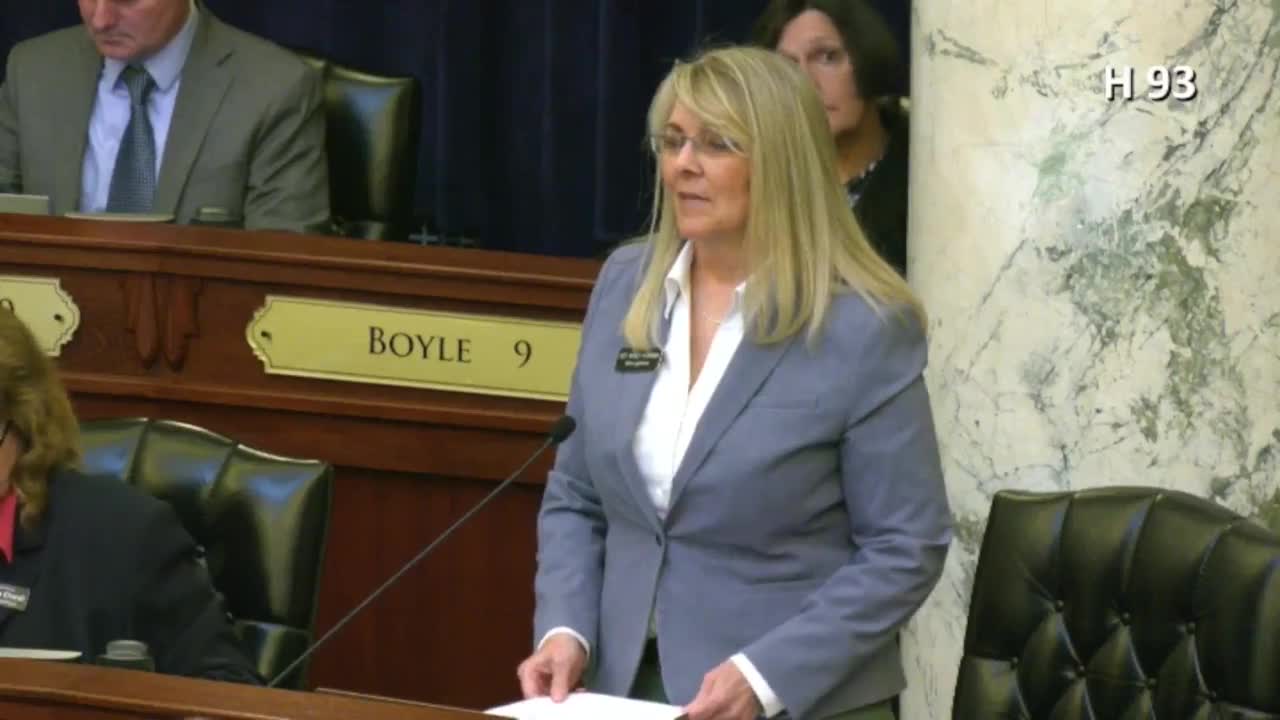
Sponsor Representative (District 32) described the bill to the chamber as a way to expand educational options without reducing public school funding: "The short version of this bill ... beginning in the 2025 tax year, parents [can receive] a credit of up to $5,000 per child, $7,500 for a child with a disability," she said, and emphasized the bill includes a $50,000,000 cap and reporting requirements for the Idaho Tax Commission.
Supporters argued the bill expands parental choice for families who cannot otherwise afford private school, micro‑schools or tutoring and that competition can improve outcomes in public schools. Representative (District 19) said the measure would give parents who lack financial flexibility a new option: "Parents want and deserve the best education for their children, but too many children do not thrive in the assigned government-run k through 12 school. It is the policy of my administration to support parents in choosing and directing the upbringing and education of their children," he said.
Opponents raised concerns about oversight, fiscal mechanics and distributional effects. Representative (District 16) warned that private schools often lack capacity to provide the specialized services public schools deliver and that students with individualized education program (IEP) needs could lose services by taking a tax-funded scholarship: "The students that will be Not best served by this bill are Idaho's children's and families with exceptional needs and that should make us pause," she said. Representative (District 23) and others expressed worry about fraud risk, the tax commission's ability to administer advance payments and the lack of strong, uniform accountability measures. Several speakers said the bill is likely to reimburse many families who already pay private tuition rather than substantially expand access for low-income families.
Key features described on the floor and in debate
- Refundable credit: Up to $5,000 per child (maximum $7,500 for children with disabilities) for qualifying K–12 expenses including tuition for nonpublic schools, tutoring, nationally standardized test fees, textbooks and transportation. The sponsor said the credit is not intended to reduce public-school funding and the program is capped at $50,000,000.
- Priority and means consideration: Families below 300% of the federal poverty level are given priority access; remaining funds open to other applicants if the cap is not reached.
- Advance payments and administration: The bill authorizes advance payments for qualifying low‑income families; opponents asked whether advances are treated as grants or loans and whether recipients would be required to repay advances if they later cease to qualify. The sponsor and supporters pointed to reporting and penalties (tax-fraud provisions) to deter misuse. The bill directs reporting by the Idaho Tax Commission and an anonymized survey to be administered and compiled as described in the bill text.
- Accountability: Debate centered on what the bill requires private providers to report and whether the Legislative Services Office and the Idaho Tax Commission have the capacity and statutory authority to administer audits and the required survey. Several members pressed for clearer audit authority and enforcement funding.
The House approved the bill following extended debate. The clerk announced the roll-call result on the floor as recorded: 42 ayes, 20 nays and 8 absent (as announced on the record). House Bill 93 will be transmitted to the Senate.
Multiple members asked for amendments and stronger guardrails if the Senate or conference committee considers the proposal, particularly on audit authority, the handling of advance payments, protections for students with disabilities, and clear standards for program reporting. Sponsors and supporters said the bill includes many of those guardrails already (reporting, criminal penalties for fraud, priority for low-income families) and argued the measure is a capped, state-level approach that preserves public education funding while giving parents another option.
The bill's fate now rests with the Senate; members on both sides asked for continued scrutiny of implementation details if the Senate advances the measure.