Get Full Government Meeting Transcripts, Videos, & Alerts Forever!
Get email alerts on the Bsu Budget Programs topic
No spam. Unsubscribe anytime.
Boise State highlights budget priorities, LAUNCH impact and free-speech institute; says lawsuit defense used non-taxpayer funds
Summary
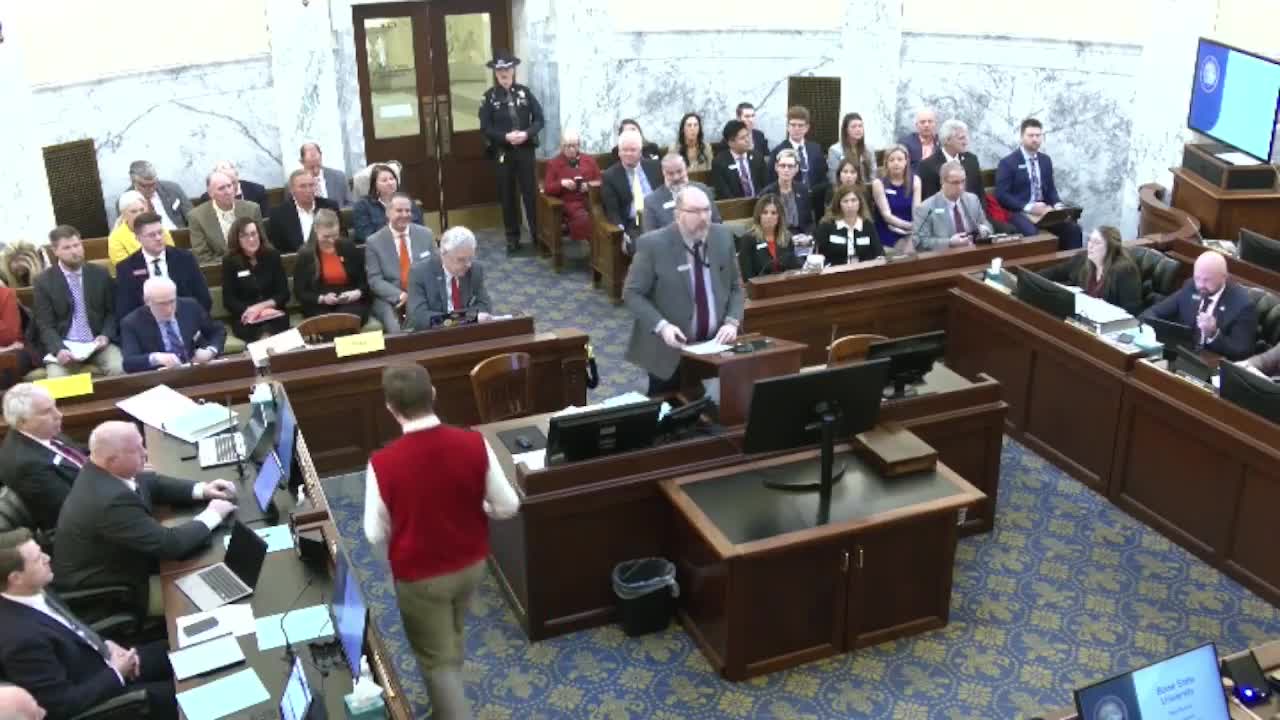
Boise State President Marlene Tromp and Legislative Services Office staff presented BSU’s FY2026 budget overview on Jan. 29, including LAUNCH enrollment figures, changes to campus equity offices, the Institute for Advancing American Values, semiconductor workforce efforts and the university’s legal defense costs paid from non-state funds.
Boise State University President Marlene Tromp told the Joint Finance-Appropriations Committee on Jan. 29 that the university’s FY2026 request centers on workforce-aligned programs, student success and competitive compensation while noting several institutional changes made over recent years.
Kevin Campbell, presenting LSO slides, said Boise State has an enrollment of more than 27,000 students supported by about 1,981 full-time-equivalent positions and noted that, unlike older land-grant institutions, Boise State does not receive endowment distributions tied to historic trust lands. Campbell reported Boise State’s expenditure mix as about 81.8% personnel, 16.5% operating and 1.7% capital outlay and said the FY2026 request is focused on placing operational capacity enhancement dollars toward competitive employee compensation.
Why it matters: Boise State is the state’s largest university by enrollment; its budget requests, program expansions and legal obligations have statewide implications for workforce development and higher-education spending.
LAUNCH and student support. Tromp said 1,300 students are enrolled in the state’s LAUNCH program at Boise State and that 600 of them depend on LAUNCH as their only financial support. She told the committee LAUNCH is supporting access to high-demand fields including nursing, computer science, radiologic sciences, business and engineering.
DEI centers and student-success realignment. Tromp said the university has restructured several student-support centers over recent years. She told the committee Boise State had eight staff in prior units and that five positions were reduced; programs such as the BUILD program were closed in October 2024. Tromp said the institution has focused on reframing those support functions toward “serving all students” and increasing graduation and retention outcomes; she cited a large gain in the university’s graduation rate over five years.
Institute for Advancing American Values. Tromp described the university’s Institute for Advancing American Values as a program created to encourage broad civic conversation on campus. She cited campus programming such as Idaho Listens and said faculty and student governance bodies have adopted free-speech commitments (the Chicago principles). Several committee members praised the institute’s moderation of civil dialogue on contentious topics.
Lawsuit defense funding. Senator Carlson asked whether state funds were used to defend Boise State in litigation related to Big City Coffee. Tromp said the defense used “only non taxpayer funds” and that the university has spent about $1,500,000 to mount the defense, and she does not anticipate a materially larger total for an expected appeal.
Semiconductor workforce and research. Tromp said Boise State is expanding engineering, computer science and applied-research capacity to meet local industry needs tied to Micron and other semiconductor investments. She noted Boise State hosts specialized equipment used in semiconductor research and said the university’s workforce and academic programs are being aligned to the industry’s needs.
Federal grant uncertainty. Committee members asked about potential impacts from federal funding pauses that were under discussion in national headlines; Tromp said Boise State’s review process was under way and the university would comply with legal directives and provide requested information to state officials.
Ending: Tromp closed by noting Boise State’s balanced-budget work, student-debt statistics and continued focus on workforce and student-success programs. Committee members asked for written follow-up and documentation on legal costs and course offerings tied to items discussed during the hearing.