Get Full Government Meeting Transcripts, Videos, & Alerts Forever!
Get email alerts on the Campaign Contributions Utilities topic
No spam. Unsubscribe anytime.
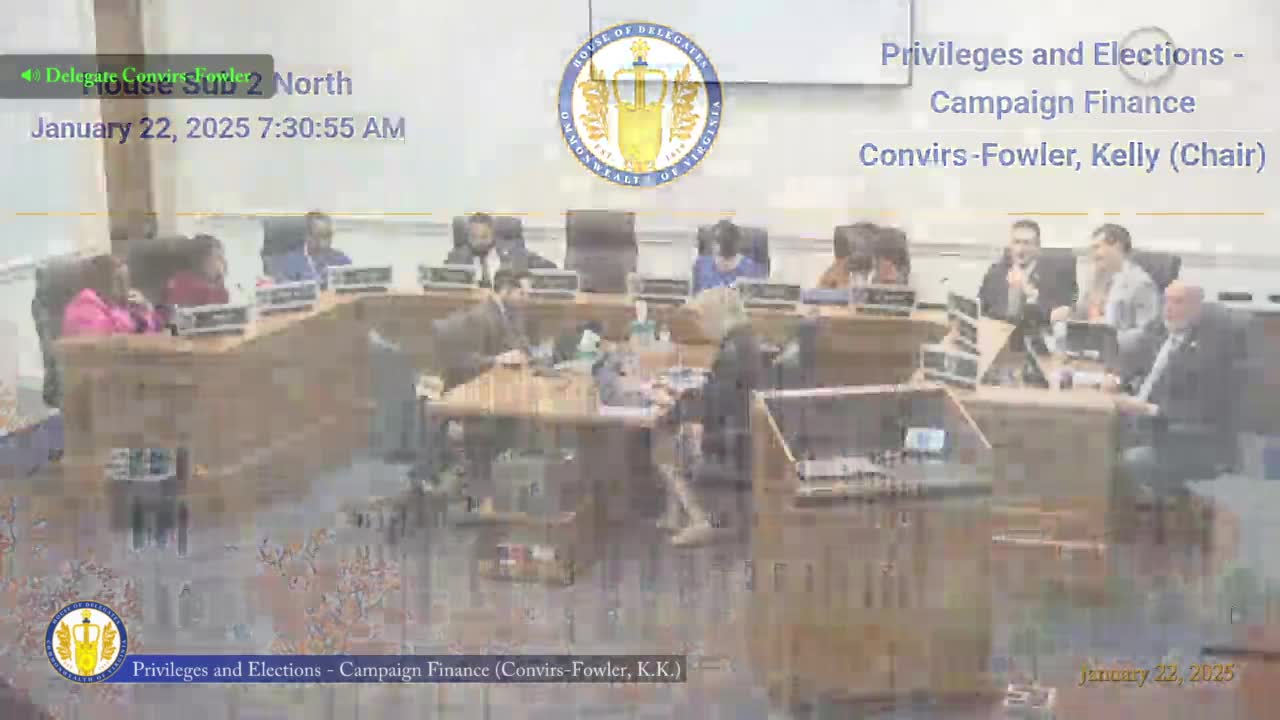
Subcommittee declines to advance bill barring regulated utilities from political donations
Summary
HB 2,607, which would bar contributions from regulated utility monopolies to political candidates and committees, failed to be reported after a motion lacked a second; supporters said the bill would prevent conflicts of interest while industry representatives opposed singling out utilities.
HB 2,607, introduced by Delegate Ware and described by the sponsor as a measure to bar regulated public monopolies from making political contributions, failed to be reported out of the Privileges and Elections Subcommittee after a motion lacked a second.
Delegate Ware said the bill would prevent regulated utilities from contributing to campaigns of officials who oversee them at the State Corporation Commission. "These are regulated public monopolies... It simply should not be the case that these monopolies be allowed to contribute to people who directly affect the State Corporation Commission's role in regulating them," Ware said.
Supporters included Clean Virginia, the Virginia Grassroots Coalition, Appalachian Voices, and individual residents who testified that utility contributions create the appearance of conflicts of interest. Clean Virginia's Wes Gobar told the committee that utilities have contributed tens of millions of dollars to campaigns in recent decades and argued the Commonwealth should prohibit such donations.
Opponents included counsel for Dominion Energy and a representative of Appalachian Power. Chris Nolan of McGuireWoods, appearing on behalf of Dominion Energy, told the subcommittee the measure singled out two corporations and that campaign finance law should apply uniformly to all entities. Keith Martin of Appalachian Power associated his comments with Nolan's, citing similar concerns.
The committee received online testimony from Kari Anderson of the League of Women Voters of Virginia supporting limits on corporate contributions from public service corporations. Delegate Ware moved to report the bill; the motion did not receive a second and the bill "fails to report." No recorded roll-call vote was held because the motion lacked a second.