Get Full Government Meeting Transcripts, Videos, & Alerts Forever!
Get email alerts on the Comprehensive Plan topic
No spam. Unsubscribe anytime.
Kerrville consultants present preliminary 2050 comprehensive plan recommendations at public engagement event
Summary
Consultants for the City of Kerrville presented preliminary updates to the city’s 2050 comprehensive plan at a public engagement event, outlining revised land-use guidance, concepts for downtown and Nimitz Lake small-area plans, and transportation and housing priorities.
Consultants for the City of Kerrville presented preliminary updates to the city’s 2050 comprehensive plan at a public engagement event, outlining revised land-use guidance, concepts for downtown and Nimitz Lake small-area plans, and transportation and housing priorities. Caitlin Admire, consultant with Freese and Nichols, led the presentation and emphasized that the recommendations are draft and intended for public feedback.
"These are preliminary recommendations. These are the first time we're bringing these out publicly. These are not baked," Caitlin Admire said, urging attendees to review boards around the room and provide input to the project team.
Why it matters: The comprehensive plan update will guide future land use, transportation investments and redevelopment priorities for Kerrville, and will inform smaller-area plans for the downtown and Nimitz Lake areas. The consulting team said the work integrates community input collected over the past year and will shape draft policy and mapping that the city will later consider for adoption.
Most important recommendations and themes
- Land use and redevelopment: The team proposed updated place types and assigned place-type designations to areas left blank in the 2018 plan’s catalyst-area map. The update recommends encouraging mixed-use development in targeted locations, reworking some previous catalyst-area boundaries and focusing redevelopment on underperforming, already-served sites rather than greenfield expansion.
- Downtown framework: Consultants proposed five downtown character areas — a downtown core for concentrated public-realm investment, commercial corridors (noting the TxDOT right-of-way along Sidney Baker), supporting development zones, a transition zone with somewhat higher density, and a university district intended to connect downtown to Schreiner University. The university district concept includes space for entrepreneurial uses such as light industrial, R&D incubators and flex space.
- Nimitz Lake small-area concepts: Preliminary ideas emphasize increased trail and river access, parks and natural-area conservation on the south bank (floodplain-sensitive areas), limited local commercial and hospitality uses near the water, and potential pedestrian crossings or lower-cost movable connections across the lake. The team said many residents currently do not know the lake is accessible or used and that some want non-motorized water access only.
- Transportation: The plan update includes a revised thoroughfare plan (major roadways) and a new active-transportation plan covering sidewalks, bike lanes, shared-use paths and trails. The team reported public input prioritized walkability and maintenance of existing roads over new road expansion.
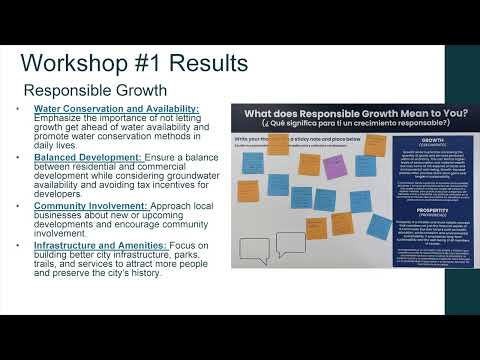
- Housing and resilience: Community feedback highlighted housing choice (diverse housing types), affordable housing, and resilience priorities including extreme heat, water supply concerns and an aging population. Consultants said residents repeatedly identified water conservation and balance between residential and commercial growth as priorities.
Process, schedule and public engagement
The project began in June of the prior year and has included advisory committee meetings, an online community survey that was open for six weeks, and multiple public workshops. As of the event, the team had completed three CPAC (Citizen Planning Advisory Committee) meetings and two DAC (Downtown Advisory Committee) meetings earlier that day. Consultants said they will revise the draft chapters and small-area concepts over the next four to six weeks, post draft documents online for at least a four-week public review period, and continue multiple rounds of revisions with staff and advisory committees before bringing materials forward for adoption and approval meetings (the team referenced a target adoption process in June during the presentation).
Quotes and outreach instructions
"We really wanna hear from you guys," Admire said, explaining the boards in the room and the staffed stations for land use, downtown, transportation and Nimitz Lake where residents could leave comments and speak with team members (Travis from TXP was available for economics questions; Chris was available on transportation; David was at the Nimitz Lake station).
What was not decided
The presentation contained no formal city votes or authorizing actions. Consultants described the materials as preliminary drafts and repeatedly asked for feedback; no final policy or adoption decision was announced at the meeting.
Next steps
Consultants said they will: refine chapter updates and small-area concepts based on feedback, post draft documents online for public comment (minimum four-week comment window), and continue iterative review with city staff and advisory committees ahead of formal adoption steps. Specific funding sources, detailed project budgets, and firm timelines for construction or capital projects were not specified during the presentation.
Ending
City staff and the consulting team encouraged attendees to review the display boards and the project’s online interactive map (open during the planning process), leave comments, and talk to station staff about specific topics. The team intends to revise the draft recommendations following public input before advancing the plan through formal city review and adoption processes.