Get Full Government Meeting Transcripts, Videos, & Alerts Forever!
Get email alerts on the Administrative Termination Dormant Committees topic
No spam. Unsubscribe anytime.
Ethics commission approves process to terminate long-dormant committees, sets threshold for small balances
Summary
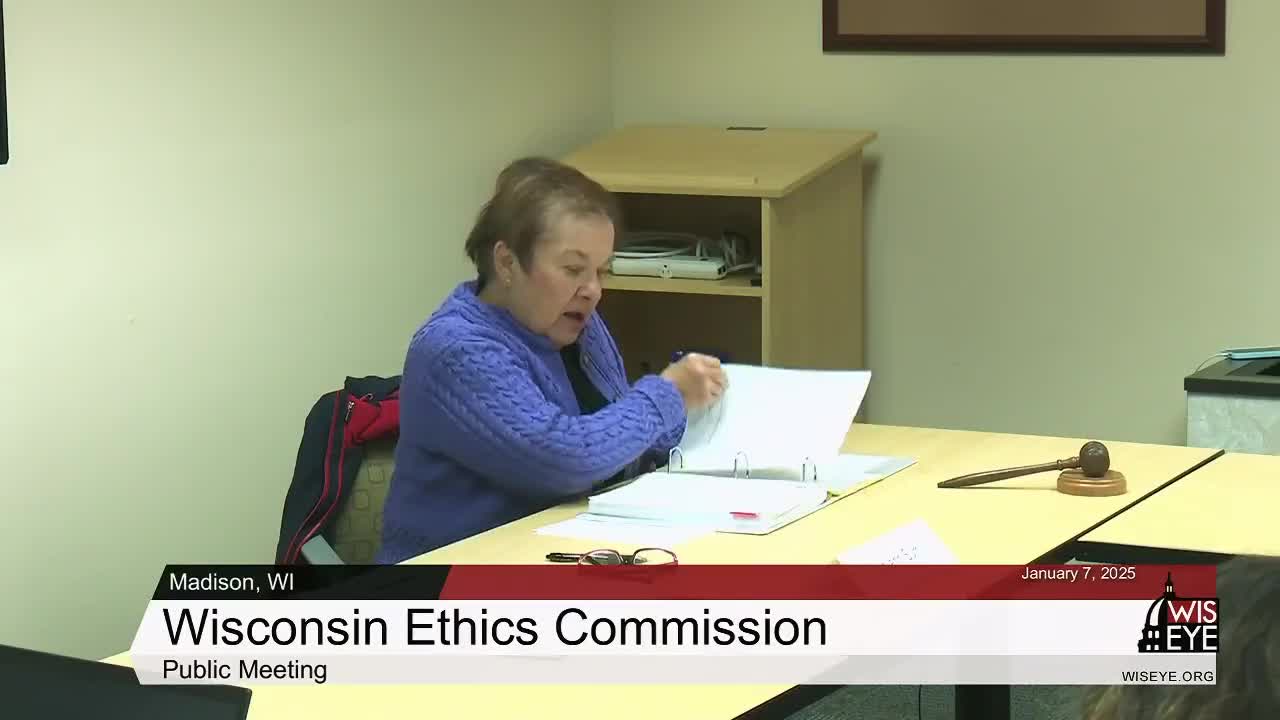
The Wisconsin Ethics Commission voted Jan. 7, 2025, to let staff administratively terminate inactive committees under a multi-step process, adopting a financial threshold tied to the exemption amount and approving case-by-case handling for conduits and committees with outstanding obligations.
MADISON, Wis. — The Wisconsin Ethics Commission on Jan. 7, 2025, approved a staff proposal to administratively terminate committees that have been inactive for at least three years and cannot be contacted, and it set a financial threshold to guide terminations of exempt committees.
Commission staff told the panel the office has roughly 1,400–1,500 dormant committees in its records and that the commission previously asked the Legislature for explicit authority to administratively terminate inactive registrants. Staff outlined a proposed, five-step process and asked for guidance on handling reported cash balances, incurred obligations and conduit committees.
The commission adopted staff recommendations with several votes in open session. Commissioners approved a financial threshold that allows staff to administratively terminate a registrant that has been on exempt status for three years if the last reported cash balance is at or below $25,100 per year since the committee’s last filed report. The commission also approved staff direction to refrain from terminating committees that have outstanding obligations payable to third parties (creditors other than the candidate or treasurer) and to treat those cases differently; staff may proceed with termination where the only outstanding obligations are to the candidate or treasurer.
Commissioners discussed practical considerations staff identified: bank inactivity fees that can erode small balances, the fact that exempt committees may lawfully spend up to $25,100 in aggregate during an election year, and that many records date back to pre-electronic filing conversions. Staff reported about 600 committees in the system that have never logged into the current CFIS portal; those would be simple candidates for administrative termination. Staff said only a small number of committees — six, by staff’s count during the presentation — have last-reported balances above the exemption-threshold formula; about 300 committees have a reported nonzero balance and roughly 90 committees show incurred obligations or loan balances.
Commissioners also addressed conduits (entities that collect and transmit contributions). Staff said 22 conduits in the database had filed a report at some point; another 10 were carried over from the original database conversion and never filed. Commissioners directed staff to handle conduits on a case-by-case basis, and they approved terminating pre-CFIS committees (those carried into the database from before the current filing system) while treating other conduit cases individually when balance information is unclear.
The commission approved the five-step staff process staff had described — which includes confirming no recent filings or registration amendments, confirming the registrant is not a current officeholder or candidate, sending a 30-day notice by email to the registrant’s provided email, and terminating the committee if the registrant does not respond and meets the financial/obligation criteria. Staff said they will retain historical data for terminated committees and can reactivate a committee if it later contacts staff and provides required information.
Several motions were made and adopted on Jan. 7; staff said outstanding settlements or enforcement matters identified in recent audits would continue to be handled and, in most cases, must be resolved before termination. Commissioners emphasized they expect staff to use certified or regular mail as appropriate and to coordinate with local clerks and registrants when contact information appears outdated.
The votes establish an administrative pathway staff can use to reduce the commission’s list of dormant committees while preserving the agency’s ability to restore a committee’s active status if the registrant requests it or if audits or enforcement matters require follow-up.