Get Full Government Meeting Transcripts, Videos, & Alerts Forever!
Get email alerts on the Content Provenance topic
No spam. Unsubscribe anytime.
Subcommittee tables content-provenance bill, asks JCOTS to study interoperability and labeling
Summary
The subcommittee tabled HB 2121, a bill that would encourage interoperable provenance labeling for AI-generated content and assign enforcement to the Attorney General, and sent a letter to the Joint Commission on Technology and Science (JCOTS) for further study.
The Technology and Innovation Subcommittee voted to table House Bill 2121 and transmit a letter to the Joint Commission on Technology and Science (JCOTS) asking for further study of content provenance and interoperability for generative content.
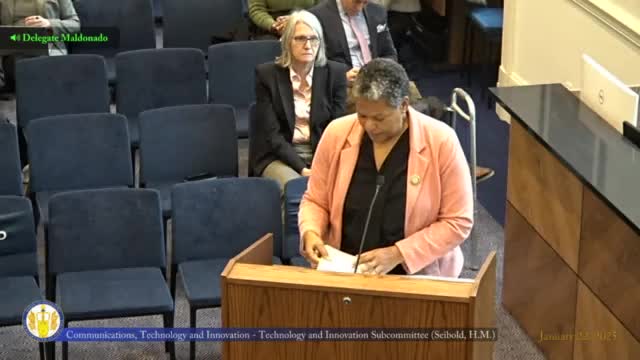
Delegate Doug Maldonado, the bill’s patron, said the measure would encourage platforms to retain provenance metadata and support interoperable content credentials so that information about how a piece of content was created moves with it between services. "All we're doing here is asking that we look at what's called content provenance — that means the history of the content," he told the subcommittee. Maldonado said the proposal does not create a private right of action and that enforcement would rest with the attorney general.
Industry witnesses including Adobe (represented online by Nick Gatz) and the Transparency Coalition supported the bill as a modest, flexible approach that relies on existing content-credential standards. Adobe’s representative noted Adobe’s Content Authenticity Initiative and the content credential standard developed with other industry partners.
TechNet, a technology trade association, opposed the bill as written, calling it overly broad and technically premature for audio and video. TechNet asked the committee to refer the issue to JCOTS for study rather than advancing the bill. TechNet’s witness, Margaret Durkin, recommended a study because audio and video provenance capabilities are less mature than image-level provenance.
After discussion, a motion to "lay this bill gently on the table with a letter to JCOTS asking for further study" passed; the clerk recorded the tabling and transmission to JCOTS with a roll call recorded as 8 to 0.
The hearing included testimony that provenance is not prescriptive — the bill leaves flexibility to platforms in how they expose provenance data — and that the bill’s authors plan to refine language to avoid unintended effects on video games and similar content.
The subcommittee action pauses advancement of HB 2121 while directing JCOTS to examine technical feasibility and policy trade-offs and return recommendations.