Get Full Government Meeting Transcripts, Videos, & Alerts Forever!
Get email alerts on the Newborn Screening Policy topic
No spam. Unsubscribe anytime.
Idaho committee advances bill broadening newborn-screening exemptions; medical-exemption language debated
Summary
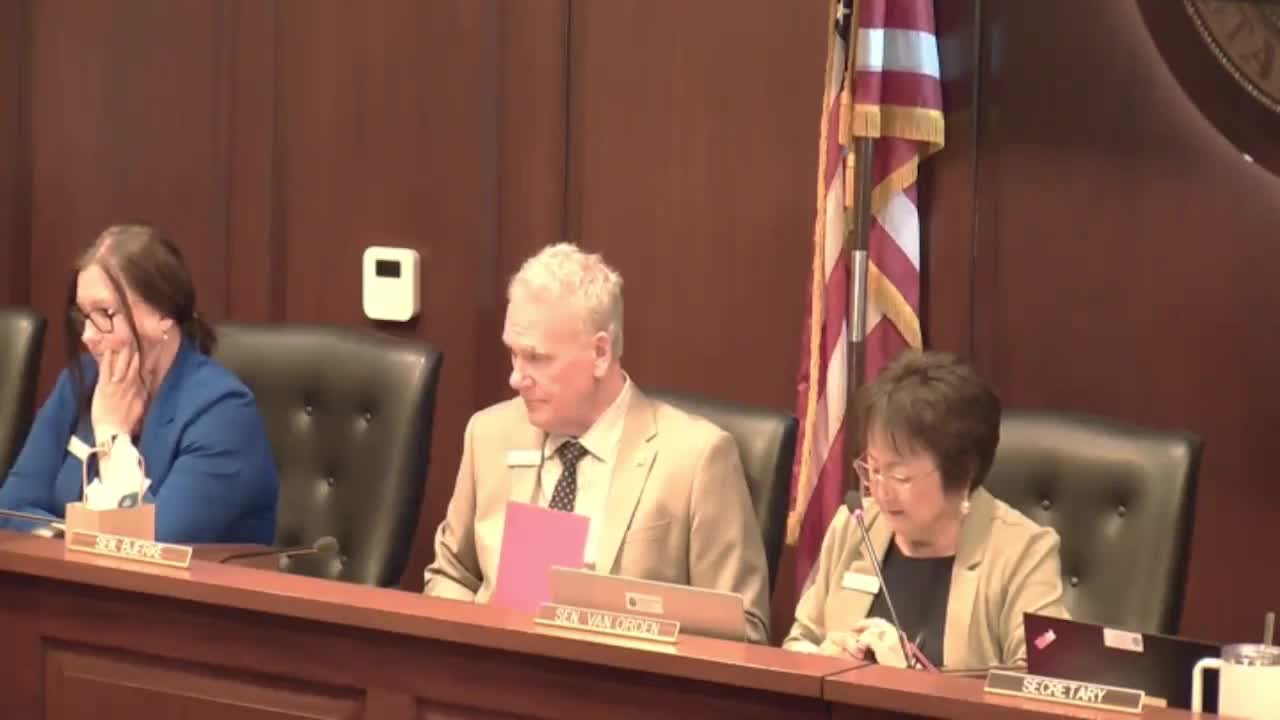
The Idaho Senate Health & Welfare Committee voted to send Senate Bill 11-79 to the floor with a do-pass recommendation after hearing testimony that the bill chiefly formalizes existing practice on newborn screening exemptions and debated wording that would allow a physician-certified medical exemption.
Senate Bill 11-79, a trailer to Senate Bill 10-14 that moves newborn-screening rules into Idaho code and clarifies parental exemptions, was advanced to the Senate floor Tuesday by the Idaho Senate Health & Welfare Committee with a do-pass recommendation.
Sen. Camille Blaylock, senator from District 11, said the bill formalizes existing practice. “The bill did not introduce new requirements or change current practices. It simply just moved that rule into code,” she said, adding that newborn screening — a heel-prick blood test and other standard checks given shortly after birth — can detect rare conditions that "can be life saving."
The bill expands exemption language so parents may decline screenings on religious or other grounds, mirroring language in Idaho vaccination law, and retains a separate subsection allowing a physician-licensed-by-the-state to certify that a requirement "would endanger the life or health of the child." That physician-certificate provision prompted most of the committee’s questions and debate.
Why it matters: Newborn screening in Idaho tests for roughly 50 conditions by blood sample and includes other checks such as pulse oximetry for congenital heart defects, participants said. Early detection often triggers diagnostic pathways and treatment within the first weeks of life; witnesses and committee members described cases in which early screening changed outcomes. Supporters said clarifying statutory language aligns code with current practice and reduces administrative scrutiny of claimed religious objections.
Committee discussion and testimony
Sen. Blaylock recounted a personal experience about accepting some newborn interventions while declining others, and she said the bill is intended to preserve parental choice while maintaining screening programs. Testifying in favor, Matt Lowsby, chair of the Libertarian Party of Idaho, said the bill reduces state intrusion on family decisions and praised language that accepts objections without probing religious sincerity.
Jen Beazer, a registered and licensed dietitian who works in rare diseases, supported updating the century-old chapter in code and emphasized the public-health rationale for screening. She told the committee the blood screen — sometimes called the Guthrie or PKU test — screens newborns for about 50 genetic conditions, and that if a screen is positive the child is routed to diagnostic testing and treatment within weeks. “For all of the conditions with the exception of the thyroid issues and cystic fibrosis, you have brain damage that occurs very rapidly that is irreversible” if not treated early, she said.
The most contested language was subsection 2, which would permit a physician’s certificate stating that a requirement of the chapter “would endanger the life or health of the child.” Sen. Wintrow asked whether that clause would let a physician override a parent’s decision; supporters said the clause is intended to allow a medical professional to document a medical reason not to apply a specific treatment or screening in rare circumstances, not to negate parental choice in ordinary cases. Sen. Bierke described the physician provision as a "fail safe" that can back up parental decision-making in clinical situations.
Motion and outcome
Sen. Keiser moved to send SB 11-79 to the Senate floor with a do-pass recommendation; Sen. Lenny seconded. The committee advanced the bill by voice vote; the clerk called for those in favor to say “aye,” and no opposition was voiced on the record.
What the bill does and open questions
- Broadens exemption language in the newborn-screening chapter of Idaho law to allow religious or other conscientious objections, modeled after vaccination-exemption language described by proponents. - Keeps a physician-certified medical-exemption pathway in subsection 2; committee members and witnesses differed on whether that language is necessary or whether it should be softened to read "could endanger" rather than "would endanger." Witnesses who work in newborn screening said the screening itself carries negligible physical risk and that the medical-exemption clause more directly applies to bundled treatments such as the vitamin K injection and erythromycin eye ointment. - Does not change which conditions are screened; testimony indicated Idaho currently screens for about 50 conditions via blood testing and performs pulse oximetry for congenital heart defects.
Next steps
The committee recommended SB 11-79 for passage to the full Senate. The measure will next be scheduled for floor action, where further debate or amendment is possible.
Sources and attribution
Quoted speakers and attributions are taken from committee testimony and remarks on the record: Sen. Camille Blaylock (introducing the bill), Sen. Keiser (motion), Sen. Lenny (second), Sen. Wintrow (questions), Matt Lowsby (Libertarian Party of Idaho), and Jen Beazer (registered and licensed dietitian, rare-disease specialist).
Ending note
Committee members repeatedly framed the bill as a clarification and codification of existing practice rather than a substantive policy shift in screening scope; the retained medical-exemption language remains the primary point of contention noted on the committee record.