Get Full Government Meeting Transcripts, Videos, & Alerts Forever!
Get email alerts on the Health Insurance topic
No spam. Unsubscribe anytime.
Health insurance increase proposals fail after debate over reserves, risk charges
Summary
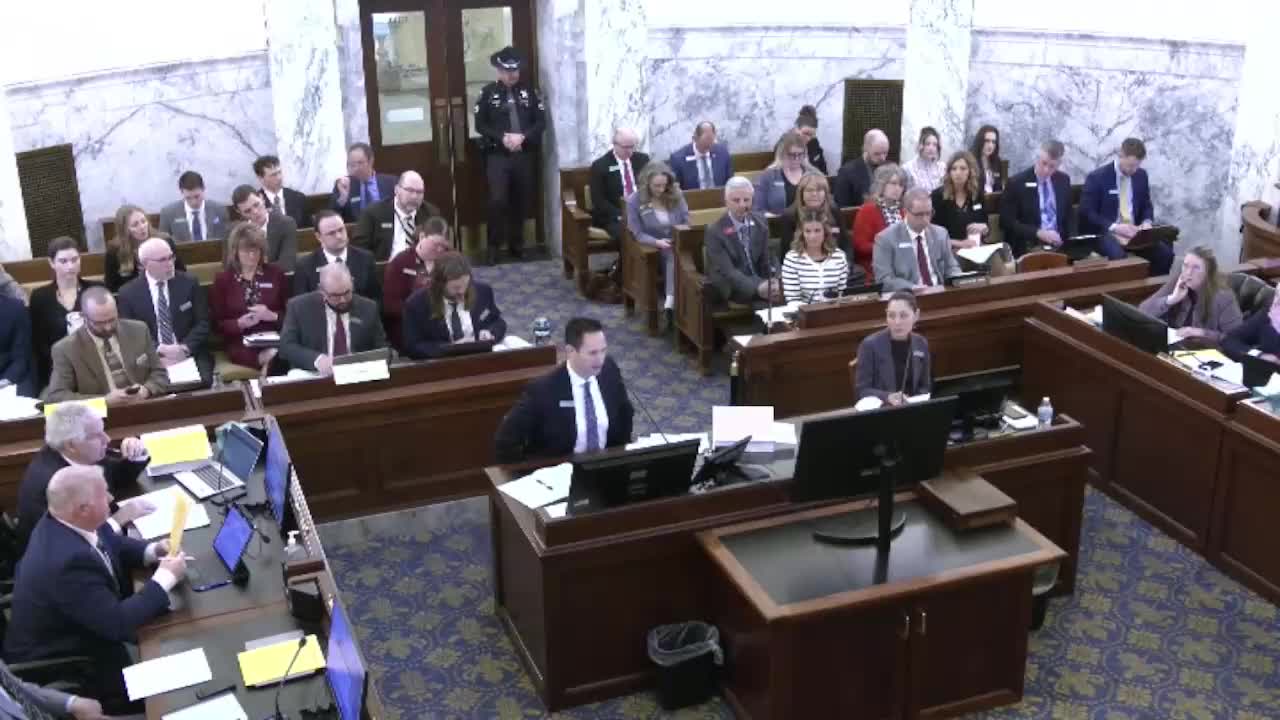
The Joint Finance-Appropriations Committee debated two rival health insurance baseline proposals for FY2026 but failed to adopt either the CEC-recommended $13,960 per eligible FTP or the governor's $14,300 proposal.
The Joint Finance-Appropriations Committee debated two competing proposals to set the base health insurance amount per eligible full-time position for FY2026 but failed to adopt either.
Keith Bybee, the Division Manager of the Budget Policy Analysis Division, presented the options and packet language. The Economic Outlook and Revenue Assessment/CEC committee recommended setting the health insurance base to $13,960 per eligible FTP; the governor’s recommendation (and a second motion on the table) would have set that base at $14,300 per eligible FTP. Committee members heard two separate recorded roll-call votes: the CEC substitute motion failed for lack of a House majority and the governor’s original motion later failed for lack of a Senate majority.
Discussion centered on reserve balances and risk. Bybee referenced actuary (Milliman) projections estimating that the CEC recommendation would drop the plan’s contingency reserve to the contractual minimum of 10% (about $51,600,000 under the projection), while the governor’s $14,300 level would leave roughly $61,400,000 in reserves — roughly $10 million more cushion in projections.
DFM Administrator Laurie Wolf said the 10% contingency is contractual and warned that falling below the minimum could subject the state to penalties. ‘‘That is the minimum. That is the floor,’’ she said in committee; she added that the 10% figure corresponds to about a 50% chance of meeting the contingency under actuarial scenarios and therefore is not a conservative budget target.
Faith Knowlton, Administrator for the division of insurance and internal support within the Department of Administration, added: "If we fall below the 10% contingency reserve, then a risk charge can be assessed to the state." She told members she was attempting to quantify what such a charge would look like but that it would depend on how far the reserve dropped below the contractual minimum.
Representative Furnace and others argued the CEC recommendation was designed to draw the reserve down toward a more normal level after prior years of elevated balances (staff cited the current balance around $80,491,337). Members in favor of the governor’s larger increase argued the larger amount preserves more cushion and reduces the likelihood of a future spike in premiums.
Votes: the CEC substitute (amounts: $29,996,000 GF; $7,179,000 dedicated; $3,086,200 federal; total $40,261,200) failed to gain the necessary majority from both delegations; the governor’s motion (amounts: $42,076,600 GF; $9,908,300 dedicated; $4,330,300 federal; total $56,315,200) subsequently failed when the Senate did not reach its required majority. Committee leaders and staff agreed the health-insurance decision would be revisited in later work if needed.
No final health-insurance baseline was adopted in the excerpted session.