Get Full Government Meeting Transcripts, Videos, & Alerts Forever!
Get email alerts on the Budgets And Finance topic
No spam. Unsubscribe anytime.
Joint Finance and Appropriations Committee approves technical corrections and program-maintenance budgets, including $5.26 billion for Health and Human Services
Summary
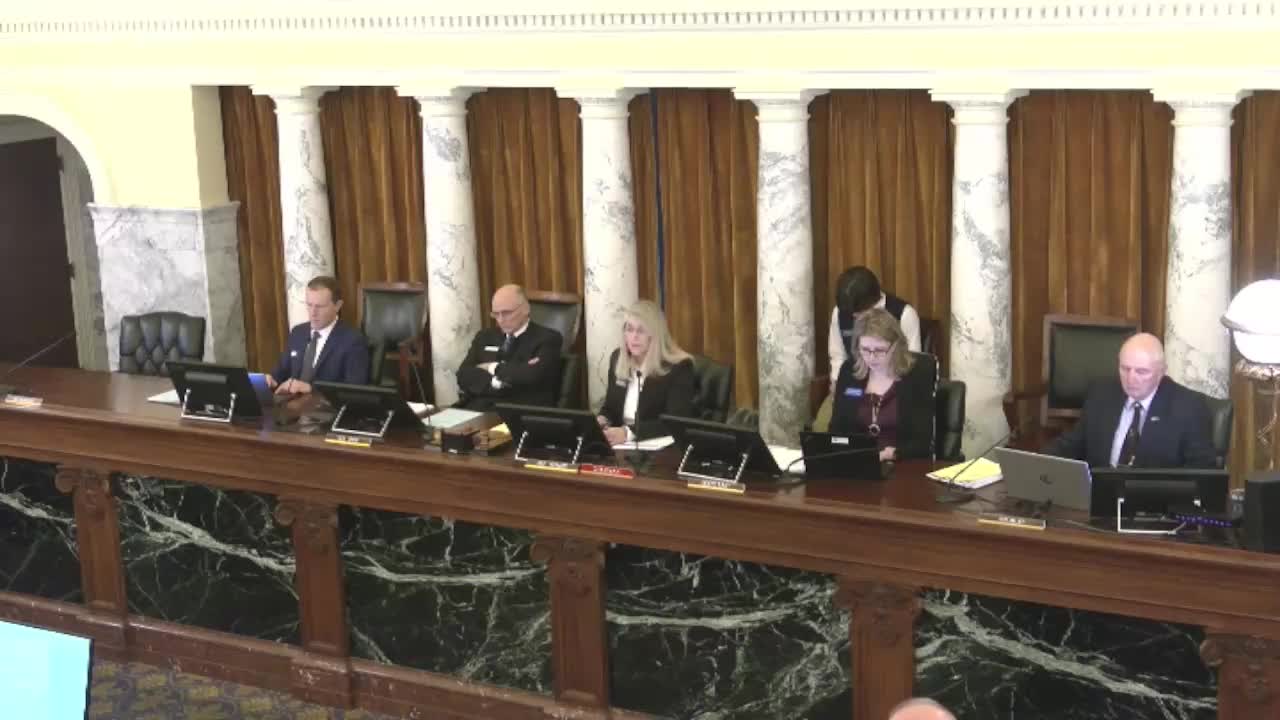
The Joint Finance and Appropriations Committee on Friday approved a set of technical corrections and program-maintenance budgets for state agencies, moving money into newly created or correct fund accounts and setting base budgets and FTE caps ahead of the 2026 budget cycle.
BOISE — The Joint Finance and Appropriations Committee on Friday approved a set of technical corrections and program-maintenance budgets for state agencies, moving money into newly created or correct fund accounts and setting base budgets and FTE caps ahead of the 2026 budget cycle.
The committee unanimously approved a pair of technical corrections to move $291,737,000 of reappropriated funds out of the Department of Commerce’s commerce program and into the newly created Broadband Office so those dollars can be tracked "for transparency moving forward," Janet Jessup, a budget and policy analyst with Legislative Services, told the committee. "This action would remove the monies that were reappropriated to the commerce, commerce program, and then also add them back into the broadband office so they can be tracked for transparency moving forward." Those two motions passed on roll calls called by the committee, each recorded as 20 ayes, 0 nays.
The committee also approved a $2,000,000 correction to reflect a general-fund transfer to the Department of Environmental Quality, and two technical adjustments in the Department of Health and Welfare that moved $160,000 and $240,000 respectively between expenditure categories so contract payments are appropriated as operating expenditures rather than trustee and benefit payments. Those motions passed unanimously.
After the technical corrections the committee set program-maintenance budgets — the ongoing base appropriations (minus one-time items) plus agreed statewide adjustments — for a wide set of agencies. Highlights include:
- Health and Human Services: The committee approved a program-maintenance package that totals $5,263,083,200 across general, dedicated and federal funds, and capped full-time equivalents at 3,008.44. That vote passed after roll calls that ultimately recorded a final committee tally of 17 ayes, 2 nays and 1 absent excused on the large maintenance appropriation motion. Representative Petzke registered a “no” during an earlier related realignment motion, saying he did not feel he had sufficient time to review a large number of transfers and reorganizations before voting.
- Public school support: The committee set the public-schools maintenance appropriation at $3,166,965,700 (general, dedicated and federal funds combined). That motion and the companion language sections describing how statutorily directed amounts will be distributed passed unanimously on roll call.
- State Board of Education: Total program-maintenance authority for board programs and affiliated institutions was set at $1,099,940,000; the committee also approved related statutory language (unanimous roll call).
- Economic development, natural resources, public safety, judicial branch, constitutional officers, legislative branch, general government and other functional areas: the committee approved program-maintenance totals and the usual sections of clear language and reappropriation authority. Examples include a public-safety program-maintenance total of $528,074,000 and a natural-resources total of $513,855,000. All of those motions passed either unanimously or with the tallies recorded on roll call.
Several routine pieces of clear language and reappropriation authority were attached to the respective appropriation actions: ARPA (American Rescue Plan Act) state fiscal recovery carryovers for court technology and legislative technology projects; continuous appropriation language for lottery payouts and endowment administrative fees; exemptions from certain expense-class and program-transfer limits in a handful of agencies (for example, legislative services and some education accounts); and reporting requirements for specific programs such as Medicaid forecasting and Department of Environmental Quality water projects.
Representative Petzke explained his lone no vote on the department reorganization motion for Health and Human Services by saying he did not feel he had sufficient time to review the dozens of FTP and dollar transfers embedded in the package: "I don't feel like I fully understand it yet... I have to vote no on this one," he told the committee during debate.
Committee staff said the next procedural step is to draft the appropriation bills that reflect the motions passed Friday and circulate them for a review hearing next Friday; staff also said they will post the draft bill language and any corrections to the committee’s SharePoint for members to review before final introduction.
Why it matters: These votes set the baseline, statutory funding and carryover authority that agencies will use as the Legislature considers enhancements and policy changes during the 2025 session. The reappropriation of broadband funds and the transfer corrections to DEQ and Health and Welfare are administrative fixes that staff said will improve transparency and align fund objects with how payments are made (contracts versus trustee payments). The larger program-maintenance votes determine the baseline from which the Legislature will consider changes to salaries, health benefits, policy-driven spending and new programs.
What’s next: Staff will draft the bills that implement the committee actions and return them for a review vote next Friday. Committee members said they may also consider a single multi-agency bill if they reach consensus on agency-wide compensation (CEC) or health-insurance adjustments.