Get Full Government Meeting Transcripts, Videos, & Alerts Forever!
Get email alerts on the Budget Process And Sales Tax topic
No spam. Unsubscribe anytime.
JFAC staff outlines program maintenance bills, sales-tax distributions and risks to general fund capacity
Summary
Budget staff told JFAC how program maintenance bills are organized, what items belong in maintenance vs. enhancement bills, and how statutory sales-tax distributions (revenue sharing, TEChum/Techum, tax relief and earmarks) reduce the share of sales tax flowing to the general fund—limiting appropriation capacity in downturns.
Budget staff reviewed how JFAC will structure program maintenance appropriation bills, described what adjustments those bills include, and explained how sales-tax distribution formulas reduce the portion of sales taxes available to the general fund.
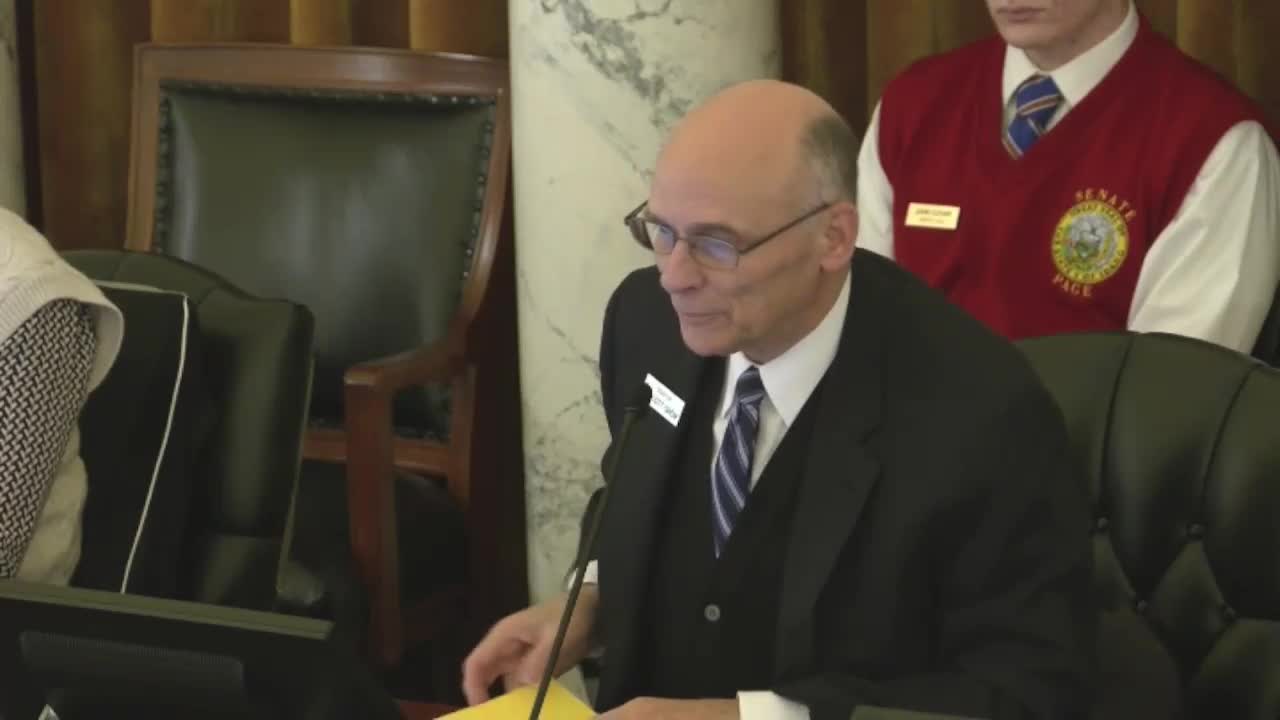
Keith Bybee, division manager for budget policy analysis, told the committee program maintenance will be organized into 10 functional appropriation bills (for example, general government, public safety, public school support, health and human services, natural resources and economic development). He described the four decision areas to be included in those program maintenance bills: personnel and benefit cost adjustments (including CEC recommendations and health insurance), contract inflation, statewide cost allocation (SWCAP) and the inclusion of CEC in the maintenance bills this year. "This year, the intent is to include all of the CEC in the program maintenance bills ... This will make for decision making and standardize our past practices," Bybee said.
Bybee also explained the committees reason for separating maintenance and enhancement bills. He said enhancement bills will handle replacement items (including a separately tracked IT replacement decision unit), annualizations, population-forecast adjustments (formerly called nondiscretionary items) and other growth items such as Medicaid changes. "We're often trying to get the best data and information we have at the time when we set that budget," he said, noting population forecasts often change as new agency data appears.
Timing: Bybee said the committee will hold an initial hearing on program maintenance adjustments on Wednesday next week and make decisions on Friday, Jan. 17.
Sales tax distributions and fiscal implications
Bybee reviewed new pages in the legislative budget book explaining how gross sales-tax collections are allocated before the general fund receives the remainder. He said gross sales-tax collections are projected to rise (about $3.37 billion in 2025 and $3.50 billion in 2026 in the materials presented), but statutory distributions reduce the share available to the general fund. Key statutory flows the committee discussed include:
- Revenue sharing: 11.5% of net collections is distributed to counties, cities and special districts. - TEChum/Techum (identified in the legislative budget book): receives approximately 4.5% of net collections; statute earmarks $80 million of that for bonding and any spillover goes to local transportation districts. - Tax Relief Fund: receives transfers (from online sales tax collections) and is statutorily earmarked; the legislative materials show an earmark of $236 million to the general fund from the tax relief fund in the current plan. - School modernization: a statutory earmark of $125 million to the state for school facility bonds.
Bybee showed that in the early years after the sales tax was enacted, as much as 85% of collections flowed to the general fund; under current statutes the general fund share is about 65 percent of sales-tax distributions after the statutory earmarks. He warned that the growing number of statutory earmarks and local distributions limits the portion of sales tax available directly to the general fund and said that could force deeper cuts at the state level if a downturn reduces more volatile revenue sources such as income tax.
Committee members asked technical questions about the TEChum/Techum allocation, how a proposed additional $50 million for TEChum would be structured (whether it would come from within the existing percentage formula or as an additional earmark that could reduce the general fund), and how circuit-breaker and other property-tax-relief programs interact with sales tax distributions. Bybee said he would correct a chart in the budget book and provide updated files to members.
Why it matters: The explanation links procedural choices about how the legislature groups budget items with a broader fiscal point: statutory distribution formulas reduce the fungibility of sales-tax revenue. That affects the committee's discretion in a downturn, when income-tax volatility typically reduces receipts while more of the sales-tax base is pre-earmarked for specific purposes.
Provenance: The program maintenance presentation and the sales-tax distribution discussion are recorded through the presentations by Keith Bybee and the subsequent Q&A in the transcript.